Hamlet is a tragedy by William Shakespeare, believed to have been written around 1600–1601. This Hamlet Summary explores the story of Prince Hamlet, who seeks revenge for his father’s murder while struggling with betrayal, grief, and uncertainty.
Hamlet Main Characters analysis
Hamlet – The Prince of Denmark and son of the late King Hamlet. Deeply devoted to his father, he is devastated by his mother’s marriage to his uncle and becomes determined to avenge his father’s murder.
King Claudius – Hamlet’s uncle, who takes the Danish throne after his brother’s death and marries Queen Gertrude. He is responsible for the former king’s murder and becomes the main target of Hamlet’s revenge.
Queen Gertrude – Hamlet’s mother and the widow of the former king. She marries Claudius only two months after her husband’s death, upsetting Hamlet deeply.
The Ghost of King Hamlet – The spirit of Hamlet’s deceased father, who reveals that Claudius murdered him by pouring poison into his ear while he slept in the garden.
Horatio – Hamlet’s loyal friend, who learns the truth about the ghost and remains faithful to the prince throughout the tragedy.
Ophelia – The daughter of Polonius and Hamlet’s beloved. She suffers from Hamlet’s strange behavior and eventually loses her mind after her father’s death.
Polonius – The king’s adviser and Ophelia’s father. He secretly spies on Hamlet and is accidentally killed by the prince.
Laertes – Ophelia’s brother, who seeks revenge against Hamlet for the deaths of his father and sister. Claudius manipulates him into taking part in a deadly duel.
Rosencrantz and Guildenstern – Hamlet’s former companions, who accompany him on his journey to England and carry secret orders from Claudius to have him killed.
Fortinbras – The Prince of Norway, who arrives in Denmark at the end of the play and orders military honors for Hamlet.
Hamlet Summary
The King of Denmark dies, and just two months later, his wife, Gertrude, marries her late husband’s brother, Claudius, who takes the throne. This deeply upsets Hamlet, Gertrude’s son. He loved his father dearly and sees his mother’s actions as a betrayal. Hamlet is also suspicious of the king’s sudden death. Claudius claims that his brother was bitten by a snake, but Hamlet suspects that his uncle was responsible for his father’s death.
One day, the prince learns that soldiers standing guard have seen the ghost of the late king several times. It appears at midnight but never speaks. Hamlet decides to meet it himself. One night, accompanied by his friend Horatio and a guard named Marcellus, he goes to the place where the ghost has been seen. At midnight, his father’s spirit appears before them and calls Hamlet aside for a private conversation. The ghost reveals that he was sleeping in the garden when Claudius crept up to him and poured the juice of henbane into his ear, killing him. The spirit asks Hamlet to avenge his murder but warns him not to harm the queen. The ghost disappears, and Hamlet tells only Horatio about their conversation.
Knowing how cunning Claudius can be, Hamlet begins acting as though he has lost his mind. The king and queen assume that he is going mad because of love. Hamlet is indeed in love with Ophelia, the daughter of Polonius, the king’s adviser. Hamlet begins treating Ophelia cruelly, but she forgives him, believing that grief has driven him insane. One day, Hamlet sends Ophelia a letter declaring his love for her. She shows it to her father, who decides to discuss the matter with the king and queen. Meanwhile, Hamlet is not only suffering emotionally but also constantly questioning what he should believe: Is Claudius really a murderer? Was the ghost truly his father’s spirit, or could it have been an evil spirit?
Around this time, a group of traveling actors arrives in the city. Hamlet enjoys their performances, especially a play about Priam, the King of Troy. He asks the actors to perform it before the king and queen because it contains a scene in which Lucianus, a close relative of a count, murders him and marries his wife. Hamlet is interested in watching the king’s reaction to this scene so that he can determine whether Claudius is guilty of murdering his brother.
During the performance, Hamlet notices Claudius’s expression change when Lucianus kills the count. After this scene, the king and queen leave the hall. Hamlet realizes that the king is guilty.
Gertrude summons her son because she wants to discuss his behavior, particularly his comments during the play. She also wants to find out what is causing his apparent madness. On his way to his mother’s chambers, Hamlet sees Claudius praying but decides not to kill him just yet.
Polonius hides behind the curtains in the queen’s room so that he can overhear the conversation between mother and son. Gertrude tells Hamlet that she and his father (meaning Claudius) are concerned about his behavior. The prince is outraged that she calls a murderer his father and begins speaking rudely to her. Hamlet decides to speak openly with his mother. The queen is offended by his tone and decides to call the king. Hamlet grabs her by the arm to stop her from leaving. Gertrude becomes frightened, believing that he really has gone mad, and cries out. A voice comes from behind the curtain, shouting, “Help the queen!” Hamlet assumes it is the king and thrusts his sword through the curtain.
The queen is horrified by his violent act, but the prince tells her that her own behavior is even worse. He urges her to admit her guilt and repent. Suddenly, the ghost appears before Hamlet and reminds him of its request that he not harm the queen. The prince promises to obey, while Gertrude becomes even more frightened by her son’s behavior. Hamlet continues trying to persuade his mother to listen to what he has to say.
When Hamlet discovers whom he has killed, he is deeply upset. Claudius now has a reason to send the prince away from the country. He orders Hamlet to travel to England, accompanied by Rosencrantz and Guildenstern. The two guards carry letters addressed to the King of England, requesting that Hamlet be executed as soon as he arrives. Suspecting that something is wrong, Hamlet secretly steals the letters during the night and replaces his own name with those of his companions.
Soon afterward, pirates attack the ship. The Danish vessel escapes, leaving Hamlet behind in the hands of the pirates. Once they discover who he is, the pirates put the prince ashore at the nearest Danish port, hoping he will reward them generously. Before long, Hamlet returns to the royal palace.
Back home, he learns that Ophelia has lost her mind. While hanging her flower garlands on the branches of a tree, one of the branches breaks, and she falls into a fast-flowing stream. Laertes, Ophelia’s brother, wants to avenge the deaths of his father and sister by killing Hamlet. Claudius takes advantage of the situation to carry out his own plan. He suggests poisoning the tip of Laertes’s sword, and Laertes agrees.
A strange scene takes place at Ophelia’s grave. Laertes jumps into the grave, wanting to be buried alongside his sister. Hamlet also feels overwhelmed with grief for the woman he loved. He rushes toward the grave as well, and he and Laertes begin fighting. They are separated, but the king encourages the naive Laertes to take part in a friendly fencing match against Hamlet. Osric, a courtier close to the king, informs Hamlet that Claudius is confident he will win the contest.
On the appointed day, everyone gathers at Elsinore Castle to watch the duel between Hamlet and Laertes. Unbeknownst to the others, King Claudius and Laertes have conspired to kill Hamlet. Laertes coats the tip of his sword with poison, while Claudius prepares poisoned wine for Hamlet to drink during the match.
However, the plan does not go as intended. Hamlet’s mother, Queen Gertrude, accidentally drinks the poisoned wine and dies. During the fight, Laertes wounds Hamlet with his poisoned sword. Later, the two men exchange weapons, and Hamlet wounds Laertes with the poisoned blade as well. Before dying, Laertes reveals the conspiracy to Hamlet and identifies the king as the one responsible.
Overcome with anger and a sense of justice, Hamlet kills Claudius by striking him with the poisoned sword and forcing him to drink the poisoned wine. The king dies, and shortly afterward, Hamlet himself succumbs to the poison. Before his death, he asks his friend Horatio to tell the world his story.
In the final scene, Prince Fortinbras of Norway arrives and finds the castle filled with dead bodies. Shocked by what he sees, Fortinbras orders that Hamlet be given full military honors as a hero. With this, the play comes to an end.
Hamlet Summary scene by scene
Hamlet Act 1 Summary
Scene 1. On the grounds outside the royal castle in Elsinore, the guards tell Horatio, Hamlet’s friend, about the appearance of the ghost of the late King Hamlet. The ghost appears but refuses to speak to the soldiers, the officer, or Horatio. They decide to inform the young Hamlet about what they have witnessed.
Scene 2. In the grand hall of the royal castle, King Claudius announces his marriage to Gertrude, the widow of his late brother, King Hamlet. He also announces that ambassadors Voltemand and Cornelius are being sent to Norway with proposals for peace, as Prince Fortinbras has threatened Denmark. Meanwhile, Laertes asks permission to return to France. He had come to Denmark for Claudius’s coronation but, following a disagreement with his father, the royal adviser Polonius, wishes to go back to France.
The reader is introduced to Hamlet, a student at the University of Wittenberg who has just returned to Elsinore following the sudden death of his father, King Hamlet. He loved his father deeply and regarded him as a role model, so the loss is extremely difficult for him to bear. His grief is made even worse by his mother’s decision to marry Claudius, the late king’s brother, who now occupies the throne.
The wedding celebrations at court and the self-confidence of Claudius, whom Hamlet strongly dislikes, make his stay at Elsinore unbearable. Nevertheless, he remains in the castle because both his mother and Claudius insist that he stay.
When Hamlet is left alone, Horatio, Marcellus, and Bernardo enter and tell him about the ghost of the dead king. They agree to meet at midnight near the castle walls, where the guards are stationed. Hamlet is overcome by dark and troubling premonitions.
Scene 3. At Polonius’s house, Laertes and Ophelia are preparing to part. Laertes warns his sister about her feelings for Hamlet. Polonius urges Laertes to hurry his departure and questions Ophelia about what she discussed with her brother. When he learns that they talked about Hamlet’s declaration of love for Ophelia, Polonius forbids her from seeing the prince, as he does not believe Hamlet’s feelings are sincere.
Scene 4. At midnight, Hamlet meets his father’s ghost. The spirit reveals the secret of his death and accuses his brother Claudius of murdering him. The ghost begs Hamlet to avenge his death but warns him not to do anything harmful to the queen.
Hamlet’s friends swear on his sword to keep the encounter secret and promise not to be surprised by anything he might do in the future. Hamlet realizes the burden of his mission and his responsibility to set things right:
“Time is out of joint… O cursed fate! Why was I born to put it right?”
Hamlet Act 2 Summary
Scene 1. Polonius sends his servant Reynaldo to Paris to find out about the Danes living in France. He instructs him to spread rumors about his own son and use them to discover how Laertes is getting along abroad. Reynaldo thus becomes Polonius’s secret spy.
Ophelia tells her father that Hamlet has been behaving as though he has lost his mind. Polonius believes that the prince’s madness is caused by his love for his daughter and decides to inform Claudius.
Scene 2. King Claudius instructs Rosencrantz and Guildenstern to spy on Hamlet. They are supposed to pretend that they are concerned about his well-being while secretly investigating the reasons for his apparent madness.
Meanwhile, the ambassadors return from Norway with good news: the Norwegian king asks Denmark to allow Fortinbras’s army to pass through the country on its way to Poland.
Polonius tries to reassure Claudius and Gertrude, who believe Hamlet’s madness may have been caused by his father’s death and their hasty marriage. He convinces them that the prince has lost his mind because of his unhappy love for Ophelia. To prove his theory, he suggests arranging a situation in which Hamlet and Ophelia can meet while being secretly observed.
Polonius speaks with Hamlet, who continues pretending to be insane. Rosencrantz and Guildenstern soon join them. Hamlet welcomes a group of traveling actors who have arrived in Elsinore and arranges for them to perform a play at the royal castle. He hopes that the performance will expose the king’s guilt.
Hamlet Act 3 Summary
Scene 1. Hamlet’s inner dialogue marks the psychological climax of the play. The king, queen, Polonius, and Ophelia question Rosencrantz and Guildenstern about the reasons for Hamlet’s madness and what they have managed to discover. The spies report that the prince plans to stage a performance at the castle the following day and deliver his invitation to everyone.
Claudius and Polonius arrange a meeting between Hamlet and Ophelia, intending to observe their conversation secretly. When Hamlet enters the royal chambers, he delivers his famous soliloquy, beginning with the question, “To be, or not to be.” Afterward, he speaks with Ophelia, rejecting both her and her love. He tells her to go away and enter a convent.
Ophelia interprets the prince’s behavior as genuine madness. Claudius, however, does not believe that Hamlet’s condition is caused by love. He is not convinced that the prince has truly lost his mind and decides to send him to England, hoping he will die there as part of a plan Claudius has already prepared. Polonius fully supports the king’s decision.
Scene 2. This scene marks the dramatic climax of the tragedy. The queen is upset by what has happened and sends Rosencrantz and Guildenstern to summon Hamlet. They tell him that the performance has frightened the queen. The two spies continue trying to discover the reason for the prince’s condition, assuring him of their love and loyalty. Polonius then informs Hamlet that the queen wishes to speak with him.
Scene 3. King Claudius orders Rosencrantz and Guildenstern to escort Hamlet to England, declaring that they must put this dangerous threat under control.
Polonius tells the king that Hamlet has gone to speak with his mother and offers to hide behind a tapestry so that he can secretly listen to their conversation.
Left alone, Claudius delivers a soliloquy in which he reflects on his crime and the guilt that torments him. Hamlet finds him praying. Although he has an excellent opportunity to avenge his father’s murder, he decides not to kill Claudius at that moment. He wants the king’s soul to suffer eternally rather than allowing him to die while praying.
Claudius, meanwhile, realizes that his words are empty because his heart is not truly repentant. He understands that his prayers cannot reach heaven when he is unwilling to give up the rewards of his crime.
Scene 4. Hamlet confronts Queen Gertrude. His mother accuses him of disrespecting his father’s memory, while he accuses her of betraying her deceased husband. The queen becomes frightened and calls for help.
Polonius accidentally reveals his hiding place and is killed by Hamlet’s sword. The prince had expected the king himself to be listening behind the tapestry and regrets that he has struck the wrong person, remarking that he aimed higher than he hit.
Hamlet then accuses his mother of her shameful and incestuous marriage to Claudius. At the height of his speech, his father’s ghost appears. Only Hamlet can see it, and the spirit reminds him that he must not direct his revenge against his mother.
Gertrude is terrified by her son’s behavior and believes that he has become completely insane. Hamlet reveals the truth to her, explaining that he is not truly mad but is deliberately pretending to be so. He advises the queen to reject Claudius or become his enemy.
Gertrude promises that she would rather hold her breath forever than reveal a single word of their conversation. Hamlet reminds her that he is about to leave for England and makes it clear that he understands the king’s plans to have him destroyed. Pointing to Polonius’s body, he remarks that the dead adviser will hasten his departure.
Hamlet Act 4 Summary
Scene 1. Queen Gertrude tells King Claudius that Hamlet has killed Polonius, explaining the murder as a consequence of the prince’s madness. The king orders Rosencrantz and Guildenstern to find Hamlet, calm him down, and arrange his departure for England as quickly as possible. Polonius’s body is to be taken to the chapel. Claudius is frightened by what has happened.
Scene 2. Rosencrantz and Guildenstern find Hamlet in another room of the castle and demand that he hand over Polonius’s body. Hamlet accuses them of being the king’s servants and threatens his enemies, telling them to hide before they are caught.
Scene 3. The king realizes how dangerous Hamlet has become but cannot openly punish him because the prince is popular with the people. He therefore decides to speed up Hamlet’s departure for England.
The conversation between Hamlet and Claudius further intensifies their hostility. The king orders Hamlet to leave Denmark and instructs Rosencrantz and Guildenstern to have him killed.
Scene 4. Along the Danish coastline, Prince Fortinbras of Norway leads his army forward. Hamlet, who is preparing to leave Denmark, speaks with a Norwegian captain about the purpose of their military campaign. The captain explains that the army is marching to conquer a small piece of land.
Hamlet delivers another soliloquy, connecting his personal tragedies with his growing awareness of the cruelty of time and fate. He reflects on the thousands of doomed men who are being dragged into war.
Scene 5. A courtier informs the queen and Horatio that Ophelia has lost her mind following her father’s death. Overwhelmed by grief, she sings sadly and has lost her sense of reality. The king orders that she be watched and protected.
Claudius is also worried about the return of Laertes from France. Driven by a desire to avenge his father’s death, Laertes raises a popular rebellion. The crowd demands that Laertes become king, shouting his name in support.
Laertes storms into the royal chambers and demands an explanation for Polonius’s death, threatening revenge. During his heated confrontation with Claudius, Ophelia enters. Her madness deeply shocks Laertes. Claudius then suggests that he and Laertes speak privately.
Scene 6. Horatio speaks with sailors who have brought him a letter from Hamlet. In the letter, the prince explains that pirates attacked his ship and took him prisoner. He arranges a meeting with Horatio and hints at what happened to Rosencrantz and Guildenstern.
Horatio helps the sailors arrange a meeting with the king and eagerly awaits the opportunity to see Hamlet as soon as possible.
Scene 7. Claudius turns Laertes against Hamlet while attempting to convince him that he was not responsible for Polonius’s death. He explains why he did not punish Hamlet according to the law and offers Laertes his support in seeking revenge.
At that moment, a messenger arrives with letters from Hamlet announcing the prince’s unexpected return to Denmark.
Claudius begins plotting Hamlet’s murder. He persuades Laertes to challenge the man responsible for his father’s death to a fencing match, presenting the contest as a result of Hamlet’s supposed jealousy of Laertes’s superior fencing skills.
Claudius promises to arrange the confrontation. Laertes, consumed by the desire for revenge, gladly agrees. To ensure that Hamlet cannot survive the match, Laertes decides to coat his sword with a poisonous substance.
Claudius suggests an additional precaution: preparing a poisoned drink in advance so that Hamlet can be offered it during the fight if anything unexpected happens. Their deadly conspiracy is now complete.
At that moment, the queen arrives with terrible news: Ophelia has drowned. Laertes is once again overwhelmed with rage and grief.
Hamlet Act 5 Summary
Scene 1. The first scene takes place in a graveyard. Two gravediggers are preparing Ophelia’s grave and discussing whether she should be considered a suicide and whether she is entitled to a Christian burial alongside other members of the community.
Hamlet and Horatio approach the graveyard and witness the gravediggers at work. Hamlet is struck by how they seem to have lost the ability to sympathize with other people’s grief while carrying out their daily duties.
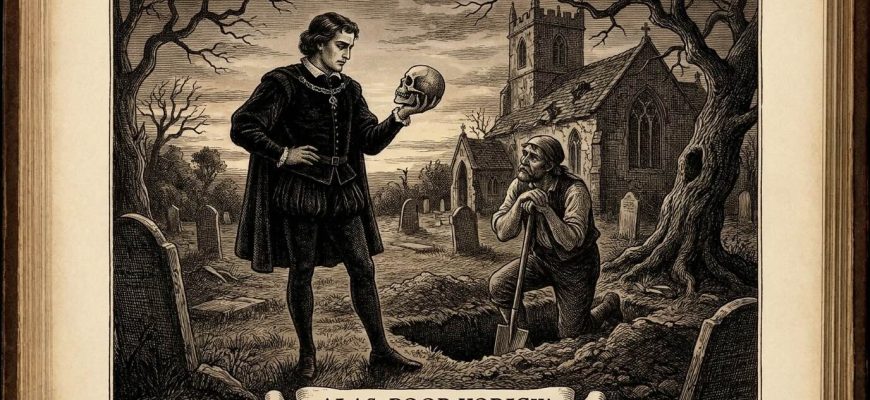
One of the gravediggers throws several skulls out of the ground. Hamlet begins wondering who these people might have been during their lifetimes. In conversation with one of the gravediggers, he discovers that one of the skulls belonged to Yorick, the former royal jester. This discovery leads Hamlet to reflect on the nature of life and death.
Meanwhile, a funeral procession arrives at the cemetery. By the king’s order, Ophelia is being given a Christian burial. Hamlet is devastated when he learns that she has died.
Laertes, overwhelmed by grief, jumps into his sister’s grave, desperate to embrace her one last time. Hamlet, realizing that he also loved Ophelia, jumps into the grave as well. A fight breaks out between the two men.
At the king’s command, the courtiers separate them. Hamlet’s anger is interpreted as another outbreak of madness, although it clearly reveals the prince’s profound emotional pain as he witnesses the hatred of people he once loved most deeply.
The king orders Horatio to keep an eye on Hamlet and reminds Laertes of their earlier conspiracy.
Scene 2. The final scene begins with a conversation between Hamlet and Horatio. Hamlet tells his friend how he uncovered the king’s treachery after reading Claudius’s letter. In it, the king had portrayed Hamlet as an enemy of England and arranged for the prince to be sent there to face certain death.
Hamlet decided to act decisively. He replaced Claudius’s letter with another one, requesting that Rosencrantz and Guildenstern be executed immediately upon their arrival in England, supposedly to confirm the friendship between the two kingdoms. The letter bore his father’s royal seal and therefore appeared completely authentic.
Although Hamlet is consumed by his desire to take revenge on Claudius, he also realizes that he went too far in his conflict with Laertes and wants to make peace with him.
Osric, acting as the king’s messenger, informs Hamlet about Claudius’s wager concerning a fencing match between the prince and Laertes. Hamlet agrees to take part in the duel.
The royal court, led by Claudius and Gertrude, gathers in the hall where the match is to take place. Horatio warns Hamlet that Laertes is a highly skilled swordsman. Nevertheless, Hamlet has already made his decision. He is not afraid of death, believing that death settles all debts.
Before the duel begins, Hamlet asks Laertes to forgive him for all the wrongs he has done. The prince hopes that the contest will be fair. The two opponents receive their weapons, and the king confirms his wager on Hamlet’s victory. In doing so, Claudius secretly ensures that cups of wine are brought into the hall.
The duel begins and develops with both opponents experiencing moments of success. During the match, the queen drinks the poisoned wine intended for Hamlet.
Hamlet and Laertes wound each other, exchanging swords during the fight. Both are struck by the poisoned weapon. Soon afterward, the queen dies. The two fighters are also close to death.
Laertes confesses to Hamlet that he has betrayed him and conspired with the king. In the final moments of his life, Hamlet strikes Claudius with the poisoned blade, killing him.
As he dies, Hamlet asks Horatio to tell the truth about him to those who do not know what really happened. He also prevents his friend from drinking from the poisoned cup.
At that moment, noise is heard announcing the return of Fortinbras from his campaign in Poland. Hamlet predicts that Fortinbras will take the Danish throne.
Fortinbras and his attendants enter the hall, accompanied by the English ambassadors. The room is filled with the bodies of the dead. Addressing the newcomers, Horatio tells them that if they have come looking for sorrow and despair, they need only look around.
Even the ruthless Fortinbras is deeply shaken by the scene before him. He asserts his claim to the Danish throne and, wishing to prevent a popular uprising, follows Horatio’s advice and orders that Hamlet receive an honorable burial with full military honors.
A funeral march and the thunder of cannons bring the tragedy to its conclusion.
Якщо ви не знайшли потрібну відповідь, можете запитати у нашого чат-бота у Телеграм.