Romeo and Juliet is a tragedy by William Shakespeare, written in the late sixteenth century. It tells the story of two young lovers from rival families whose forbidden love leads to a series of tragic events.
Romeo and Juliet Main Characters analysis
Romeo Montague – The son of the Montague family, who falls deeply in love with Juliet and is willing to risk everything for her.
Juliet Capulet – The young daughter of the Capulet family, who falls in love with Romeo despite the feud between their families.
Mercutio – Romeo’s closest friend, known for his sharp wit and eloquence.
Benvolio – Romeo’s friend, who tries to prevent conflicts and advises him to look beyond his unrequited love.
Tybalt – Juliet’s cousin, who is fiercely hostile toward the Montagues.
Count Paris – A nobleman and relative of the Prince of Verona, who seeks Juliet’s hand in marriage.
Friar Laurence – Romeo’s spiritual adviser, who secretly marries the young lovers and tries to help them.
The Nurse – Juliet’s devoted nurse and confidante, who helps the lovers communicate.
Lord Capulet – Juliet’s father, who agrees to Paris’s marriage proposal.
Lady Capulet – Juliet’s mother, who informs her of the proposed marriage.
The Prince of Verona – The ruler who tries to put an end to the feud between the two families.
Romeo and Juliet Short Summary
Shakespeare begins the tragedy with a prologue in which he introduces the familiar wandering tale from the Italian Renaissance that he uses as the basis for his play.
The action of the tragedy covers five days of a single week, during which a fatal chain of events unfolds.
Act One begins with a fight between servants belonging to two rival families—the Montagues and the Capulets. Prominent members of both households soon join the servants, followed by the heads of the families themselves. The townspeople, weary of the feud, can barely manage to separate the combatants. Finally, the supreme ruler of Verona, the Prince, arrives. He orders the families to put an end to their clashes on pain of death, then angrily leaves the scene.
Romeo, the son of Montague, appears in the square. He is in love and suffering. The object of his unrequited passion is the unattainable beauty Rosaline. In a conversation with his friend Benvolio, he shares his feelings. Benvolio good-naturedly advises him to turn his attention to other girls and laughs at Romeo’s objections.
Meanwhile, Count Paris, a relative of the Prince, visits the Capulets and asks for the hand of their only daughter. Juliet is not yet fourteen, but her father agrees to the proposal.
Paris is noble, wealthy, and handsome, and it is difficult to imagine a better suitor. Capulet invites him to the annual ball they are holding that evening. Lady Capulet goes to her daughter’s room to tell Juliet about the proposal. The three of them—Juliet, her mother, and the Nurse, who raised the girl—discuss the news animatedly.
Juliet is still carefree and obedient to her parents’ wishes. Several young men from the rival household enter the lavish masked ball at the Capulets’ home, including Benvolio, Mercutio, and Romeo. They are all spirited, sharp-tongued, and eager for adventure. Mercutio is particularly mocking and eloquent; he is Romeo’s closest friend. Romeo himself is overcome by a strange sense of unease as he approaches the Capulets’ house.
Amid the bustle of the ball, among the casual remarks exchanged by the hosts, guests, and servants, Romeo and Juliet’s eyes meet for the first time. Like a blinding flash of lightning, they are struck by love.
Juliet’s brother Tybalt overhears their words and reaches for his sword, but he is stopped. Juliet learns that Romeo is the son of her family’s enemy.
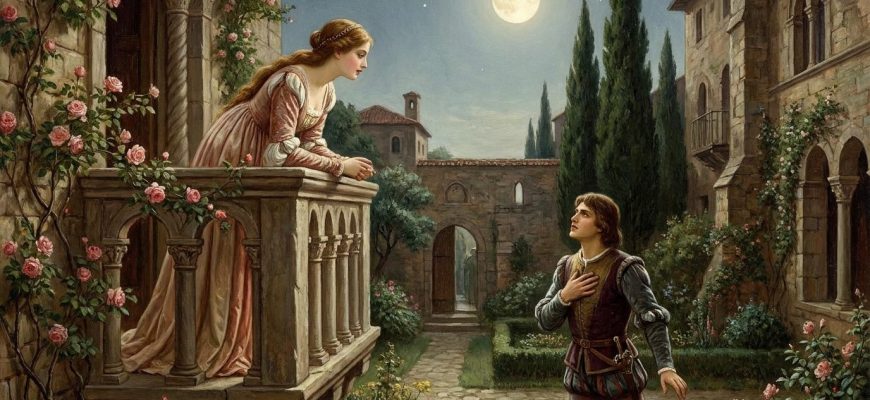
Romeo hides in the Capulets’ garden and makes his way to Juliet’s balcony. The conversation between the two lovers begins with timid exclamations and questions but ends with declarations of love and a decision to unite their lives without delay.
The lovers find two confidants: Friar Laurence, Romeo’s spiritual adviser, and the Nurse, Juliet’s trusted companion. Laurence agrees to marry them in secret. He hopes that the union of the young Montague and Capulet will bring peace between the two families. The wedding ceremony takes place in Friar Laurence’s cell. The lovers are overwhelmed with happiness.
But their happiness does not last long. Romeo encounters Tybalt. Mercutio, Romeo’s friend, intervenes in the confrontation, and Tybalt mortally wounds him before fleeing. Mercutio’s last words are: “A plague on both your houses!”
Romeo is devastated. He has lost his best friend and understands that Mercutio died because of him—that Mercutio was loyal to Romeo when he defended his honor. “Thanks to you, Juliet, I have become too soft…” Romeo mutters in a fit of remorse, bitterness, and rage.
At that moment, Tybalt appears in the square again. Romeo draws his sword and rushes at him in fury. A few seconds later, Tybalt lies dead. Benvolio warns that Tybalt’s death in a duel will be considered murder and that Romeo faces execution.
Romeo leaves, overwhelmed by everything that has happened, while the square fills with outraged townspeople. After hearing Benvolio’s explanation, the Prince delivers his judgment: Romeo is henceforth sentenced to banishment; otherwise, he will face death.
Juliet hears the terrible news from the Nurse. Her heart is crushed with grief. Although she mourns her brother’s death, she remains steadfast in defending Romeo.
Meanwhile, Romeo listens to Friar Laurence’s advice. The friar urges the young man to go into hiding and obey the law until he is granted forgiveness. Romeo is desperate: banishment means death to him. He is consumed by longing for Juliet. They manage to spend only a few hours together when Romeo secretly slips into her room at night. In the morning, Romeo leaves, and Juliet is overcome with tears.
Lady Capulet enters her daughter’s bedroom and, seeing Juliet in tears, assumes that she is grieving over Tybalt’s death. Her parents have decided to marry Juliet to Count Paris, who is insisting on the match. In despair, Juliet turns to Friar Laurence. He suggests that she take a miraculous potion that will plunge her into a deathlike state for several hours. Laurence will inform Romeo, who will then take Juliet from the tomb, allowing them to disappear together.
Juliet carries out the plan, and her home is filled with confusion and horror:
Juliet is dead! She is dead!
Meanwhile, Romeo is in Mantua. He has a dream.
Romeo waits for news from Friar Laurence, but instead his servant arrives with the sad news of Juliet’s death. Overcome with grief, Romeo buys poison from an apothecary and rushes back to his beloved.
The final scene takes place in the tomb of the Capulet family. Juliet, apparently dead, has just been laid in the family vault beside Tybalt. Paris lingers beside his bride’s coffin, scattering flowers over Juliet. Hearing footsteps, he hides. Romeo arrives with his servant. Paris threatens to have Romeo arrested and executed.
A duel begins, and Paris is killed. Romeo is finally left alone before Juliet’s coffin. He is astonished that she looks alive and just as beautiful as ever. Cursing the evil forces that have taken the most perfect creature on earth, Romeo kisses Juliet for the last time and, saying, “I drink to you, my love!” drinks the poison.
Friar Laurence arrives before Juliet awakens, but he cannot bring Romeo back to life. Juliet drives a dagger into her chest.
The other characters enter the tomb and find Paris and Romeo dead, with Juliet lying beside them. Friar Laurence tells them the tragic story of the lovers. The Montagues and Capulets forget their old quarrels and reach out to one another, mourning their dead children inconsolably. They decide to erect a golden statue of each of the lovers over their graves.
The story of Romeo and Juliet will remain the saddest tale in the world…
Romeo and Juliet Summary by Acts
Romeo and Juliet Act 1 Summary
In a square in Verona, Sampson and Gregory, armed with swords and shields, prepare to avoid disgracing themselves in front of the “Montague dogs.” When they spot Abram and Balthasar, Sampson and Gregory begin provoking them. Sampson pointedly urges his companion to show off his “manly thrust.” Benvolio appears and orders the servants to put away their weapons and leave. However, Tybalt notices Benvolio and declares that he hates the world and the very word “peace.” Benvolio and Tybalt draw their swords and fight. Supporters of both households join the brawl. The heads of the two rival families arrive in the square with their wives and loudly insult one another. The Prince intervenes. He stops the “rebels, enemies of peace,” orders them to “throw their swords from their dishonored hands,” and commands Montague and Capulet to appear before him and give their accounts.
Lady Montague is worried about her son’s condition. She asks Benvolio why Romeo seeks solitude, avoids communicating with his parents, and refuses to answer their questions. Benvolio promises to discover his secret.
Benvolio learns from Romeo that he is in love with Rosaline. Benvolio advises his friend: “Give your eyes freedom and room to roam—look at other beauties.”
Capulet tells Paris that the Prince has fined both him and Montague. Paris asks for Juliet’s hand in marriage, but Capulet initially gives him an evasive answer. He advises Paris to get to know Juliet, promising that in two years he will announce her as Paris’s bride. Capulet invites Paris to his house that evening, where a ball will be held. There, the young man will have an opportunity to appreciate Juliet’s beauty without prejudice.
A servant who has been ordered to visit all the guests on Capulet’s list happens to meet Romeo and Benvolio in the street. Since the servant cannot read, he asks them to read the names and addresses of the invited guests to him. Romeo spots Rosaline’s name on the list and decides that, whatever it takes, he will sneak into the ball under a false identity to see his beloved. Benvolio shares his friend’s enthusiasm, but has a different goal in mind: “The finest beauties in Verona will be at Capulet’s ball.” Romeo will therefore be able to compare Rosaline with the other girls, and Benvolio is convinced that his friend will immediately forget his sorrow.
Lady Capulet tells Juliet that young Paris has asked to marry her. The Nurse and Juliet’s mother enthusiastically praise the suitor, calling him “a picture of a man” and “a flower such as Verona has never seen.” Her mother advises Juliet to take a good look at Paris at the ball and try to get to know him better. Juliet obediently agrees, wishing to please her parents.
Romeo, Mercutio, and Benvolio, accompanied by several masked revelers and a torchbearer, stand before the gates of the Capulet house. Romeo continues to lament his unhappy fate because of his love for Rosaline. He feels that he is going to the party for no good reason, since he had a bad dream the night before.
Romeo, Benvolio, and Mercutio enter the hall in masks, where Capulet’s guests are dancing. Romeo sees Juliet among the dancers. He cannot take his eyes off her and asks a servant who the girl is, but the servant cannot answer. Romeo does not know that she is the daughter of Capulet, his family’s sworn enemy. He instantly forgets Rosaline, his unhappiness, and all his complaints about his fate.
Disguised as a monk, Romeo approaches Juliet and kisses her. She kisses him in return. Romeo learns from the Nurse that Juliet is the lady of the house. He is stunned, but cannot resist the passion that has taken hold of him. Romeo has no intention of giving up Juliet simply because she is a Capulet. When Juliet herself discovers who kissed her at the ball and who has so captivated her, she understands perfectly well that, in her parents’ eyes, “Romeo is no suitable bridegroom.”
Romeo and Juliet Act 2 Summary
An overwhelming love takes hold of the young couple. Neither Romeo nor Juliet can think about anything but each other. Romeo sneaks into the Capulets’ garden and waits for Juliet to appear on the balcony of her room, hoping to catch another glimpse of the girl who has captivated his imagination.
Juliet appears on the balcony. Unable to see her beloved, she speaks aloud to herself. She regrets that Romeo bears the name Montague. She dreams that he will renounce his family and make her his wife, so that she will no longer have to be a Capulet. After all, a name is not what matters; the person himself is what counts.
Romeo answers from below, saying that he is willing to take a new name for her sake. Neither the high garden wall nor Juliet’s family’s hostility can stop his love. He would rather face “death from their blows than a long life without Juliet’s tenderness.”
Juliet asks the young man not to deceive her or make empty promises.
She tells Romeo that if he has truly decided to marry her, he must inform her servant the following day when and where the wedding will take place. The lovers find it difficult to part. They say goodbye again and again, only to return to one another. At last, Juliet disappears after the Nurse repeatedly calls for her.
Friar Laurence brings a basket of sleeping herbs into his cell, from which he intends to prepare a healing potion. He reflects that everything in the world has its purpose and that nothing is without value, because everything is created by the earth, “the mother of all kinds.”
Romeo visits Laurence and asks the monk to marry him and Juliet as soon as possible. Laurence jokes about how quickly Romeo has forgotten Rosaline. But the young man has an answer ready: he has chosen Juliet over Rosaline because “the one was cruelty, and this one is goodness.” Laurence agrees to fulfill Romeo’s request because he believes that the marriage of Romeo and Juliet may put an end to the feud between the Montagues and the Capulets.
Romeo meets Benvolio and Mercutio. They wonder where their friend disappeared the previous evening, since they had agreed to leave the Capulet ball together. Romeo gives an evasive answer. He is not yet ready to tell his friends everything that happened to him the night before.
The Nurse appears. She needs to speak with Romeo privately about the wedding. Romeo asks her to tell Juliet to find an excuse to come to Friar Laurence’s cell for confession before noon. The monk has agreed to marry the lovers.
Juliet impatiently waits for the Nurse in the garden. She counts the minutes until her return and scolds her for being so slow. The Nurse delivers Romeo’s message and tells Juliet that he will come to her that night using a rope ladder.
Friar Laurence performs the wedding ceremony for Romeo and Juliet. Romeo asks Juliet to find words to express the feelings that overwhelm him.
Romeo and Juliet Acts 3–4 Summary
Mercutio, Benvolio, a page, and several servants walk through the square. Benvolio urges Mercutio to go home. He has a premonition that they will not avoid trouble that day because “the Capulets are everywhere.” While they are arguing, Tybalt appears. He picks a quarrel with Mercutio and provokes him. A fight breaks out. Benvolio does everything he can to prevent a clash, suggesting that they withdraw somewhere, discuss their “questions” with “cool heads,” and then go their separate ways.
But Tybalt spots Romeo. He refuses to leave without a fight, no matter what. Romeo, who is now Tybalt’s relative by marriage, calmly explains that he does not want to quarrel with him, that he is willing to forgive his “blind hatred,” and that they should part as friends. Mercutio, who does not yet know that Romeo has married Juliet, contemptuously declares that he must wash away Romeo’s disgrace with blood.
Mercutio draws his sword and rushes at Tybalt. Romeo tries every possible way to separate the combatants, even throwing himself between them. Under Romeo’s arm, Tybalt wounds Mercutio and escapes with his companions.
“A plague on both your houses!” cries the dying Mercutio. Benvolio leads him away. Romeo feels guilty because his friend, who is also a relative of the Prince, has been dangerously wounded on his account, while Romeo himself has “silently endured a deadly insult”—a public humiliation inflicted by Tybalt, a man who had become his relative only an hour earlier.
Benvolio returns to Romeo and tells him that Mercutio is dead. Tybalt comes back, triumphant. Romeo rushes at him to avenge his dead friend, kills him, and flees.
The townspeople, the Prince, Montague, and Capulet rush into the square. Benvolio explains what has happened to the Prince. Lady Capulet weeps over her nephew’s body and demands justice and revenge. The Prince, whose own family feelings have also been hurt because Mercutio was his relative, orders Romeo to be banished from the city immediately. Angered by the feud, which has finally exhausted his patience, the Prince imposes a huge fine on both the Montagues and the Capulets. If Romeo ever returns to Verona, he is to be executed.
In the Capulets’ garden, Juliet waits for evening, when she will see Romeo again. The Nurse tells her that Tybalt has been killed and Romeo banished. At first, Juliet begins to reproach Romeo for killing her cousin.
Then, as if suddenly coming to her senses, Juliet stops herself. Her beloved “was not born for disgrace.” He is a wonderful man, pure and sincere, and it would be shameful for a wife to speak ill of her husband. To her, the worst thing is not her cousin’s death. If anything bad were to happen to Romeo, her life would be overshadowed forever. The thought of her beloved being banished is unbearable. The Nurse promises to find Romeo, who is hiding in Laurence’s monastery, and bring him to Juliet.
Friar Laurence urges Romeo to leave the city quietly and wait until the Prince’s anger subsides. But Romeo is deaf to all his arguments. He wants to rush to Juliet; he is consumed by thoughts of her and cannot imagine life without her.
The Nurse comes to Laurence’s cell and tells Romeo that Juliet longs to see him. In a burst of despair, Romeo renounces his family and draws his sword, intending to stab himself because he has caused Juliet so much suffering. Friar Laurence stops him and scolds him for his tears and reckless behavior, as well as for cursing his own family.
Laurence reminds Romeo that he should be thanking God for his good fortune. Tybalt has not killed him, and Juliet loves him and is waiting for him. Friar Laurence advises Romeo to visit Juliet secretly that night and return before dawn, before the guards make their rounds. In the morning, Romeo must leave for Mantua immediately. He should remain there until an opportunity arises to make their marriage public and reconcile the Montague and Capulet families. Laurence promises to send Romeo regular news about Juliet in Mantua through his servant.
Juliet cries constantly because Romeo has been banished. Her parents, however, believe that she is mourning the dead Tybalt. Her father thinks that Juliet needs something to distract her from her sorrow. Paris, who comes to the Capulet house on the day of Tybalt’s funeral, reminds the family of his marriage proposal. Capulet promises him Juliet’s hand, sets the wedding for the following Thursday—three days away—and orders that his daughter be informed of the coming celebration.
At dawn, Romeo prepares to leave Juliet’s room. The lovers cannot bear to part. Romeo promises to send his wife messages from abroad, urges her to hope for the best, and assures her that the pain of separation will one day become a memory they can look back on. Juliet is troubled by dark premonitions. Romeo disappears.
Lady Capulet tells her daughter that she is to marry Paris in three days. Juliet weeps bitterly, explaining her sorrow as grief over Tybalt’s death. Her mother promises to take revenge on Tybalt’s killer by arranging for a trusted servant to mix poison into his food. Juliet offers to prepare the poison herself but refuses to marry Paris.
Capulet appears. He cannot understand how his daughter has dared to disobey him instead of being proud of her parents’ choice. He harshly scolds Juliet. He is beside himself because all his years of effort to find a worthy husband for his daughter have been met with neither gratitude nor obedience. Capulet threatens to throw Juliet out of the house, leave her without a bite to eat, and gives her two days to think it over. Juliet begs her mother to intervene on her behalf and postpone the wedding for at least a month, but her mother remains firm. Her parents leave.
Juliet weeps in the Nurse’s arms. The Nurse advises her to forget her husband and marry Paris, because “a new marriage will make the former one seem insignificant by comparison,” and “her present husband is so far away that he might as well be dead—it makes no difference.” Realizing that the Nurse is no longer her ally, Juliet sends her to her parents to ask them to let her go to confession in Friar Laurence’s cell.
Paris visits Laurence and announces that his wedding to Juliet is scheduled for Thursday. Laurence tries to dissuade the young count from rushing into marriage. At the friar’s cell, Paris meets Juliet and calls her his wife. Juliet does not openly refuse to marry him, but she does not answer his questions and does everything she can to avoid speaking with him.
Left alone with Laurence, Juliet begs him to do whatever is necessary to save her from the hated marriage and help her reunite with Romeo. Laurence tells her to go home and agree to the wedding with her father. Then, on Wednesday evening, she must drink a glass of the potion he gives her before going to sleep. It will plunge Juliet into such a deep sleep that she will appear to be dead. Her family will bury her in the family tomb in an open coffin, according to the Capulets’ tradition. Meanwhile, Laurence will summon Romeo, and they will go together to the tomb. Juliet will then awaken, and Laurence will arrange for her and Romeo to escape. Juliet fearlessly takes the glass and promises to follow his instructions exactly.
On Wednesday evening, pretending that she needs to pray properly before the wedding, Juliet persuades the Nurse to leave her alone in her bedroom for the night. At the thought that the monk might have given her real poison, Juliet feels “a slight chill run through her, and terror stops the blood in her veins.” She imagines Tybalt impaling Romeo with his sword. Juliet drinks the potion “to Romeo’s health” and falls onto her bed, breathless.
The next morning, preparations for the wedding are in full swing at the Capulet house. At last, the Nurse goes to wake the young bride but returns in tears. News of Juliet’s death spreads throughout the house. Capulet is devastated. Friar Laurence appears. He had been preparing to “marry Juliet to Paris,” but now he must conduct her funeral, and the wedding feast will become “a funeral ceremony.”
Romeo and Juliet Act 5 Summary
Balthasar brings Romeo the news in Mantua that Juliet has died and is lying in the family tomb. Friar Laurence had given a letter for Romeo explaining that Juliet would awaken from her deep sleep to his brother Friar John, but the latter had been unable to find anyone to deliver the letter to Mantua.
Romeo immediately prepares to return to Verona. He does not want to live without Juliet, but he longs to see her one last time before his own death, even if she is already dead. Before his departure, an apothecary visits him. At Romeo’s request, he brings poison that will kill a person instantly and without pain.
Friar Laurence learns from Friar John that his letter to Romeo was never delivered. He hurries to the Capulet tomb because “Juliet may awaken at any moment.” Laurence decides to take her to his own cell for protection and, in the meantime, write to Romeo again and summon him from Mantua. He does not know that Balthasar has already visited Mantua and that Romeo is now racing toward Verona.
Paris comes to the Capulet tomb with his page. He says farewell to his bride and decorates her coffin with flowers. Hearing footsteps, he hides.
Romeo arrives with Balthasar. He sends Balthasar away, explaining that he wants to take the expensive ring from his wife’s finger. However, Balthasar hides in nearby bushes just in case, intending to come to Romeo’s aid if necessary, because his master’s appearance frightens him.
Paris stops Romeo and attempts to arrest him, since Romeo is forbidden to enter Verona. Romeo tries to avoid a confrontation and explains that he is “preparing his own punishment.” But Paris refuses to back down. They fight, and Romeo kills him. The page runs off to summon the guards. At Paris’s dying request, Romeo carries his body into Juliet’s tomb. Left alone with Juliet, Romeo weeps over her lifeless body.
Romeo presses his lips to Juliet’s face to “seal with a long kiss his everlasting pact with death.” He drinks the poison for the sake of his love and dies.
Friar Laurence enters the tomb. Balthasar has already told him that Romeo has come to Verona without receiving his message. Laurence sees Romeo and Paris beside Juliet’s coffin. At first, he cannot find “the key to this mystery.”
Juliet awakens. Laurence bitterly explains that an evil force has acted faster than he could. He has failed to keep his promise. Romeo is dead. Laurence urges Juliet to leave the tomb, offering to help her enter a convent.
Juliet refuses to leave the tomb. Laurence goes away. Juliet sees that the glass from which Romeo drank the poison is empty. She kisses her husband on the lips, hoping that even a single drop of poison may remain there. Juliet hears voices approaching. They are the guards, summoned by Paris’s page. Juliet takes Romeo’s dagger and stabs herself.
The Prince, Montague, and Capulet arrive at the tomb, along with the guards. They question Balthasar and Friar Laurence closely.
Laurence explains to the Prince the true reason behind the deaths of the young heirs of the Montague and Capulet families. Montague’s wife has also died: she could not bear being separated from her son. The Prince reproaches the heads of the rival families.
At their children’s graves, Capulet and Montague shake hands and agree to erect a monument of pure gold in honor of Romeo and Juliet. Everyone leaves, united in their grief. As the Prince declares, “The story of Romeo and Juliet will remain the saddest tale in the world.”
Якщо ви не знайшли потрібну відповідь, можете запитати у нашого чат-бота у Телеграм.