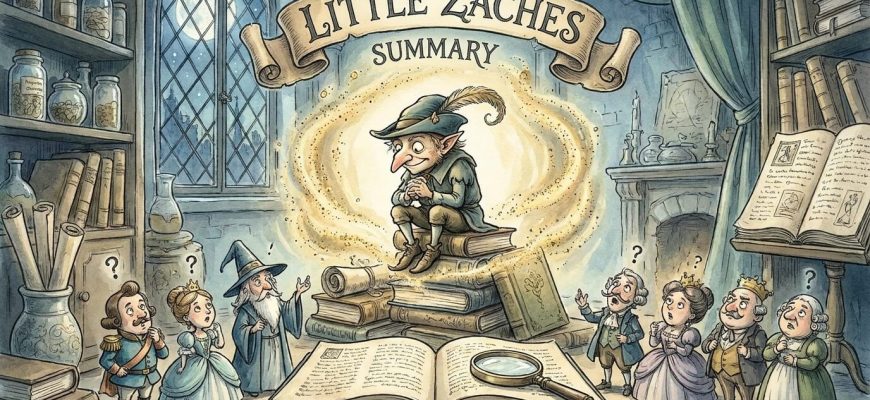
Little Zaches Called Cinnabar is a satirical fairy tale by German Romantic writer E. T. A. Hoffmann. Through the story of a grotesque dwarf who receives magical powers, the author mocks vanity, social prejudice, false reputations, and the absurdities of an allegedly enlightened society.
Little Zaches Main Characters analysis
- Little Zaches / Cinnabar – A grotesque, deformed dwarf who receives three magical hairs that allow him to take credit for other people’s achievements while making others appear responsible for his own failures.
- Balthazar – A melancholy young poet who recognizes Cinnabar’s true nature and falls in love with Candida.
- Candida – The cheerful and charming daughter of Professor Mosch Terpin. She is initially captivated by Cinnabar’s magical influence but ultimately becomes Balthazar’s wife.
- Rosabelverde – A good fairy and mistress of flowers who takes pity on the unfortunate Zaches and gives him his magical gift.
- Prosper Alpanus – A powerful magician traveling incognito. He discovers the secret behind Cinnabar’s influence and helps Balthazar expose him.
- Fabian – Balthazar’s friend, a student whose education initially makes him skeptical of magic. He eventually helps uncover the truth about Cinnabar.
- Professor Mosch Terpin – Candida’s father, obsessed with what he considers the true ancient German spirit: ponderousness combined with vulgarity.
- Lisa – A poor peasant woman and the mother of Little Zaches. She carries her deformed son in a basket and is eventually rewarded by the fairy.
Little Zaches Called Cinnabar Summary
In a small state ruled by Prince Demetrius, every inhabitant enjoyed complete freedom to pursue their own interests. Fairies and magicians value warmth and freedom above all else, so during Demetrius’s reign, numerous fairies from the magical land of Jinnistan moved to this blessed little principality.
However, after Demetrius’s death, his successor, Prince Paphnutius, decided to introduce Enlightenment into his country. His ideas about education were extremely radical: all magic had to be abolished because fairies practiced dangerous sorcery. The ruler’s foremost concerns, he believed, should be growing potatoes, planting acacias, cutting down forests, and introducing smallpox vaccination.
This kind of Enlightenment dried up the flourishing land within a few days. The fairies were expelled to Jinnistan, although they did not put up much resistance. Only the fairy Rosabelverde managed to remain in the principality. She persuaded Paphnutius to give her a position as a canoness at a boarding school for noble girls.
One day, this kind-hearted fairy, the mistress of flowers, saw a peasant woman named Lisa asleep beside a dusty road. Lisa had been returning from the forest with a basket of firewood. In the same basket, she was carrying her hideously deformed son, nicknamed Little Zaches.
The dwarf had a disgusting, elderly-looking face, twig-like legs, and spidery arms.
Feeling sorry for the spiteful little creature, the fairy spent a long time combing his tangled hair. Then, smiling mysteriously, she disappeared.
When Lisa woke up and continued on her way, she encountered the local pastor. For some reason, he was captivated by the ugly little creature. Repeatedly declaring that the boy was extraordinarily handsome, he decided to take him in and raise him.
Lisa was delighted to be rid of the burden, without really understanding what had suddenly made her deformed son so appealing to other people.
Meanwhile, at the University of Kerepes, a young poet named Balthazar was studying. He was a melancholy student in love with Candida, the cheerful and charming daughter of his professor, Mosch Terpin.
Mosch Terpin was obsessed with the ancient German spirit as he understood it: ponderousness combined with vulgarity. This was even more unbearable than Balthazar’s mystical Romanticism.
Balthazar indulged in all the romantic eccentricities so typical of poets. He sighed, wandered alone, and avoided student festivities. Candida, on the other hand, embodied life and cheerfulness. With her youthful coquetry and healthy appetite, she found her student admirer very pleasant and amusing.
Meanwhile, a new figure entered this touching university preserve, where typical student rowdies, typical Enlightenment thinkers, typical Romantics, and typical patriots embodied the ailments of the German spirit.
It was Little Zaches, endowed with a magical ability to attract people’s admiration.
When he entered Mosch Terpin’s house, he completely enchanted both the professor and Candida. From that moment on, he was known as Cinnabar.
Whenever someone read a poem or made a witty remark in his presence, everyone became convinced that the achievement belonged to Cinnabar. Whenever he let out an unpleasant meow or stumbled, someone else among the guests was inevitably blamed.
Everyone admired Cinnabar’s refinement and agility. Only two students, Balthazar and his friend Fabian, could see the dwarf’s ugliness and wickedness.
Meanwhile, through deception, Cinnabar managed to obtain a position as a secretary in the Ministry of Foreign Affairs and eventually became a Privy Councillor for Special Affairs. He achieved all this by appropriating the accomplishments of the most deserving people.
It so happened that the magician Dr. Prosper Alpanus visited Kerepes in his crystal carriage, with a pheasant on the coachman’s seat and a golden beetle at the rear. He was traveling incognito.
Balthazar immediately recognized him as a magician, but Fabian, whose education had made him skeptical, initially had his doubts.
However, Alpanus demonstrated his powers by showing the friends Cinnabar’s true nature in a magical mirror.
It turned out that the dwarf was neither a magician nor a gnome, but simply a deformed creature helped by some mysterious force.
Alpanus quickly discovered the source of this mysterious power, and the fairy Rosabelverde hurried to pay him a visit.
The magician informed the fairy that he had cast a horoscope for the dwarf. According to his calculations, Zaches-Cinnabar could soon bring ruin not only upon Balthazar and Candida but also upon the entire principality, where he had become a trusted figure at court.
The fairy was forced to agree and withdraw her protection from Zaches. This was made all the more necessary by the fact that Alpanus had cunningly broken the magical comb with which she had once brushed the dwarf’s curls.
The secret was that after the fairy had combed his hair, three fiery hairs had appeared on the dwarf’s head.
They gave him his magical powers: all other people’s achievements were attributed to him, while all his shortcomings were blamed on others. Only a few people could see the truth.
The hairs had to be pulled out and burned immediately.
Balthazar and his friends managed to do this just in time, when Mosch Terpin was already arranging Cinnabar’s engagement to Candida.
Thunder roared, and everyone saw the dwarf as he really was.
They tossed him around like a ball, kicked him, and threw him out of the house. In wild fury and terror, he fled to his luxurious palace, which the prince had given him.
Meanwhile, unrest among the people continued to grow. Everyone heard about the minister’s transformation.
The unfortunate dwarf died after becoming stuck in a jug into which he had tried to hide.
As her final act of kindness, the fairy restored his handsome appearance after his death.
She did not forget his mother either. The old peasant woman Lisa found that an exceptionally beautiful and sweet onion had grown in her vegetable garden. As a result, she was appointed the personal supplier of the enlightened court.
Meanwhile, Balthazar and Candida began a happy life together, as befits a poet and a beautiful woman whose union had been blessed at the very beginning of their lives by the magician Prosper Alpanus.
Little Zaches Chapter Summary
Chapter 1
The son of a peasant woman named Lisa was a hideous little creature, deformed and hunchbacked. He was also developmentally delayed. One day, while Lisa was asleep on a path, a fairy named Rosabelverde happened to pass by. Taking pity on the little boy, Zaches, she gently smoothed his hair.
When Lisa awoke, she was surprised to see that her son’s hairstyle had changed, but she noticed nothing else unusual.
However, when the pastor saw the child, he was completely delighted and offered to take Zaches away so that he could be raised alongside his own son. Lisa gladly handed the little boy over.
All this happened in an unfortunate kingdom from which every fairy had been banished.
Chapter 2
The city of Kerepes was famous for its university, and all the students enjoyed attending the lectures of Professor Mosch Terpin.
After one such lecture, a student named Balthazar went into the forest, lost in thought. His cheerful fellow student Fabian followed him, teasing him about his love for the professor’s beautiful daughter, Candida.
Suddenly, they saw a horse that appeared to have no rider. But when it galloped closer, a tiny deformed creature wearing enormous boots fell off its back.
Fabian made fun of the little creature, while Balthazar felt sorry for him.
The creature, who was none other than Zaches, became angry and rode off toward the city. The students followed him.
Chapter 3
In the city, the two friends were astonished to hear about the arrival of a magical, though very small, man named Zinnober.
They went to visit the professor and saw Zaches there again.
Balthazar reminded Zaches of his fall from the horse, but Zinnober declared that he was the greatest horseman in the world. He then let out a piercing cry and began jumping around on the floor on all fours.
Mosch Terpin accused Balthazar of being the one who had screamed and jumped around, refusing to listen to the student’s attempts to defend himself.
Later, Balthazar read his poems aloud, but everyone began praising Zinnober for supposedly writing such wonderful verses. Candida even kissed the little creature.
Even Fabian admitted that Zinnober’s poems were good. Furious, Balthazar ran home.
Chapter 4
In the forest, Balthazar met a famous violinist who had fled the city because his reputation had been transferred to Zinnober. Balthazar realized that Zinnober was under an enchantment and possessed the power to cast spells over other people.
There, he also encountered a referendary named Pulcher, who was about to shoot himself. Pulcher explained that his hopes of obtaining a good position had been shattered. During the examination, everyone had praised Zinnober, who had done nothing but snort and laugh, and the vacant position had been awarded to him instead.
Balthazar told Pulcher what he had witnessed, and the two began cursing Zinnober, calling him a sorcerer.
Suddenly, a carriage drawn by two unicorns passed by. A man dressed in magnificent clothes nodded to them. A ray of light shot from his walking stick and touched Balthazar’s chest.
The carriage disappeared, and Balthazar decided that this mysterious man would be able to break Zinnober’s spell.
Chapter 5
During dinner, the prince was so delighted by Zinnober’s manners—he smacked his lips while eating and wiped his hands on the tablecloth—that he appointed him a privy councillor.
Fabian told Balthazar that Candida was engaged to Zinnober. Balthazar, in turn, told his friend about the magical carriage. But Fabian mocked him, claiming that the man had been Doctor Alpanus, who merely pretended to know the secrets of the supernatural.
The friends set off for Alpanus’s country estate. Two frogs greeted them and transformed into an old man and an old woman when Fabian threw a stone at them. At the entrance, an ostrich welcomed the visitors and led them to the doctor.
Alpanus listened to Balthazar and began searching through his books for an image of Zinnober, but found none. He then took Balthazar to a magical mirror, in which the student saw the dwarf embracing Candida. Enraged, Balthazar struck the little creature with his walking stick.
Alpanus explained that Zinnober was an ordinary human being, but that he was under the influence of a magical force.
Fabian mocked the doctor, who responded by stroking his coat.
Soon, Fabian noticed that the sleeves and tails of his coat had begun to grow longer.
Meanwhile, Balthazar encountered Pulcher in the city. Pulcher told him that he was wanted for beating Zinnober and would be executed. Balthazar fled to the countryside.
Chapter 6
Candida was firmly determined to marry Zinnober. Meanwhile, Pulcher saw a woman combing Zinnober’s hair in the garden. Afterward, a fiery streak appeared on the dwarf’s head.
Pulcher rushed toward Zinnober and smashed the golden comb. He then wrote to Balthazar, revealing this secret.
At the same time, the prince decided to reward Zinnober. However, the dwarf was so tiny that it proved impossible to fasten the order’s ribbon to him. Only a theatrical tailor managed to attach it with the help of twenty buttons.
Meanwhile, a mysterious visitor arrived at Doctor Alpanus’s home. It was Fairy Rosabelverde. The two magicians tested their powers against each other, and the fairy lost. She admired Alpanus, who eventually brought up the subject of Zinnober.
He showed the fairy Balthazar’s horoscope, and she admitted that she was powerless against a higher force. They parted, each assuring the other of their friendship.
Chapter 7
By this time, Zinnober had become Minister of Foreign Affairs, while Mosch Terpin spent his days constantly drinking wine in the prince’s cellar.
Balthazar was in despair, but then Alpanus appeared before him. The doctor told the student the story of Zinnober.
Alpanus explained that the fairy had enchanted the dwarf so that everything beautiful or remarkable accomplished by other people in his presence was attributed to him instead. However, if three fiery hairs were pulled from Zinnober’s head, the spell would disappear.
Alpanus gave Balthazar a lens that would allow him to see the hairs. He then explained that he would have to leave the country but would leave his castle to the student as an inheritance.
He also handed Balthazar a box intended for Fabian.
Chapter 8
Balthazar secretly made his way into the city and found Fabian in despair. All of Fabian’s clothes had been growing longer until they had become impossible to wear. As a result, people regarded him as a freethinker and threatened to bring him before a court.
Balthazar gave Fabian the box from Alpanus. Inside was a tailcoat that did not grow longer.
The time for Candida’s engagement ceremony had arrived. Balthazar and his friends burst into the hall, located the three hairs on Zinnober’s head, and threw them into the fire.
Zinnober began desperately appealing to the prince, but the prince looked at him angrily and blamed Terpin for the commotion. Terpin grabbed Zinnober and threw him out.
Candida came to her senses and fell into Balthazar’s arms. Terpin blessed their union, although his thoughts were already occupied with the prince’s displeasure and the poverty that might follow.
Chapter 9
Zinnober hid at home and refused to show himself to anyone. Only once did he look out of the window, and Lisa immediately spotted him.
She began calling for her little son, Zaches, while the people laughed. Then the crowd rushed to storm the house, and the cowardly Zinnober drowned in a chamber pot.
The fairy approached his body and gently stroked his head. A fiery streak appeared in Zaches’s hair.
Zinnober was buried with great honors because everyone once again saw him as a handsome and admirable man.
Meanwhile, the prince became fascinated by Lisa’s onions and arranged for her to supply them for his table.
Chapter 10
The wedding of Balthazar and Candida took place at their new country house. In the evening, Alpanus said goodbye to everyone and flew away in his magical carriage.
Якщо ви не знайшли потрібну відповідь, можете запитати у нашого чат-бота у Телеграм.