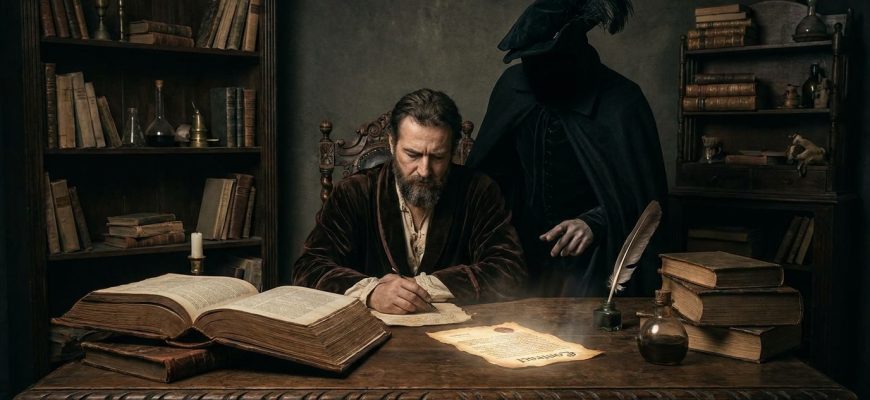
Faust is a dramatic tragedy by the German writer Johann Wolfgang von Goethe, inspired by the medieval legend of a scholar who makes a pact with the devil in exchange for knowledge, power, and worldly pleasures. The work explores humanity’s endless pursuit of truth, the conflict between good and evil, temptation, love, ambition, and the meaning of life. It consists of two parts and opens with three introductory texts that establish its central themes.
Faust Main Characters analysis
- Faust — A distinguished scholar dissatisfied with the limits of human knowledge. His desire to understand the universe and experience life to its fullest leads him to make a pact with Mephistopheles.
- Mephistopheles — A devilish spirit who embodies denial, skepticism, and temptation. He offers Faust worldly pleasures and accompanies him on his extraordinary journey.
- Margarete (Gretchen) — A young woman whom Faust falls in love with. Their relationship develops into a tragedy that brings death and suffering.
- Wagner — Faust’s student, who represents shallow academic ambition and the tendency to substitute borrowed ideas and impressive language for genuine knowledge.
- The Lord — The divine figure who believes in Faust’s ability to overcome his weaknesses and continue striving toward truth.
- The Director — A practical and cynical theater manager who believes that entertainment and commercial success should be the main purposes of the stage.
- The Comic Actor — A performer who supports the Director’s view that immediate popularity matters more than lofty artistic ideals.
- Helen of Troy — The legendary embodiment of feminine beauty whom Faust encounters during his journey into the world of ancient mythology.
- Euphorion — The son of Faust and Helen, portrayed as a daring young man drawn to struggle and extraordinary challenges.
- Philemon and Baucis — An elderly couple whose modest home stands in the way of Faust’s ambitious construction project.
Faust Summary
Three introductory texts open the tragedy.
The first is a dedication to the friends of Goethe’s youth. It is filled with lyrical tenderness and nostalgic memories of those who were close to the poet while he was working on the drama.
Next comes the Prelude in the Theater, in which the Director, the Poet, and the Comic Actor argue about the role of art in society.
The Director, a down-to-earth cynic, firmly believes that art in general, and theater in particular, should serve the public’s entertainment. Simple jokes, amusing situations, and intense displays of primitive passions are, in his opinion, the best ways to attract an audience and make a performance successful.
The Comic Actor agrees with him. He advises the Poet not to spend too much time reflecting on eternal values and instead advocates immediate success.
The Poet, however, objects to using the lofty art bestowed by heaven as entertainment for an undemanding audience. Bringing the argument to an end, the Director urges everyone to get down to work and reminds the Poet and the Actor that all the technical wonders of his theater are at their disposal.
The Prologue in Heaven
The Prologue in Heaven begins with the archangels praising the wonders of God’s creation in elevated and elaborate language. Their solemn celebration is interrupted by Mephistopheles, who points out, with the characteristic skeptical charm of the spirit of denial, how miserable human life actually is.
Mephistopheles believes that the reason God has given humanity is practically useless. In his view, people have been granted a spark of intelligence, yet they continue to live much like animals.
The Lord points to Faust as an example of someone who uses reason in the pursuit of knowledge. He assures Mephistopheles that Faust will overcome any difficulties he encounters along the way.
Mephistopheles is genuinely surprised. He believes that the contradictions within the scholar’s nature will eventually lead to his downfall. Thus, the two make a wager.
The Lord allows Mephistopheles to experiment with Faust as he pleases, confident that the scholar will eventually find his way out of the dead end through his own instincts and determination.
Another stage in the eternal struggle between light and darkness, good and evil, is about to begin.
Part One of Faust Summary
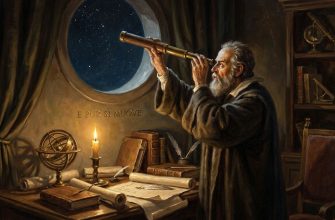
The subject of the wager, the great scholar Faust, spends a sleepless night in his study, surrounded by enormous books, scientific instruments, scrolls, and all the other objects associated with the world of learning. He is determined at any cost to master the secrets of the universe and understand the laws governing all existence.
Dr. Faust does not deceive himself about his achievements. Although he has acquired extensive knowledge in almost every field of science, he admits that he has failed to discover the ultimate truth about the nature of everything that exists. He has studied theology, struggled with philosophy, mastered jurisprudence, and learned medicine, yet his efforts have not brought him the understanding he seeks.
His attempt to summon the most powerful spirit only reinforces his awareness of the insignificance of his earthly achievements.
Neither sorrow nor despair can be dispelled by the visit of his neighbor and student, Wagner. This character is a perfect example of someone who strives to master academic knowledge while replacing genuine understanding and inspiration with impressive speech and borrowed ideas.
Wagner’s self-confident foolishness irritates Faust, and the scholar sends him away.
The gloomy sense of hopelessness and the bitter realization that his life has passed among retorts and glass vessels, surrounded by the futile darkness of endless searching, drive Faust toward suicide. He intends to drink poison, but just as he raises the cup to his lips, the bells announcing Easter begin to ring. The holy celebration saves him from death.
The next scene depicts a popular outdoor celebration. Students, servants, noble ladies, burghers, and beggars mingle in the crowd. Lighthearted conversations and cheerful jokes create a feeling of light and openness that sharply contrasts with Faust’s tormented thoughts during the night.
Accompanied by his student Wagner, Faust joins the cheerful townspeople. The respect and admiration he receives from the local residents because of his medical achievements bring him no joy.
His conflicting desire to understand both the secrets of the earthly world and the wonders of the heavens drives him to call upon heavenly spirits, hoping they will help him attain the truth. Along the way, a black poodle joins them, and Faust takes the animal home.
The scholar tries to overcome his depression and lack of will by turning to the translation of the New Testament. Following his theory of active knowledge, he translates the Greek word Logos as deed, interpreting the opening statement of the Gospel as meaning that in the beginning was the deed.
However, the poodle’s strange behavior distracts him from his scholarly work. Suddenly, Mephistopheles appears before Faust and the reader in the guise of a traveling student.
Faust cautiously asks his unexpected visitor who he really is. The answer gives rise to the famous statement: Mephistopheles is part of the force that eternally desires evil but continually produces good.
The new companion proves far more interesting than the dull and rather foolish Wagner. Mephistopheles matches Faust in intellectual power, sharpness of mind, and breadth of knowledge. With biting precision, he mocks human weaknesses as though he can see directly into Faust’s troubled soul.
After lulling the scholar to sleep with the help of a chorus and a procession of spirits, Mephistopheles disappears, leaving Faust fascinated by their unexpected encounter.
During his second visit, Mephistopheles appears as a fashionable gentleman and proposes an agreement: Faust will surrender his soul to the devil. The pact is sealed with blood.
The two set off on their journey, traveling on Mephistopheles’s broad cloak as though it were a flying carpet. Faust is now young, handsome, and full of energy. All the pleasures and illusions of the world are placed at his disposal.
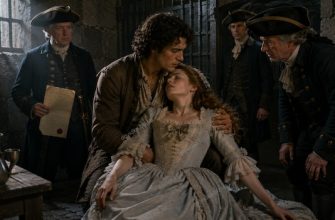
His first great experience is his love affair with Margarete. At first, she seems to offer the only happiness possible in earthly life, but their relationship soon turns into a tragedy that brings death and grief.
Part Two of Faust Summary
The second part of Faust and Mephistopheles’s adventures takes them to an imperial court. The description of this court makes it easy to recognize the features of one of the German states.
Act One
The first act begins with Faust resting in a beautiful summer meadow. Spirits of light fill his mind with gentle and pleasant dreams, soothing the scholar’s wounded and tormented soul as he struggles with guilt over Margarete’s death.
The next scene transports the characters and the audience to the imperial court. Luxury and gilded splendor conceal widespread poverty and financial ruin.
The emperor’s advisers are deeply worried, but Mephistopheles, an unconcerned and mischievous devil, organizes a grand ball. Amid the festivities, he manages to put an ingenious plan into action to improve the empire’s financial situation.
The scheme involves paper certificates bearing the emperor’s signature. Their stated value is supposedly backed either by the imperial treasury or by the hidden wealth buried beneath the earth.
Naturally, the fraud is bound to collapse sooner or later. For the moment, however, the entire country celebrates, and Faust and Mephistopheles are honored as heroes and saviors.
After the ball, in one of the palace’s dark galleries, Faust receives a modest-looking key from his tempter. It turns out to be a passage into the magical world of ancient gods and heroes.
During his travels, Faust brings Paris and Helen of Troy to the imperial court, where the emperor and his subjects are eager for ever more spectacular entertainment.
As tradition dictates, the court ladies criticize Helen’s appearance. Faust, however, feels with his entire being that he is standing before the ideal of feminine beauty, a remarkable union of spiritual and aesthetic perfection.
The scholar tries to hold on to Helen, but the apparition cannot last forever. Soon it disappears, leaving Faust overwhelmed with sorrow.
Act Two
Mephistopheles brings Faust to a cramped Gothic room that turns out to be the scholar’s old laboratory. It is filled with piles of books, papers, rags, and dust.
While Faust remains unconscious, Mephistopheles takes great pleasure in mocking the stupidity and arrogance of the scholar’s former students.
After sending them away, Mephistopheles looks into the laboratory, where a diligent student, now swollen with pride and convinced of his own creative powers, is attempting to produce an artificial human being inside a glass vessel. This creature is called a homunculus.
The experiment succeeds, and another being from the world of shadows comes into existence inside the flask.
The homunculus and Mephistopheles decide to take Faust into the supernatural world, hoping to break the spell of his enchanted sleep and bring him back to consciousness.
Beyond the boundaries of ordinary existence, Faust encounters mythical and marvelous creatures. He speaks with sphinxes and lamias, sirens, and Charon, who tells him where he can find the beautiful Helen.
Nothing can stop Faust now. His determination to reach his goal has become an obsession.
The sirens and Nereids, the homunculus, Faust, and Mephistopheles move together through a procession of visions and extraordinary adventures. Among these events is a monologue by the homunculus about the dual nature of his existence, which prevents him from finding peace and happiness.
Act Three
The third act presents the beautiful Helen at the gates of the palace of Menelaus in Sparta.
Anxious and sorrowful, Helen enters the palace without knowing what awaits her. Goethe’s magnificent verse, which he deliberately brought as close as possible to the Greek hexameter, transports the audience to the world of ancient Greek tragedy.
The events that unfold inside the palace require readers to be familiar with Greek mythology and ancient history. They refer to a period of internal conflicts in the country, when Athens and Sparta were at war.
According to the words of the Phorcyad, Helen and her attendants are supposed to face death. However, a mist suddenly appears, and the Phorcyad disappears with it. Helen finds herself in the inner courtyard of a castle, where she meets Faust.
Magnificent, wise, and powerful, as though he embodies the qualities of a dozen ancient Greek kings, Faust wins Helen’s love. Their extraordinary union produces a son named Euphorion, whom Goethe deliberately portrays with a distinctly Byronic aura.
For a moment, the scene presents a picture of magical family happiness. But their enjoyment of life is suddenly interrupted when Euphorion disappears.
The young man is drawn toward struggle and the challenge of the elements. He rushes upward, leaving behind only a shining trail.
As she says goodbye, Helen embraces Faust and remarks that an ancient saying is coming true in her own life: happiness and beauty cannot coexist.
In Faust’s arms, only Helen’s clothing remains, as though the physical beauty she embodied has proved as fleeting as an illusion.
Act Four. The Return
Like any inhabitant of the supernatural world, Mephistopheles does not reject unusual means of transportation. Wearing seven-league boots, he brings Faust back from the world of idealized Greek hexameter to the familiar Middle Ages.
Mephistopheles offers Faust various plans for achieving fame and recognition, but the scholar rejects them one after another.
Frustrated, Faust finally admits that he would like to try his hand at creating solid land itself by reclaiming a piece of fertile territory beside the sea.
Mephistopheles objects that this magnificent idea can wait. For now, they must help the emperor, who had enjoyed only a brief period of prosperity after approving and implementing the fraudulent paper-money scheme. The emperor is now in danger of losing his throne and perhaps even his life.
A brilliant military operation follows. The two heroes demonstrate their knowledge of military tactics and strategy, as well as their undeniable abilities in sabotage and covert operations. Their campaign ends in victory.
Act Five
In the fifth act, Faust is firmly determined to carry out his ambitious plan, which he believes will make him equal to the Creator.
Unfortunately, there is an obstacle: a small cottage belonging to an elderly couple, Philemon and Baucis, stands on the very site where Faust intends to build his dam.
Goethe deliberately gave these seemingly minor characters the names of figures from ancient Greek mythology who represent the happiness of a peaceful old age spent together.
Faust offers them another place to live, but the stubborn couple refuses to leave their home.
Irritated by this obstacle, Faust asks the devil to resolve the situation. Mephistopheles handles the matter in a way entirely consistent with his character.
The elderly couple, together with an unexpected guest, are killed by the guards, and their cottage is destroyed in an accidental fire.
Faust is overwhelmed with grief. He cries out in anguish.
Now an old man, he feels sorrow and exhaustion. All his dreams have narrowed down to one thing: the construction of his dam.
But another blow awaits him: he suddenly loses his sight.
Yet even in the darkness surrounding him, Faust can hear voices, the sound of shovels, and the rumbling of wheels. He joyfully realizes that construction is underway and that his cherished goal is finally within reach.
Sadly, this is another cruel trick by Mephistopheles. Instead of builders, lemures are moving around Faust. On Mephistopheles’s orders, they are not digging a foundation for a dam but a grave for the old scholar.
Meanwhile, Faust is happy. He delivers an inspired monologue in which he gathers together the knowledge and experience he has acquired during his long journey through life.
He realizes that the greatest happiness on earth does not come from power or fame, wealth or possession of a beautiful woman. True fulfillment comes from collective work that benefits everyone and is recognized by the world as necessary.
Thus, at the end of his life, Faust finally understands that, indeed, in the beginning was the deed.
Overwhelmed by the great truth that has been revealed to him, he utters the famous words: “Stay, moment! You are so beautiful!”
Immediately afterward, he collapses.
Mephistopheles rejoices, believing that he has won the wager. But angels carry Faust’s enlightened soul to heaven, saving him from the devil’s grasp.
Mephistopheles is furious and curses his own actions and intentions.
In the afterlife, Faust encounters the spirit of Gretchen, who guides him along a path he has never traveled before.
Якщо ви не знайшли потрібну відповідь, можете запитати у нашого чат-бота у Телеграм.