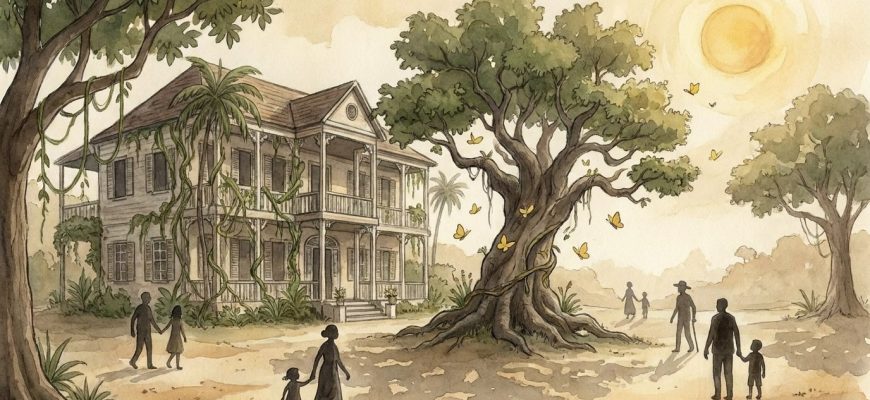
One Hundred Years of Solitude by Gabriel García Márquez is a novel set in the fictional Latin American town of Macondo during the twentieth century. It tells the story of several generations of the Buendía family, whose lives are shaped by love, war, ambition, violence, and an inherited tendency toward loneliness. Through the rise and decline of Macondo, the novel explores the repetition of history, the fragility of memory, and the consequences of isolation.
- One Hundred Years of Solitude Main Characters Analysis
- One Hundred Years of Solitude Summary
- The Founding of Macondo and the Buendía Family Summary
- The Insomnia Plague and the Arrival of Melquíades Summary
- Rebeca, Amaranta, and Pietro Crespi Summary
- Aureliano’s Marriage and the Death of Remedios Summary
- The Civil War and the Rise of Colonel Aureliano Buendía Summary
- Colonel Aureliano’s Crisis and Defeat Summary
- Arcadio’s Tyranny and the Death of the Family Patriarch Summary
- The Arrival of the Banana Company Summary
- Aureliano Segundo, José Arcadio Segundo, and Fernanda del Carpio Summary
- The Illusion of Progress in Macondo Summary
- José Arcadio Segundo and the Banana Workers’ Strike Summary
- The Decline of Macondo Summary
- Aureliano Babilonia and the Final Generation Summary
One Hundred Years of Solitude Main Characters Analysis
- José Arcadio Buendía – The founder of the Buendía family and Macondo. Fascinated by science and alchemy, he eventually loses touch with reality and spends his final years tied to a chestnut tree.
- Úrsula Iguarán – José Arcadio Buendía’s wife and the matriarch of the family. She works tirelessly to support her household and witnesses the rise and decline of several generations.
- José Arcadio – The eldest son of José Arcadio Buendía and Úrsula. After an affair with Pilar Ternera, he leaves Macondo with a group of gypsies. He later returns and marries Rebeca.
- Aureliano Buendía – The younger son of the founders. Initially a dreamer, jeweler, and poet, he becomes the famous Colonel Aureliano Buendía, a military leader whose ambition and years of warfare turn him into a ruthless and lonely man.
- Amaranta – The daughter of José Arcadio Buendía and Úrsula. She falls in love with Pietro Crespi but rejects his proposal, with tragic consequences.
- Rebeca – An adopted daughter of the Buendía family who falls in love with Pietro Crespi before unexpectedly marrying José Arcadio.
- Pilar Ternera – A woman who has relationships with members of the Buendía family and becomes the mother of two of their children.
- Pietro Crespi – An Italian music and dance teacher who becomes involved in a love triangle with Amaranta and Rebeca.
- Remedios Moscote – The young daughter of Macondo’s magistrate, Apolinar Moscote, who marries Aureliano and brings happiness into the Buendía household.
- Arcadio – The illegitimate son of José Arcadio and Pilar Ternera. Left in charge of Macondo during the civil war, he becomes a cruel and corrupt ruler.
- Santa Sofía de la Piedad – Arcadio’s wife and the mother of his children. After his death, Úrsula takes her and the children into the family home.
- José Arcadio Segundo – One of the twins born to Arcadio and Santa Sofía de la Piedad. He becomes a leader of the banana plantation workers’ union and survives the massacre of striking workers.
- Aureliano Segundo – José Arcadio Segundo’s twin brother. A cheerful and extravagant man who becomes wealthy through his relationship with Petra Cotes.
- Fernanda del Carpio – A woman from an impoverished aristocratic family who marries Aureliano Segundo. Proud and authoritarian, she imposes strict rules on the Buendía household.
- Remedios the Beauty – The daughter of Arcadio and Santa Sofía de la Piedad, later known for her extraordinary beauty.
- Mauricio Babilonia – A working-class man who falls in love with Remedios, Fernanda’s daughter.
- Amaranta Úrsula – A later descendant of the Buendía family who returns to Macondo and falls in love with her nephew, Aureliano Babilonia.
- Aureliano Babilonia – The last major descendant of the Buendía family. He studies Melquíades’s manuscripts and eventually discovers the history and fate of his family.
- Melquíades – A mysterious gypsy who introduces José Arcadio Buendía to scientific and alchemical ideas. His manuscripts contain the prophecy of the Buendía family’s fate.
One Hundred Years of Solitude Summary
The Founding of Macondo and the Buendía Family Summary
At the beginning of the novel, García Márquez introduces José Arcadio Buendía, the founder of the Buendía family, and his wife, Úrsula Iguarán. They are cousins who marry despite their parents’ warnings. However, their fear that their union might produce a child with a pig’s tail makes Úrsula determined to preserve her virginity even after the wedding.
Her behavior gives their fellow villager, Prudencio Aguilar, an opportunity to insult José Arcadio Buendía in a deeply humiliating way. The confrontation has tragic consequences: José Arcadio kills Prudencio. Haunted by guilt and trying to escape the threat of blood revenge, he takes his wife and leaves his homeland. After a long journey, he founds a new settlement isolated from the outside world, which becomes Macondo. The couple have two sons, José Arcadio and Aureliano, and a daughter, Amaranta, born much later.
Under Melquíades’s influence, José Arcadio Buendía becomes fascinated by alchemy. He tries to discover the philosopher’s stone, extract gold from the earth using a magnet, and invent a perpetual-motion machine. His uncontrolled imagination gradually destroys his sense of reality, and he falls into “a state of eternal delirium from which he would never be able to free himself.” He smashes everything in his laboratory and is eventually tied to a chestnut tree.
Earlier, he had attempted to establish a road connecting Macondo with the outside world so that civilization could reach the settlement. However, he chooses a route that leads to the sea.
Meanwhile, Úrsula begins making sweets that become extremely popular, bringing prosperity to the household. Her eldest son, José Arcadio, has an affair with Pilar Ternera while still very young. Frightened by the possibility of becoming a father, he leaves with a group of gypsies. Úrsula sets out to find him. She does not succeed in finding her son, but she discovers a route to the wider world and returns with a large group of people who settle in Macondo. As a result, the isolated settlement develops into a town situated along a trade route.
The Insomnia Plague and the Arrival of Melquíades Summary
Before Macondo enters a new historical era, its inhabitants are struck by a mysterious disease. It begins with insomnia and eventually causes people to lose their memories. To fight the epidemic, the townspeople start labeling objects with their names: “table,” “chair,” “clock,” “door,” and “wall.”
They even hang a sign around a cow’s neck explaining that it is a cow, that it must be milked every morning to obtain milk, and that the milk must be boiled and mixed with coffee to make coffee with milk. At the entrance to the town, they put up a sign bearing the name “Macondo.” On the main street, they place another notice reminding people that “God exists.”
The author explains that the disease came from Indian lands, suggesting that people have forgotten the destruction of America’s ancient civilizations by European conquerors.
Melquíades saves the inhabitants of Macondo from this unexpected disaster. He has even visited the world of the dead and returned. Using a miraculous elixir, he cures the townspeople and settles in Macondo permanently. He begins filling his manuscripts with coded writings in which he foretells the fate of the Buendía family.
One detail announces that the inhabitants of Macondo have become part of history: José Arcadio Buendía installs musical clocks in every house.
After Melquíades’s death by drowning, a new generation begins to emerge. By this time, Aureliano, Amaranta, and the adopted daughter Rebeca have grown up in the Buendía household. The family also raises the illegitimate sons born to Pilar Ternera, because José Arcadio Buendía, the head of the family, cannot allow his descendants to be abandoned. The boys are named José Arcadio, whom everyone calls Arcadio to distinguish him from his father, and Aureliano, the younger.
Despite Úrsula’s fears, all the children are born perfectly normal. However, beginning with the second generation, they share a common characteristic: a tendency toward loneliness that eventually becomes an inherited trait.
Rebeca, Amaranta, and Pietro Crespi Summary
Conflict enters the Buendía household when Amaranta and Rebeca both fall in love with Pietro Crespi, an Italian music and dance teacher. He chooses Rebeca, and the two decide to marry. Amaranta becomes so resentful that she begins to hate her sister.
However, quite unexpectedly, Rebeca is captivated by the physical strength of the prodigal son of the family, José Arcadio, who returns home after having “circled the globe sixty times.” She marries him instead of Pietro Crespi. Although José Arcadio and Rebeca are not actually brother and sister, Úrsula cannot accept their marriage. She sees it as a disgrace to the family, and the young couple are forced to leave the family home forever.
Aureliano’s Marriage and the Death of Remedios Summary
Aureliano marries Remedios Moscote, the charming daughter of Apolinar Moscote, the magistrate appointed to govern Macondo after Úrsula opens a road connecting the town with other settlements.
Remedios has a cheerful and loving nature. She cares for everyone, including the family patriarch, José Arcadio Buendía, who has lost his mind and lives tied to the chestnut tree. She brings happiness and comfort into the Buendía household. To the family’s great sorrow, however, the young Remedios dies in childbirth.
Pietro Crespi, who has by now become a familiar presence in the Buendía household, eventually falls in love with Amaranta and proposes to her. But proud Amaranta, remembering his earlier intention to marry Rebeca, refuses him. The unhappy Pietro Crespi takes his own life.
The Civil War and the Rise of Colonel Aureliano Buendía Summary
The civil war in Macondo begins unexpectedly. The Conservatives are in power in the country. When the magistrate, Apolinar Moscote, arrives in town, a representative of the left-wing opposition, the terrorist Alirio Noguera, soon follows him.
At first, the people of Macondo are indifferent to politics. José Arcadio Buendía’s younger son, Aureliano, sympathizes with the Liberals because he is outraged by the abuses of the Conservatives. Nevertheless, he cannot understand such extremes as starting a war.
During the election, however, Don Apolinar Moscote replaces the ballots to ensure a Conservative victory. Fearing the anger of the townspeople, he then calls in government troops. Macondo is placed under military rule, and searches and public executions in the town square become commonplace.
The soldiers beat the kindly Father Nicanor to death, as well as an unfortunate woman who has been bitten by a rabid dog. Aureliano leads an uprising, executes the men responsible for the assaults, and leaves Macondo to join the Liberal army.
The dreamer, jeweler, and poet Aureliano Buendía becomes a famous but excessively ambitious military commander. War corrupts him, poisons his soul, and transforms him into a cruel dictator. Wherever he appears, his aides draw a circle on the floor in chalk, and only he is allowed to enter it. Standing at its center, Colonel Aureliano Buendía issues short, categorical orders that determine the fate of the world.
The colonel loses his sense of family and his love for his homeland, which for him is Macondo. He becomes “entangled in the desert of solitude.”
Colonel Aureliano’s Crisis and Defeat Summary
An unexpected and tragic turning point comes in Aureliano’s life. Colonel Gerineldo Márquez declares that the struggle is now being waged solely for power and that abandoning the Liberal Party’s program amounts to betrayal. Aureliano Buendía decides to have his old friend executed.
On the eve of the execution, however, Úrsula comes to see her son. “You are doing what you would have done if you had been born with a pig’s tail,” she tells him. She warns him that if he carries out his intention, she will find him wherever he goes and kill him with her own hands.
A mother’s judgment becomes a judgment on the entire family. Aureliano therefore cancels his order, abandons his ambitious plans, and tries to make peace. Yet, in an attempt to put an end to the violence, he is forced to begin another war.
At the cost of numerous casualties, Aureliano “wins his defeat.” Filled with hatred for himself, he signs the act of surrender and then makes an unsuccessful attempt to take his own life.
The colonel has to “roll like a pig in the mire of glory” before he can understand the meaninglessness of his life. He returns to his family home and resumes making jewelry. The work requires his complete concentration and helps him avoid memories of the war.
Arcadio’s Tyranny and the Death of the Family Patriarch Summary
The war also destroys the soul of Colonel Aureliano’s nephew, Arcadio, whom his uncle leaves in charge of Macondo. Thinking only of his own interests, Arcadio abuses his authority, takes bribes, and spends public money on building his own house and furnishing it with Viennese furniture. Through his cruelty, he becomes “the most inhuman ruler Macondo had ever seen.”
After Arcadio orders a violent attack on Don Apolinar Moscote and his family, Úrsula, burning with shame, beats her grandson. She now feels “terribly lonely” herself.
Arcadio eventually becomes another victim of the unjust war. Corrupted by the conflict, he meets his death when the Conservatives execute him.
After Arcadio’s death, Úrsula takes his wife, Santa Sofía de la Piedad, and their children into her home. They include a daughter, Remedios, who later becomes known as Remedios the Beauty, and twin sons, José Arcadio Segundo and Aureliano Segundo.
During the long years of war, other changes take place in the Buendía family. The founder of the family, José Arcadio Buendía, dies. José Arcadio, Rebeca’s husband, is murdered in his own home, although the identity of his killer remains unknown. After his death, Rebeca condemns herself to a life of complete seclusion.
The Arrival of the Banana Company Summary
Soon, a new disaster strikes Macondo: the arrival of the North American banana company. A man named Mr. Jack Brown comes to town, accompanied by lawyers, surveyors, and hired killers who replace the police.
The locals call the North Americans “gringos.” They take control of the town and treat its inhabitants with contempt. When a child accidentally spills lemonade on the uniform of one of the unwanted newcomers, both the child and his grandfather, who tries to save him, are brutally murdered.
Colonel Aureliano decides to start another war to overthrow the regime that has surrendered the country to foreigners. But nobody supports the old colonel, not even Gerineldo Márquez. All that remains for him is to wait patiently for death.
Meanwhile, a new town emerges in Macondo, complete with white cottages, palm trees, and swimming pools. Wooden barracks are built for the workers. The arrival of the foreigners also changes the way the inhabitants live. Eager to become rich quickly and easily through business, they lose their love of the land and their willingness to work.
Aureliano Segundo, José Arcadio Segundo, and Fernanda del Carpio Summary
The “banana fever” determines the fate of Úrsula’s great-grandsons, the twins Aureliano Segundo and José Arcadio Segundo.
Aureliano Segundo is a cheerful, carefree spendthrift who becomes wealthy thanks to his mistress, Petra Cotes. He covers the walls of the family home with banknotes. Unlike his wife, Fernanda, who is horrified by the vulgar behavior of the gringos, Aureliano Segundo adapts to their presence. He organizes lavish feasts and eating contests, trying to drown his sense of loneliness in wine.
Fernanda del Carpio is the heir to an impoverished aristocratic family. She brings a golden chamber pot decorated with coats of arms into the Buendía household, a symbol of the colonial era. Her name is an ironic reference to the legendary hero of fourteenth-century Spanish chivalric romances, Bernardo del Carpio, known as the Mighty Fighter.
Fernanda is a strict, authoritarian woman who has dreamed of becoming a queen since childhood. Her boundless pride drives her to commit terrible and cruel acts. When she discovers that her daughter Remedios has fallen in love with a working-class man named Mauricio Babilonia, Fernanda hires a killer who shoots him. She sends her daughter away to a convent.
When a nun later brings the baby to the family home, the enraged grandmother refrains from drowning the child only because she fears God.
Fernanda, whose hands were made only “for playing the clavichord and weaving funeral wreaths,” introduces a new order in the household. She forbids the making and selling of sweets. Even Úrsula begins dreaming with her of having Fernanda and Aureliano Segundo’s son, José Arcadio, become Pope.
All this infuriates Colonel Aureliano. “We are turning into aristocrats. Yes, we will go to war against the Conservatives again, but this time it will be to put a king in their place,” he declares.
The Illusion of Progress in Macondo Summary
“The progress that had begun when the town of Macondo became part of history turned out to be an illusion.” It is no coincidence that the founder of the family, José Arcadio Buendía, once concluded that “the time machine was broken,” while Úrsula felt that “time was going around in circles.”
In the beginning, the people of Macondo lived and worked together like one large family. Their houses were arranged so that each received an equal amount of sunlight. They considered themselves equal and independent. That is why José Arcadio Buendía regarded the magistrate’s first order—to paint the fronts of all the houses blue in honor of the anniversary of national independence—as a personal insult.
The outside world brings Macondo not only the supposed benefits of civilization, such as a brothel, gambling, a mechanical toy shop, and a cinema, but also violence and lies.
José Arcadio Segundo and the Banana Workers’ Strike Summary
Only one member of the Buendía family openly protests against foreign domination: one of the twins, José Arcadio Segundo. As a child, he witnesses the execution of a man, an experience that leaves a lasting impression on him. He grows up to become “a sad man with a kind of sorrowful expression on his face.”
José Arcadio tries to escape his loneliness through religion and cockfighting, defying the prohibition imposed by José Arcadio Buendía. His actions and eccentricities are all driven by a spirit of protest. He eventually takes a job as a supervisor on a banana plantation. However, after witnessing the harsh working conditions and lawlessness, he sides with the workers and becomes the leader of their union.
The depiction of the strike is based on real events that took place on November 12, 1928. The strikers are lured into the railway station square and then machine-gunned. The people are trapped like livestock in a pen. They whirl around in a gigantic vortex that gradually contracts toward its center as its edges are continuously cut away, “like the peeling of an onion,” by the insatiable and methodical scissors of machine-gun fire.
The writer gives the real names of those responsible for the massacre: the provincial governor, General Carlos Cortés Vargas, and his secretary, Major Enrique García Isaza. They order the soldiers to shoot the strikers “without sparing ammunition.”
Then a terrible downpour descends upon Macondo. The rain lasts four years, eleven months, and two days. Meanwhile, the government issues statements through every mass medium, claiming that “there were no dead, the satisfied workers had returned to their families, and the banana company had temporarily suspended operations until the rains ended.”
When the rain finally stops, nobody in Macondo remembers the three thousand murdered workers except José Arcadio Segundo, who was with the strikers in the square. He regains consciousness among the corpses in one of the carriages of an enormous train. The train is carrying dead men, women, and children to be dumped into the sea like rejected bananas.
When José Arcadio returns to Macondo and tries to remind the townspeople about the massacre, they consider him insane.
The Decline of Macondo Summary
When the clouds finally clear above Macondo, the town lies in ruins. A hot wind blows, the rose bushes have withered, and dust covers the rusted roofs and almond trees.
During the long period of rain, which lasted almost five years, Macondo seems to have returned to the days when it was isolated from the rest of civilization. The gypsies appear once again, astonishing the inhabitants with a magnet, a magnifying glass, an artificial jaw, and other curiosities.
Macondo has fallen back into its childhood. At the beginning of the settlement’s existence, nobody died. Now, however, nobody is born, and death becomes increasingly common.
Aureliano Babilonia and the Final Generation Summary
Only Aureliano Babilonia remains in the old Buendía house. He immerses himself in the manuscripts left by the old gypsy, Melquíades. His studies are repeatedly interrupted, sometimes by the arrival and death of a relative, and sometimes by the return of Amaranta Úrsula, who is his aunt.
The aunt and nephew fall deeply in love. They become so absorbed in each other that they no longer need anyone else. They withdraw into an isolated world where “the only daily and eternal reality was love.”
As punishment for their separation from the outside world, they have a child born with a pig’s tail. Amaranta dies, and the gypsy’s prophecy about the child comes true: “The last of the family will be eaten by the ants.”
Aureliano deciphers the writings on the old parchments and discovers the history of his family and the secret of his own birth. At the same time, as described in the manuscripts, a great whirlwind sweeps Macondo from the face of the earth.
Before his death, Aureliano understands the prophecy: everything recorded in the manuscripts will never be repeated, “because races condemned to one hundred years of solitude had no second opportunity on earth.”
The life stories of all the characters end in loneliness, often with lonely deaths. Ultimately, Macondo itself emerges as a place condemned to solitude.
Якщо ви не знайшли потрібну відповідь, можете запитати у нашого чат-бота у Телеграм.