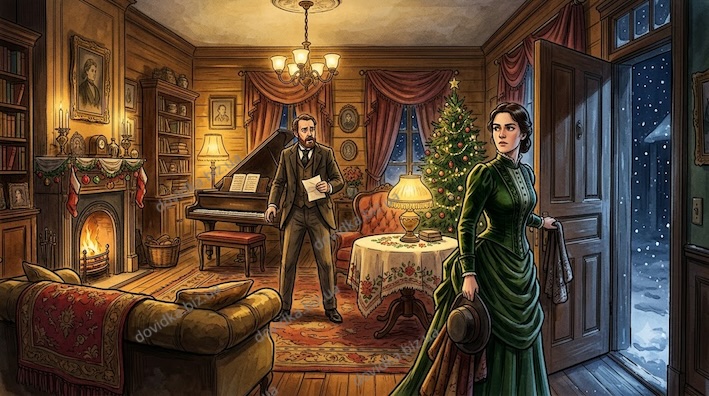
A Doll’s House is a three-act play by Norwegian playwright Henrik Ibsen, first published in 1879. The play tells the story of Nora Helmer, a wife and mother who has secretly broken the law to save her husband’s life. When her secret threatens to come to light, Nora begins to question her marriage, her role in the family, and the expectations society places on women. This A Doll’s House summary follows the key events and main characters of the play.
A Doll’s House Main Characters Analysis
- Nora Helmer — The main character, a cheerful and seemingly carefree wife who hides a serious secret. She borrowed money illegally to save her husband’s life and gradually realizes that her marriage has prevented her from becoming an independent person.
- Torvald Helmer — Nora’s husband, a successful and respectable man who is about to become the director of a joint-stock bank. He treats Nora affectionately but often regards her as a child who needs his guidance. His concern for his reputation becomes central to the conflict.
- Kristine Linde (Mrs. Linde) — Nora’s old friend, a widow who has endured years of hardship while supporting her family. She comes to the city hoping to find steady employment and later reconnects with Krogstad.
- Nils Krogstad — A lawyer employed at the bank where Torvald is about to become director. He knows that Nora forged her father’s signature on a loan document and uses this knowledge to pressure her into protecting his position.
- Dr. Rank — A close friend of the Helmer family who suffers from an incurable illness inherited from his dissolute father. He secretly loves Nora and eventually reveals his feelings to her.
- Anne-Marie — Nora’s former nurse and the nursemaid who looks after the Helmer children. She once had to leave her own daughter to take a position that would allow her to earn a living.
- The Helmer Children — Nora and Torvald’s children, whom Nora loves and plays with. Their presence becomes part of Nora’s painful reflection on her ability to raise them.
A Doll’s House Summary
A Doll’s House Act One Summary
The play opens in the Helmers’ apartment, a comfortable room furnished tastefully but inexpensively. A piano stands between the doors leading to the entrance hall and Torvald’s study. Near the window are a round table, an armchair, and a small sofa. Several chairs and a rocking chair stand beside the tiled stove. Engravings decorate the walls, and a bookcase holds books in expensive bindings. A fire burns in the stove on a winter day.
Nora enters the room humming, carrying several bags and parcels. A messenger has brought a Christmas tree and is waiting in the entrance hall. Nora pays him, takes some biscuits from her pocket, eats a few, hides the rest, and carefully wipes her lips.
Torvald calls to her from his study, teasingly asking where his little lark is singing and whether his squirrel has been spending money again. He comes out of his study, and Nora cheerfully explains that this is the first Christmas when they can afford to enjoy themselves without worrying so much about expenses. Torvald is about to earn a great deal of money.
Nora proudly shows him the Christmas presents for the children but keeps the parcel intended for her husband hidden. Torvald also wants to give his wife a present, so Nora asks him for money and promises to buy herself whatever she wants.
Torvald agrees but advises her not to spend everything on the household and to buy something for herself as well. He wonders how she manages to spend so much money and why she often cannot explain where it has gone. He considers her as wasteful as her father was.
Nevertheless, it is Christmas, good wine has already been ordered, and Dr. Rank is expected to visit them. The family will celebrate the holiday happily. Unlike the previous year, Nora will not have to spend three weeks alone making Christmas decorations. Torvald has made progress in his career and has become the director of a joint-stock bank.
The couple’s cheerful conversation is interrupted by a doorbell. The maid brings a woman into the room, and Nora can barely recognize her old friend Kristine Linde.
The two women have not seen each other for ten years. Kristine has become a widow, and her husband left her neither money nor children.
They sit closer to the fire to warm themselves and talk about their lives. Nora apologizes for not having written to her friend and then proudly describes her husband, children, and comfortable home. She admits that there was a time when she had to earn money through small jobs such as sewing, knitting, embroidery, and copying documents. Before the previous Christmas, she spent three weeks locked in her room writing, while Torvald believed she was making decorations for the Christmas tree. Fortunately, their financial situation has improved.
Nora is ready to continue talking about her own life, but she suddenly notices the sadness and exhaustion in Kristine’s eyes. Feeling somewhat ashamed, she asks her friend to tell her story instead.
Kristine married a wealthy man she did not love because she needed to support her sick mother and two younger brothers. Her husband’s business was unreliable, and when he died, everything collapsed. She was left with nothing and had to survive by doing small-scale trading, teaching at a little school, and taking whatever work she could find. The last three years had seemed to her like one long, uninterrupted day without rest.
Now her mother is dead, her brothers are independent, and Kristine feels a terrible emptiness because she no longer has anyone to live or work for. She has left the remote place where she lived and come to the city, hoping to find a permanent position in an office.
Nora suggests that Kristine should travel somewhere to rest, but Kristine bitterly smiles. She has no father who can give her money for a journey. Nora therefore agrees to speak to Torvald about finding her friend a job.
Kristine is touched by Nora’s eagerness to help. She remarks that it is especially generous because Nora herself seems to know so little about the hardships and worries of life. Kristine believes that her friend has never really suffered. Nora appears almost childlike: cheerful, lively, beautiful, well-dressed, and a beloved little squirrel and lark to her husband.
Suddenly, Nora reveals a secret she would not have trusted to anyone else.
When she was expecting her second child, her beloved husband, Torvald, became seriously ill. A doctor told Nora that he would die unless he went to Italy for treatment. Nora could not tell her husband the truth about his condition, so she tried every possible way to persuade him to travel south. She cried, begged, explained that her condition meant he should indulge her wishes, and hinted that they could borrow money.
Torvald dismissed her requests, saying that she had a flighty mind and that it was his duty as a husband not to give in to her whims. At that very time, Nora’s father died. She was forced to do something that her husband still knew nothing about.
Nora imagines that one day, when she no longer pleases Torvald as she does now, he might stop being entertained by her dancing, dressing up, and reciting. Perhaps then she will tell him how she saved his life, how she later saved every penny, and how she bought herself the cheapest clothes possible to repay what she owed.
For the moment, however, Nora is happy. She has wonderful children, a husband she loves, and a comfortable home.
The doorbell rings again. The maid announces the arrival of the lawyer Krogstad. Kristine, startled and visibly shaken, turns toward the window.
Nora is also surprised by his visit. Krogstad explains that he holds a minor position at the joint-stock bank and has come to see Torvald about a personal matter. He enters Torvald’s study. Kristine asks Nora about the lawyer and learns that he is a widower with young children.
Dr. Rank, a friend of Torvald’s, comes out of the study. He tells the women that Krogstad is a thoroughly bad man whose very roots are rotten. Rank says that Krogstad is always looking for signs of moral corruption in others and has come to Torvald with some unpleasant business.
Nora suddenly realizes how much influence her husband will have at the bank and laughs happily. When Torvald joins them, she asks him to give Kristine a job. She explains that her friend is an excellent office worker and wants to work for an intelligent person from whom she can learn more. Torvald promises to give Kristine a position.
Mrs. Linde and Dr. Rank say goodbye and leave. Torvald also goes out, and the nursemaid Anne-Marie enters with the children. Nora rushes to them, helps them take off their outdoor clothes, and asks what they saw in the street. Then she plays hide-and-seek with them. The game is filled with laughter and excitement as they hide in different rooms.
Nobody notices Krogstad returning. He watches the game for a moment and then addresses Nora. She sends the children back to the nursemaid, promising to continue playing with them later, and turns to the lawyer.
Nora assumes that he has come to ask for the money she once borrowed from him. Since the repayment date has not yet arrived, she wants to know what he expects.
Krogstad asks about Mrs. Linde. Nora defiantly explains that she has persuaded her husband to give her friend a job. Krogstad seems to have anticipated this answer. He advises Nora to use her influence over Torvald to ensure that he keeps Krogstad in his position instead of dismissing him over a matter that never went to trial. He insists that his offense was no worse than Nora’s.
The bewildered Nora learns that Krogstad knows she forged her father’s signature on the loan document that enabled her to obtain the money for Torvald’s medical treatment.
Nora tries to explain that her father was dying at the time and that she could not burden him with the additional worry of her husband’s illness. She broke the law out of love for the people closest to her. Krogstad replies that the law does not concern itself with motives. If he submits the document, she will be convicted under the law.
After Krogstad leaves, Nora can no longer bring herself to play with the children.
Torvald returns and asks why Krogstad came to see him, having noticed the lawyer near the gate. Nora changes the subject to the upcoming fancy-dress ball and asks her husband to help her choose a costume. Only afterward does she casually bring up Krogstad’s situation.
Torvald sternly explains that Krogstad committed forgery, whether out of poverty or carelessness, and that forgery is a crime. A person who has fallen can sometimes regain moral standing by openly admitting the offense and accepting punishment. Krogstad, however, has lied and tried to evade responsibility to the very end.
Torvald believes that Krogstad has no moral right to work at the bank or even to raise his own children. Children absorb the seeds of evil with every breath they take in a home whose atmosphere has been poisoned by lies.
Torvald goes into his study to work on his papers. Horrified by his words, Nora turns pale and repeatedly wonders whether she could corrupt her own little children and poison her family. She insists to herself that this cannot be true.
A Doll’s House Act Two Summary
The scene remains the same, but the Christmas tree now stands in a corner without its decorations, and its candles have burned down. Nora is alone, pacing anxiously around the room.
She keeps glancing at the letterbox, which is still empty. She does not want to believe that Krogstad will carry out his threat and tell Torvald about her offense.
Nora prepares for the fancy-dress ball. Anne-Marie helps her, and the two women talk about the nursemaid’s own past. Anne-Marie had been forced to leave her daughter when she took a position nursing Nora. Her daughter, however, had not forgotten her and continued to write to her mother.
Mrs. Linde enters and begins helping Nora repair her costume for the ball. As they sew, they discuss Dr. Rank. Kristine advises Nora to end her relationship with him because she has concluded that the doctor is the wealthy admirer who gives Nora money. Shocked, Nora explains that Rank has always been only a friend of the family and that she obtained the money by another means.
Torvald enters from the hall carrying a folder of papers. Nora tries to charm him, promising to sing like a lark throughout the house, act like a sylph, and dance in the moonlight if he will let Krogstad keep his position at the bank. She fears that the lawyer might publish the most disgusting lies about Torvald in the newspapers.
Torvald reminds her that he has always been and remains an impeccable official, so he has no reason to fear lies. What upsets him even more is that Krogstad addresses him informally, using the familiar form of “you” because of their old acquaintance. Torvald does not hesitate to send an order to the bank dismissing Krogstad.
Nora is desperate. She begs her husband to take the letter back, but he only smiles indulgently, believing that her concern is merely an expression of her devotion to his reputation.
The doorbell rings in the entrance hall, and Nora goes to answer it. Dr. Rank enters. He has discovered that he is dying from an incurable disease inherited from his dissolute father. Standing on the threshold of death, he confesses that he loves Nora and would do anything for her.
Nora is shocked. She had wanted to ask Rank for a favor, but his confession makes her reproach him. She assures him, however, that she will continue to regard him as a friend of the family.
The maid brings Nora a calling card. Rank notices the young woman’s anxiety, but Nora insists that nothing is wrong and asks him to keep Torvald occupied in his study.
Rank leaves through one door, and Krogstad enters through another. He tells Nora that he still has the loan document, but he will not initiate legal proceedings against her if Torvald gives him a higher position and helps him rebuild his standing.
Nora knows that her husband will never agree to such a demand.
Krogstad understands her predicament. He repeats her own fears: if her secret is exposed, she may be forced to leave her family and home or even take her own life. But the cunning lawyer explains that, even if she dies, he will still have power over her memory. To prevent this, Torvald must make Krogstad his right-hand man.
Krogstad goes into the entrance hall and drops the letter into the letterbox.
In despair, Nora confesses to Mrs. Linde that she borrowed the money from Krogstad, who has been blackmailing her and now intends to destroy her completely.
Kristine explains that she once knew Krogstad well and that he had been willing to do anything for her. She promises to persuade him to take the letter back.
Meanwhile, Nora begs Torvald to put aside his work and refrain from reading any letters. She needs his help to practice the dance she will perform the following evening. Torvald agrees, sits down at the piano, and begins to play.
Nora dances while laughing and shaking her tambourine. She dances more wildly than necessary and ignores her husband’s instructions. Her movements are so frantic that she seems to be dancing for her life. In a way, she really is.
A Doll’s House Act Three Summary
The scene remains the same. Mrs. Linde sits at the table waiting for Krogstad. Quiet footsteps sound on the stairs, and the lawyer carefully crosses the threshold.
Kristine and Krogstad are more than old acquaintances. Many years earlier, she had rejected him and married a wealthy older man so that she could support her sick mother and younger brothers. Now the two seem like people who have survived a shipwreck in the sea of life and reached safety on the broken pieces of the wreck.
Kristine is the first to suggest that they join hands again. She believes that two people clinging to the same wreckage are safer and better off together than when each struggles alone.
Krogstad can hardly believe her offer because Kristine knows his past well. But she explains that she wants someone to love and care for, someone whose mother she can become. His children need a mother, and she wants her life to have a purpose again.
Krogstad is prepared to wait for the Helmers to return from the ball and retrieve his letter, but Kristine stops him. She wants Torvald to learn the truth. She believes that the unhappy secret must finally come into the open.
The celebration ends, and Torvald and Nora return home. Torvald is captivated by his wife’s beauty and her dancing. He loves her, is proud of her, and wants to continue expressing his feelings and praising her.
Their conversation is interrupted by Dr. Rank, who speaks about the next fancy-dress ball, where he intends to appear in an invisible costume. He has completed his investigations and is certain that he has only a few days left to live. Yet when he says goodbye to the couple, he does not speak about his own approaching death. Instead, he calls Nora a favorite of fortune and the finest of women.
Torvald remembers the letterbox, which is now completely full. He unlocks it with his key and notices Dr. Rank’s calling cards lying on top. A black cross has been drawn above the doctor’s name, as if the cards announce his death.
Torvald understands that Rank has said a final farewell to them and sighs bitterly. But when he looks at Nora, his face brightens with love. Overwhelmed by his feelings, he tells her that he has often wished some terrible danger would threaten her so that he could risk his own life and blood, sacrificing everything for her.
Nora steps away from him and firmly tells him to read the letters.
Torvald goes into his study. Nora looks around the room, takes her husband’s fancy-dress costume, and prepares to leave the house.
Suddenly, Torvald appears in the doorway holding an opened letter. Nora tries to leave, but he shuts the door and begins pacing around the room.
He accuses her of having deceived him throughout their eight years together. The woman he thought was his joy, his pride, and his beloved little lark, he now calls a hypocrite, a liar, and a criminal. He expresses disgust at what he sees as the depth of her corruption.
Torvald refuses to let Nora explain herself. He speaks only about his own ruined career and destroyed reputation. Although he is stunned by the revelation, his practical mind quickly turns to finding a way to manage the situation. To preserve appearances, everything in the household must look as it did before. However, Nora will no longer be allowed to raise the children because he no longer trusts her.
His angry tirade is interrupted by the maid, who brings another letter from Krogstad. In it, Krogstad expresses remorse for his actions and promises to destroy the evidence of Nora’s crime.
After reading the letter, Torvald immediately changes his attitude. He begins speaking of his love again and declares that he forgives Nora because she committed the offense out of love for him. By tomorrow, he says, everything will be forgotten, and his little lark will sing happily again. From now on, however, she will be both his wife and his child, while he will be her will and conscience.
Nora slowly removes the fancy-dress costume she had put on to leave and calmly begins speaking to Torvald.
She reminds him that throughout their eight years of marriage, they have never once exchanged serious thoughts about serious matters. First her father and then her husband treated her like a doll. She lived among her loved ones like an old dependent who was fed and clothed while her only responsibility was to entertain them.
Their entire home had been a doll’s house, and Nora had been the doll-like daughter and wife. Her children had become her dolls in turn. She enjoyed the way her husband played with and amused her, just as the children enjoyed having their mother play with them.
Nora now realizes that she is not capable of raising the children properly under these circumstances. She decides to leave her family and go to the city where she was born.
Torvald reminds her of her duties as a wife and mother. Nora quietly replies that she also has a duty to herself. She must become a human being in her own right and discover whether what the pastor taught her about God is true. She must also examine the laws that deny a woman the right to spare her dying father further distress or save her husband’s life.
She wants to observe society and understand how life really works. She admits that she still understands very little, but she knows that she no longer loves Torvald because he has turned out to be different from the man she believed him to be.
Nora had expected a miracle. She thought that her husband would stand up for her and take all the blame upon himself. Instead, he thought only of his career, which he feared would be destroyed, and his honor, which he believed would be stained.
Once the danger had passed, Torvald behaved as though nothing had happened. It was at that moment that an unbridgeable gulf opened between them.
Torvald is completely bewildered. He promises to change, but Nora tells him that this can happen only when he no longer has a doll to control and play with.
She gives him back her wedding ring, takes his ring from him, and leaves the house carrying only a small traveling bag.
Torvald sinks helplessly into a chair and covers his face with his hands. The house feels empty without Nora. Yet he clings to hope as he remembers her suggestion that a miracle might still save their marriage: perhaps the two of them could change so completely that a new relationship between them might become possible.
Якщо ви не знайшли потрібну відповідь, можете запитати у нашого чат-бота у Телеграм.