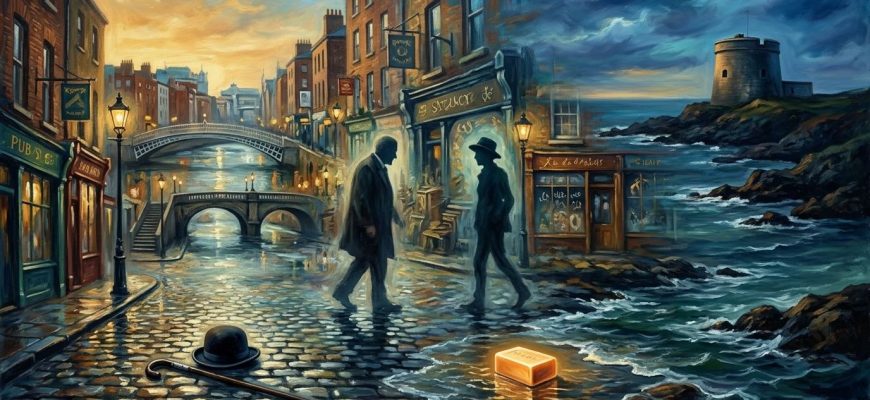
James Joyce’s Ulysses, published in 1922, is a modernist novel set in Dublin, Ireland, that follows Leopold Bloom and Stephen Dedalus through one ordinary day, exploring their thoughts, relationships, memories, and desires.
Ulysses Main Characters analysis
- Leopold Bloom — A small-time advertising agent whose experiences and thoughts form the central focus of much of the novel. Throughout the day, he deals with work, food, his wife’s suspected infidelity, and memories of his deceased son.
- Stephen Dedalus — A young intellectual and aspiring writer who struggles with grief over his mother’s death and a difficult relationship with his father. His search for a father figure connects his story with Bloom’s.
- Molly Bloom (Marion Bloom) — Leopold’s wife, a concert singer who is involved in an affair with Hugh Boylan. Her thoughts and memories dominate the novel’s final episode.
- Buck Mulligan — Stephen’s witty and irreverent acquaintance who shares rented accommodation with him in the Martello Tower.
- Haines — Another resident of the Martello Tower whose disturbing behavior at night makes Stephen uncomfortable.
- Hugh E. Boylan — Molly’s concert manager and lover, whose planned afternoon visit becomes a source of jealousy and anxiety for Bloom.
- Millicent (Milly) Bloom — Leopold and Molly’s fifteen-year-old daughter, who works as a photographer’s assistant in Mullingar.
- Simon Dedalus — Stephen’s father, who appears among the mourners at a funeral attended by Bloom.
- Martha Clifford — A woman who exchanges romantic letters with Bloom after responding to a newspaper advertisement he placed under the pretense of seeking a secretary.
- Gerty MacDowell — A young woman Bloom watches on the beach, where she appears to encourage his interest in her.
- Patrona — The woman giving birth at the maternity hospital, whose prolonged labor provides the setting for one of the novel’s episodes.
- Bella Cohen — The owner of the brothel Bloom visits during the night.
- Rudy Bloom — Leopold and Molly’s son, who died in infancy eleven years before the events of the novel. Bloom’s memories of him reflect his grief and longing for family connection.
- Martin Cunningham — An acquaintance whom Bloom seeks at a pub to discuss insurance matters connected with the funeral of Paddy Dignam.
- Joseph Hynes — A journalist and acquaintance who appears during Bloom’s day in Dublin.
Ulysses Summary
The three parts of this enormous book, divided into eighteen episodes, are intended by the author to correspond to Homer’s Odyssey (Ulysses is the Latin form of the name of its central hero). However, the connection with the ancient Greek epic is very loose and works more through contrast than direct correspondence. In this lengthy novel, remarkably little happens in terms of conventional plot.
The setting is Dublin, the capital of Ireland.
The first part consists of three episodes. At eight in the morning, Buck Mulligan, who shares rented accommodation with Stephen Dedalus in the Martello Tower, wakes his friend. Stephen is deeply displeased because their third housemate, Haines, fired a gun in his sleep while having a nightmare during the night. Stephen, who is timid and sensitive, finds the situation disturbing. His mother recently died of liver cancer, and their relationship had been difficult while she was alive. He also resents Mulligan for making disrespectful remarks about her.
Their conversation revolves around the theme of a son searching for his father, repeatedly touching on the examples of Hamlet, Jesus Christ, and Telemachus, the son of Ulysses. The same theme arises during a history lesson Stephen teaches two hours later at the school where he works part-time. It also appears in his conversation with the school principal, who asks the young man to pass along a lengthy, wordy article about foot-and-mouth disease to his contacts at a newspaper office. After the lesson, Stephen wanders in his thoughts along the seashore.
That same morning, the wanderings of Leopold Bloom, a minor advertising agent, begin. The central and longest part of the novel consists of twelve episodes and opens with Bloom’s breakfast. He eats a pork kidney, which he has just bought at Dlugacz’s butcher shop. There, he also picks up a prospectus for a model farm in Palestine and begins entertaining various schemes related to the idea.
At home, two letters await him. The first is from his daughter Milly, or Millicent, who turned fifteen just the day before and is already working as a photographer’s assistant in Mullingar. The second letter is addressed to his wife, Molly, a concert singer. It comes from her manager, Hugh E. Boylan, who informs her that he will visit at four o’clock that afternoon.
After breakfast, Bloom visits the toilet with a magazine in his hands. He must attend the funeral of a former schoolmate at eleven, so he leaves home an hour early to take care of various small errands. Among other things, he collects a letter from the post office from a woman named Martha Clifford, who has responded to a newspaper advertisement he placed ostensibly seeking a secretary but really hoping to find a romantic correspondent.
Martha has replied to his amorous letter and even writes that she dreams of meeting him. Bloom develops a variety of indecent fantasies in response. However, it is time to head to the cemetery.
Bloom travels in the funeral carriage with other mourners, including Stephen’s father, Simon Dedalus. Their conversation covers all sorts of subjects, including Bloom’s wife’s upcoming concert tour and Bloom’s own father, who once took his own life. After the funeral ceremony, Bloom heads to the newspaper offices where he arranges advertisements as an agent.
There, he encounters the same group of men who attended the funeral, along with Professor MacHugh, the consumptive lawyer O’Molloy, and the editor Miles Crawford. Bloom comes and goes. During his absence, Stephen Dedalus arrives at the office with the school principal’s article. After some conversation, Stephen invites everyone to a pub. The editor remains behind, and Bloom returns during this time, becoming the target of Crawford’s irritation.
Embarrassed, Bloom leaves the newspaper office and wanders through the city. He gradually becomes hungry and increasingly preoccupied with food. He exchanges a few words with an acquaintance, encounters a madman, and eventually heads to Davy Byrne’s pub. There, one of the regular customers tells the owner that Bloom is a Freemason.
Meanwhile, at two in the afternoon, Stephen Dedalus presents his theory of Shakespeare’s life and personality to Dublin’s intellectual elite in the library. Among other things, he argues that Shakespeare acted on stage and considered himself the ghost of Hamlet’s father.
Despite the originality of his ideas and his desire to be understood, Stephen remains an outsider among those present. His poems are not included in an anthology of young poets, and he is not invited to an evening gathering, unlike his acquaintance Buck Mulligan, who is also there.
Already feeling insulted, Stephen finds further reasons to resent those around him. Bloom also visits the library and narrowly misses meeting Stephen.
It is the middle of the day, and Dublin’s residents are occupied with their own affairs. Bloom’s acquaintances discuss his wife’s charms, while Leopold himself browses books with masochistic themes and chooses one to read. Hugh Boylan sends a messenger to a certain address with wine and fruit. Stephen encounters his sister, who has recently separated from their father.
Bloom knows from the letter that his wife, Molly, is due to meet Hugh Boylan at four o’clock. He suspects that they are having an affair, and his suspicions are in fact correct.
After encountering Boylan, Bloom secretly follows him to the Ormond restaurant on the quayside. He has lunch there with an acquaintance and listens to music before learning that Boylan has left in a carriage. Jealousy, the secret desire to imagine his wife betraying him with another man, and thoughts of this modern-day Penelope, who supposedly satisfies everyone’s desires, including her own, overwhelm Bloom as he listens to the stirring music.
Imagining what is happening at home in his absence, he writes a reply to Martha, declining to meet her immediately and enjoying the game of correspondence itself, which allows him to postpone gratification.
At five o’clock, Irish patriots gather at Barney Kiernan’s pub. They discuss current affairs, both their personal concerns and those of their poor country, which they consider oppressed by the English and the Jews.
Bloom arrives looking for Martin Cunningham to discuss insurance matters related to the funeral of Paddy Dignam, who was buried that morning. As they drink, the patriots debate various issues and turn their attention to Bloom, a Jew who does not share their extremism, particularly their hostility toward the English. The encounter ends with an antisemitic act of aggression: as Bloom gets into a carriage, someone throws an empty tin can at him.
By around eight in the evening, Bloom finds himself on a beach. There, he masturbates while watching one of three young women, Gerty MacDowell. Sensing his interest, she appears to display her underwear and other intimate charms almost accidentally. When she leaves with her friends, Bloom notices that she is lame.
He also discovers that his watch has stopped at half past four. He wonders whether this happened at the very moment Boylan was meeting his wife.
Bloom has no desire to return to his wife. At ten in the evening, he arrives at Dr. Horne’s maternity hospital, where one of the women giving birth, already a mother of several children, has been in labor for three days and is still unable to deliver her latest baby.
Upon entering, Bloom finds a group of drinking, joking young men, among whom is Stephen Dedalus. Leopold drinks and talks with them.
It is worth noting that Ulysses is far from easy to read or summarize because it is written in the stream-of-consciousness style. In this episode, Joyce also imitates a variety of literary styles, ranging from the earliest forms of writing to the most contemporary ones.
Among the young men is the talkative Buck Mulligan. Their increasingly suggestive conversation is interrupted when a nurse arrives to announce that the woman has finally given birth.
The lively group heads off to continue drinking and partying at a pub. Stephen and his friend Lynch separate from the others to go to Bella Cohen’s brothel. For some reason, Bloom, who feels sympathy for Stephen, decides to follow the young men.
At midnight, Bloom finds himself in the heart of Dublin’s nightlife and sexual underworld. Drunk, he experiences hallucinations involving his parents, women he knows, and people he has encountered throughout the day. He is forced to defend himself against accusations from these apparitions, which accuse him of various secret indecencies.
His subconscious desires for power and honors, his fears, and his obscene thoughts emerge in a series of vivid scenes and images.
Eventually, Bloom finds himself with the prostitute Zoe in the brothel, where he encounters Stephen and his friend. His drunken, druglike delirium continues, and reality becomes indistinguishable from his imagination.
Bloom imagines himself transformed into a woman and accused of various perversions, including taking pleasure in watching his wife commit adultery with Boylan.
Suddenly, at the height of an indecent encounter, Stephen sees the ghost of his poor mother rising from the grave. He smashes a chandelier with his walking stick and runs out of the brothel into the street, where he gets into a fight with soldiers.
Bloom follows him outside and somehow manages to settle the disturbance. He bends over the young man lying in the dust and recognizes him as his son Rudy, who died eleven years earlier in childhood.
The third part of the book consists of the final three episodes.
At one in the morning, Bloom and Stephen make their way to a late-night tea establishment called the Cabman’s Shelter, where they settle into a corner. Bloom does his best to keep the conversation going, although he occasionally runs out of things to say. He shows Stephen a photograph of his wife and invites him home to meet her.
After discussing numerous subjects that seem immensely important to two intoxicated men, they arrive at Bloom’s house at two in the morning. After struggling to open the door, they sit in the kitchen, drink cocoa, and continue talking about all sorts of topics.
They then go into the garden, visit the toilet together, and eventually part ways without incident.
Later, lying in bed beside his wife, Bloom reflects, among other things, on Molly’s infidelity and the many men he suspects of having been her lovers. He talks with her briefly and eventually falls asleep.
The novel ends with forty pages of Molly Bloom’s thoughts, presented without punctuation. She reflects on her suitor, her husband, and her personal preferences. Along the way, she discovers that her menstrual period has begun, but this does not prevent her from entertaining various seductive thoughts.
The enormous novel ends with the words: “so he felt my breasts their fragrance and his heart was beating wildly and I said yes I want to.”
Якщо ви не знайшли потрібну відповідь, можете запитати у нашого чат-бота у Телеграм.