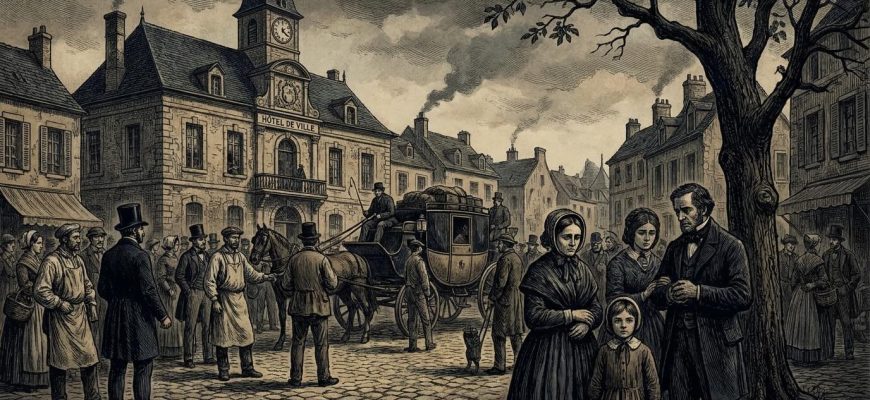
The Fortune of the Rougons is the first novel in Émile Zola’s twenty-volume Les Rougon-Macquart series. It tells the story of the origins of the Rougon and Macquart families and the rise of France’s Second Empire, which created enormous opportunities for bourgeois speculation and political opportunism. Through the history of one family, Zola examines the flaws and virtues passed down from generation to generation.
- The Fortune of the Rougons Main Characters analysis
- The Fortune of the Rougons Summary
- General Overview
- The Fortune of the Rougons Chapter I Summary
- The Fortune of the Rougons Chapter II Summary
- The Fortune of the Rougons Chapter III Summary
- The Fortune of the Rougons Chapter IV Summary
- The Fortune of the Rougons Chapter V Summary
- The Fortune of the Rougons Chapter VI Summary
- The Fortune of the Rougons Chapter VII Summary
The Fortune of the Rougons Main Characters analysis
Pierre Rougon — The legitimate son of Adélaïde Fouque, who inherits his father’s shrewdness and determination to acquire wealth. He uses political events to advance his position and secure his family’s fortune.
Félicité Rougon — Pierre’s ambitious wife. She is determined to improve her family’s social standing and plays a decisive role in the political intrigue that brings the Rougons success.
Adélaïde Fouque — The matriarch of the Rougon-Macquart family. Emotionally unstable and driven by sensual desires, she has children with both Rougon and Macquart.
Antoine Macquart — Adélaïde’s illegitimate son, who is lazy, drinks heavily, and resents his half-brother Pierre. He becomes involved in the Republican movement but ultimately betrays the rebels.
Ursula Macquart — Adélaïde’s illegitimate daughter, whose descendants form part of the Macquart branch of the family.
Eugène Rougon — Pierre and Félicité’s eldest son. An ambitious lawyer who becomes involved in Louis-Napoleon’s political plans and helps his family gain influence.
Aristide Rougon — Pierre and Félicité’s younger son, who is greedy and opportunistic. He initially supports the Republic but waits for the right moment to join the winning side.
Pascal Rougon — Pierre and Félicité’s middle son, a doctor and distinguished physiologist. Unlike the other Rougons, he has little interest in wealth and lives an austere life devoted to science and helping the poor.
Silvère — Antoine’s nephew and Adélaïde’s beloved grandson. A young idealist who believes in freedom, equality, and brotherhood, he joins the Republican rebels.
Miette — Silvère’s young beloved, who joins the rebels alongside him and shares his hopes for freedom.
Josephine (Fine) Gavaudan — Antoine’s wife, a hardworking but indecisive woman who supports her husband despite his laziness and mistreatment.
Justine — Miette’s cousin, who despises her and tries to make her life miserable.
Marquis de Carnavant — A royalist aristocrat who becomes involved with the Rougons and influences the political club that meets in their home.
The Fortune of the Rougons Summary
General Overview
In the first novel of this twenty-volume series, Zola tells the story of the origins of the Rougon and Macquart families, as well as the emergence of the Second Empire in France, which created enormous opportunities for bourgeois speculation and political adventures. Through the example of this family, the author traces the flaws and virtues passed down through generations.
The novel begins with an author’s preface in which Zola clearly states the purpose of his work as a naturalist writer:
“I want to show how one family behaves in society and, as it develops, gives rise to ten or twenty individuals. At first glance, they seem completely different from one another, but analysis reveals that they are very closely connected. Heredity, like the force of gravity, has its own laws.”
At the very beginning of the novel, we meet Silvère, the son of an artisan and one of the central characters, who is waiting for his beloved Miette. When the workers prepare to rise up against the monarchy, the young couple take their place at the head of the column. Zola describes the handsome young man and his delicate skin with evident sympathy.
The author then provides a detailed description of Plassans, a provincial town in France where the main events of the novel unfold. Zola divides its inhabitants into three groups: the aristocracy, the bourgeoisie, and the artisans. He examines each social class in the context of the 1851 coup d’état, which replaced the republican system with a monarchy. Each group responds to the political upheaval in its own particular way.
Alongside Silvère’s story runs the account of the family’s founder, Adélaïde Fouque. She came from a family of wealthy townspeople but was neither pragmatic nor interested in finding a husband within her own social circle. Her blood burned with a passion for sensual pleasure, and she was drawn to Macquart, a robber and smuggler who had no desire to bind himself through marriage. As a result, their children, Antoine and Ursula, suffered greatly because they were born out of wedlock.
After her lover’s death, Adélaïde lost interest in everything, including her children. A man named Rougon managed to bring her out of this state to some extent. Their marriage was legitimate, and they had a son, Pierre. Having inherited his father’s peasant cunning, Pierre worked determinedly to secure his mother’s inheritance. Adélaïde, meanwhile, spent the rest of her life in a small house on the outskirts of Plassans that she had inherited from Macquart.
Pierre Rougon’s marriage to Félicité produced a large family. During the first five years of their marriage, this delicate woman gave birth to three sons—Eugène, Aristide, and Pascal—and later had two daughters. Zola describes Pierre’s sons in considerable detail, emphasizing the traits they inherited from their father. He also devotes much attention to Pascal, although the latter seems to have been an exception to the family rule. He lacked the Rougons’ trademark characteristic: an insatiable desire for wealth. On the eve of the February Revolution of 1848, Pierre’s three sons were in Plassans.
Through the Rougon family, Zola portrays the middle class and examines how the country’s political situation affected its opportunities. By exploiting political events for their own benefit, the Rougons became wealthy. They took part in every stage of the political crisis and rose to prominence on the ruins of freedom. When the Republic fell, they played a direct role in dividing up what remained.
Zola carefully analyzes the political forces in Plassans and their role during the Revolution of 1848. The aristocracy and the bourgeoisie were united by their hatred of the Republic, while only the artisans and peasants genuinely defended it.
After many years of military service, Pierre’s older maternal half-brother, Antoine, returns home. Army life has thoroughly corrupted him, turning him into a drunkard and idler. Antoine wants to sue Pierre over the inheritance but receives no support from his relatives. He has three children: Lisa, Gervaise, and Jean.
Meanwhile, the political events of 1851 continue to unfold violently, reaching Plassans and radically changing the lives of its inhabitants and the destinies of the novel’s characters. Silvère and Miette join a group of rebellious workers. Antoine Macquart, whom the proletarians consider one of their own, enters into a conspiracy with Pierre Rougon. He lures the Republicans into a trap, including his own nephew Silvère, who is among their ranks. Pierre promises to pay him 800 francs for his betrayal. Miette is killed during the fighting, and Silvère is shot by the gendarmes.
For the Rougons, however, these same events open the way to success. Applause rings out in their yellow drawing room. Félicité makes no attempt to hide her delight. Pierre raises his glass to the Emperor!
The Fortune of the Rougons Chapter I Summary
December 1851. Plassans is a small town in southern France. In a secluded corner of Saint-Mittre’s Square, on the site of the former town cemetery, the lovers Silvère and Miette meet. The young man has joined the revolutionaries, who are preparing to march and join the rebel army, so he has come to say goodbye to his beloved.
Miette is thirteen years old and lives under her uncle’s care at the large Ja-Meiffren estate, near Saint-Mittre’s Square. Her father was a poacher serving a sentence of hard labor after shooting a gendarme in self-defense. In Plassans, people regarded him as a murderer and a thief. Miette’s uncle treated his niece like a servant and constantly reproached her for having such a father. When Silvère says goodbye to her, the girl feels completely defenseless.
Silvère was raised by his grandmother, while his uncle taught him to love the Republic. Silvère sincerely believes that the revolution will bring happiness and freedom to him and his beloved.
The lovers walk together until the rebels approach Plassans.
The Plassans detachment has been entrusted with carrying the flag. To join his comrades more quickly, Silvère brings Miette along with the group. Someone begins shouting that she should leave because they do not need the daughter of a thief and murderer. One of the hunters, who knew her father in the past, comes to the girl’s defense, and the others support him.
Miette is allowed to join them and is chosen to carry the flag. She is delighted that she will be able to stay beside Silvère.
The Fortune of the Rougons Chapter II Summary
The town of Plassans is divided by broad avenues into three districts: working-class, bourgeois, and aristocratic. The inhabitants of each district live separately. Even during their traditional Sunday walks, people from the different districts do not mix.
It is in this environment that the story of the Rougon-Macquart family begins. The first of the Rougons, a shrewd and calculating peasant, marries Adélaïde, the half-mad daughter of a wealthy market gardener. After giving birth to their son Pierre, she becomes even more unstable and takes an interest only in sensual pleasures.
In time, Rougon dies, and Adélaïde takes a lover: a poacher and smuggler known as Macquart the Vagabond. The man’s miserable hut stands in one of the remote corners of Saint-Mittre’s Square. Adélaïde eventually gives birth to his illegitimate children. Her son Antoine is lazy and drinks excessively, while her daughter is excessively sensual.
Pierre is different from his brother and sister. Like his peasant father, he is intelligent. He attends school with reasonable regularity and understands the importance of education.
Before long, the greedy Pierre gains complete control over his unstable mother and finds a way to avoid sharing the inheritance with his brother and sister. He sends Antoine into the army and arranges his sister’s marriage. Then he persuades his mother to sell the remaining land she inherited from her market-gardener grandfather to the owner of Ja-Meiffren. Soon afterward, Macquart is killed by customs officers, and Adélaïde moves into his hut.
Pierre marries Félicité, the daughter of a merchant who has nearly gone bankrupt selling butter. During their thirty years of marriage, Félicité gives birth to three sons and two daughters. The Rougons fail to become wealthy, but their mother directs all her ambition toward her sons. Spending a great deal of money, she sends them to study in Paris, hoping that her boys will achieve extraordinary success there and make her rich.
Félicité’s dreams do not come true. Her daughters marry and leave Plassans, while her sons return home after completing their studies. The eldest, Eugène, is a lawyer with an ambitious desire for power. The youngest, Aristide, is greedy and lazy. After getting married, he works as a minor official in the prefecture.
The middle son, Pascal, resembles the Rougons in appearance. He becomes a doctor and a distinguished scientist specializing in physiology. In Plassans, however, no one knows about his achievements. Everyone considers him eccentric because he lives an austere life, treats the poor, and studies corpses that he digs up in the cemetery.
In 1845, the Rougons sell their business because they no longer have enough money to maintain their own home. Pierre and Félicité move into a rented apartment furnished with old yellow furniture.
On the eve of the Revolution of 1848, Eugène leaves for Paris.
The Fortune of the Rougons Chapter III Summary
After the February Revolution of 1848, Marquis de Carnavant begins visiting the Rougons’ yellow drawing room. In Plassans, people believe that Félicité is his illegitimate daughter. The marquis wants France to return to a monarchy, with Henry V of the House of Orléans as king. He hopes to regain his fortune and promises to leave everything to Félicité if she supports him.
The Rougons become royalists, and a small political club is established in their yellow drawing room.
De Carnavant lives in a relative’s house, where he is forbidden to invite people who share his political views. For this reason, the marquis decides to make the Rougons’ home his meeting place. Pierre is officially the head of the club, but in reality, the marquis controls everything, backed by influential figures from the clergy.
In April 1849, Eugène returns from Paris and stays at his parents’ house for two weeks. During this time, he attends the club’s meetings. Before leaving, he decides to take advantage of this gathering of fools and devise a political scheme. He tells his father about his plans but intends to use his mother later. In return for his assistance, Pierre hopes to obtain a position as a private tax collector.
Félicité insists that Pascal also attend her drawing-room gatherings, hoping that he will find wealthy clients there. However, the scientist feels as though he is in a zoo when visiting his mother’s salon and observes its inhabitants with the curiosity of a physiologist.
Aristide’s goal is to sell himself to the highest bidder by switching sides at the last possible moment and joining the winner. For now, he is considered a Republican and even publishes a Republican newspaper. Aristide tries to learn something from his brother, but Eugène forbids their father from involving the unreliable Aristide in the conspiracy. He knows that his brother will always find a way to escape trouble.
Eugène regularly sends his father letters containing detailed instructions, which Pierre keeps locked away. One day, Félicité steals the key, reads the letters, and discovers that Eugène is a supporter and spy for the party of the current president, Louis-Napoleon, who intends to seize the imperial throne. If Louis-Napoleon becomes Emperor of France, the Rougons will gain everything they desire.
Félicité joins the scheme without telling her husband. Thanks to her influence, the club sides with Prince Louis-Napoleon. The marquis eventually realizes what she is doing and resigns himself to the fact that the time for the Orléans dynasty has not yet come.
In December 1851, workers and peasants in the department that includes Plassans rise up in support of the Republic. Before the uprising begins, Aristide pretends to have injured his hand and claims that he cannot write.
Pierre tells his wife nothing about their plans. Félicité feels insulted, and, seeking revenge, arranges things so that Pierre remains in Plassans when the rebels occupy the town. She wants him to be arrested, but he manages to hide in his mother’s hut.
The Fortune of the Rougons Chapter IV Summary
Antoine Macquart returns to Plassans after Napoleon’s defeat, hoping to claim part of the inheritance and live in comfort. When he discovers that Pierre has taken control of the inheritance, Antoine begins wandering around town in rags and publicly denouncing his brother. He lives with his mother, takes the last of the poor old woman’s money, and leaves her with barely enough to survive on bread and water.
Eventually, Félicité grows tired of the constant arguments and persuades her husband to give his brother some money for clothes and rent. When the money runs out, Antoine begins weaving willow baskets and selling them at the market. He does not buy the materials but secretly cuts the willow branches outside town at night. One day, a watchman catches him doing this, after which Antoine becomes a Republican.
For ten years, Antoine searches for a way to live well without doing any work. Eventually, he marries Joséphine (Fine) Gavaudan. This heavyset woman works hard at several jobs but lacks the determination to stand up for herself, and Antoine takes advantage of her. Sometimes they get drunk and beat each other viciously.
Over twenty years, Macquart has three children. Their eldest daughter is taken into service by a neighbor while still a child and is soon taken away to Paris permanently. The younger son and daughter grow up and begin working. Antoine lives at the expense of his wife and children, spending his days in cafés, gossiping about politics and cursing the Rougons, whom he continues to hate. To get revenge on his brother, Antoine decides to find an ally within Pierre’s family.
Meanwhile, Antoine’s sister dies of tuberculosis, and her husband hangs himself out of grief. Their older children have already found their places in life, but their youngest son, Silvère, is left with no one to care for him. Seventy-five-year-old Adélaïde takes him in. The boy loves his grandmother and looks after her during her nervous attacks.
At the age of twelve, Silvère becomes an apprentice to a carriage maker. He reads every book that comes his way.
Antoine tries to instill in his growing nephew a love of the Republic and hatred of the Rougons. He tells him about his grandmother’s past, presenting himself as a model son and Pierre as a scoundrel and thief. Silvère embraces the ideals of freedom, but the noble soul of the young man, filled with lofty dreams of liberty, equality, and brotherhood, never develops hatred. He loves his grandmother.
At the beginning of 1850, Fine dies of pneumonia. Macquart’s children go their separate ways, refusing to support their lazy father. After selling everything he owns, Antoine puts his rags back on and resumes weaving baskets.
Antoine greets the rebels with enthusiasm. He hopes to corner the Rougons and easily convinces his Republican friends that the enemies of the people must be arrested. He personally sets out to arrest Pierre, but when he arrives at his house, he discovers that his brother has already managed to hide at their mother’s place.
The rebels are not supposed to enter Plassans, but their short-sighted leader decides that the people need to be fed. They arrest the mayor and other officials and seize the gendarmerie. During a brief skirmish, Silvère shoots out a gendarme’s eye. There is a great deal of blood, and the young man believes that he has killed someone.
In shock, Silvère leaves Miette alone in the street and walks away. The girl is found by her cousin Justine, who begins insulting her. The young man hates his cousin because she refused to become his lover, and he has already informed her father about her secret meetings. When Silvère returns home, he stands up for his beloved, and Miette does not regret having left her uncle’s house.
The arrested mayor displays remarkable wisdom and feeds the rebels. That same night, they set out for the departmental capital, taking the captured officials with them. Pascal joins the rebels as their doctor. Antoine, who already feels like the master of the town, decides to defend Plassans and takes up residence in the town hall.
The Fortune of the Rougons Chapter V Summary
The rebels are not particularly intelligent. Naïve and gullible, they have no idea that the entire region has already surrendered and that they are marching toward their own destruction. By morning, Miette is tired and begins to fall behind. Silvère suggests that she rest before catching up with their companions by taking a shortcut.
Until this moment, Silvère and Miette’s love has been more like childhood affection, but now passion awakens in them. Silvère kisses Miette on the lips for the first time. The girl is frightened by the kiss and develops a sense of foreboding. They do not become intimate that night.
Miette’s father was sent to hard labor when she was nine years old. She was taken to live with her aunt, the wife of a tanner named Rébufat. This domineering and strict woman runs the entire household. She initially takes Miette in as a servant, but soon grows attached to the girl, protects her from her husband and son, and does not allow her to do heavy work.
Her cousin Justine hates Miette and does everything he can to make her life miserable. When the girl turns eleven, her aunt dies, and Rébufat forces Miette to do all the hard work. Justine begins tormenting her with stories about the penal colony and prisoners, telling her about the life her father is leading there.
Miette might have grown to hate them, but her encounter with Silvère saves her. They meet by a well near Adélaïde’s hut. One day, the well’s lifting mechanism breaks. Silvère climbs onto the wall to repair it and sees Miette. From that moment on, the young people meet every morning at the well to draw water and talk.
The workers at the carriage workshop tell Silvère about Miette’s father, and the young man decides to protect his new friend. They meet for two years, first near the well and later after Miette finds a way to slip out of the house in the evenings. Together, they take long walks through the meadows and swim in the river.
Nevertheless, they are still children. They talk and play, not yet knowing the language of love, and simply enjoy each other’s company and closeness. Even winter cold and rain cannot separate the lovers. They walk arm in arm, wrapped in Miette’s large cloak. Determined to restore his beloved’s honor, Silvère firmly decides to marry her.
After resting, the lovers reach the town of Ouchères at the same time as the rebels. The town welcomes the insurgents with joy, but the following morning they learn that the regular army is approaching.
The inexperienced rebel leader fails to organize the defense properly, and most of the insurgents are killed in the battle. The survivors face deportation to the penal colonies. Miette is shot in the heart and dies in Silvère’s arms. The devastated young man is arrested.
The Fortune of the Rougons Chapter VI Summary
After the rebels leave Plassans, Pierre Rougon emerges from his mother’s hut. He fears that the Empire will be proclaimed without him, so he gathers the members of his club, supplies them with weapons, and sets out to restore order in the town.
Despite the cowardice of his companions, Pierre quickly deals with Antoine. The Republican detachment is fast asleep and offers no resistance. The whole affair ends after a few accidental shots.
Macquart is locked in the mayor’s lavatory, while Pierre, hailed as the town’s liberator, is temporarily appointed mayor of Plassans. Rougon believes that he has achieved everything on his own, without his wife’s help. Félicité is deeply offended and decides to repay him at the first opportunity.
The people of Plassans are convinced that the regular army will soon enter the town. But this does not happen, and rumors begin to spread that the Republicans have won. Meanwhile, fires appear beyond the town walls, the alarm bell begins to ring, and the sounds of La Marseillaise can be heard. The inhabitants conclude that the Republicans have surrounded Plassans.
The following day, Pierre is no longer regarded as a hero. The people of Plassans recall his mother’s past and begin calling Rougon a swindler. No letter arrives from Eugène, and Pierre concludes that their scheme has failed.
In the latest issue of the royalist newspaper, Félicité reads an article praising the Empire. The man who publishes the paper used to visit the yellow drawing room and, after the coup, appointed himself head of the town post office. Félicité suspects that he has opened Eugène’s letter, which contains news of Louis-Napoleon’s victory.
She goes to the post office and collects the letter but does not show it to her husband. Exaggerating the seriousness of the situation, she portrays the Rougons’ position as hopeless and frightens Pierre almost to death. He submits completely to his wife and agrees to undertake another political intrigue.
Pierre pays Antoine to gather the remaining Republicans in Plassans and attack the town hall at night. Rougon organizes the defense, and that night a battle takes place. National Guardsmen lying in ambush kill three workers, while the rest flee. The bloodshed and the bodies help restore Rougon’s reputation, and he becomes a hero once again.
Aristide immediately switches sides and joins the royalists, confirming his change of allegiance in an article in his newspaper. Pierre reconciles with his son and swears that from now on he will do everything together with his wife.
The Fortune of the Rougons Chapter VII Summary
Two days later, the mayor returns to Plassans, and Rougon reluctantly gives up his position. Brutal punitive measures sweep across the entire prefecture. Troops march with captured Republicans and execute several people in every town.
Eugène secures his father not only the position of private tax collector but also the Legion of Honor. The Rougons decide to borrow money and celebrate the occasion with a lavish dinner. The only thing that spoils Pierre’s happiness is the thought of his Republican nephew, Silvère.
Pierre takes the promised money to Antoine, who is hiding in Adélaïde’s hut, and witnesses his mother’s attack of madness. Pascal, who has been released because of his medical profession, is now looking after his grandmother. He suspects that Adélaïde saw her beloved grandson being executed and is now destined to spend the rest of her days in an asylum.
Pascal is right. Silvère, whose soul died along with Miette, offers no resistance.
He thinks of Miette. The gendarme whose eye Silvère had shot out executes him in a secluded corner of Saint-Mittre’s Square, the very place where he used to meet his beloved. Two people witness the execution: Miette’s malicious cousin and Adélaïde.
Meanwhile, the Rougons celebrate the coup d’état that marks the beginning of their family’s rise to power.
Якщо ви не знайшли потрібну відповідь, можете запитати у нашого чат-бота у Телеграм.