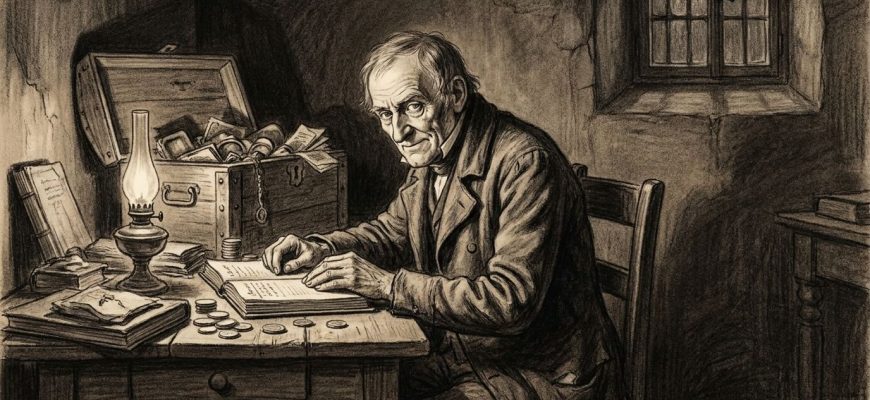
Gobseck (1830) is a novella by French writer Honoré de Balzac about an enigmatic Parisian moneylender whose wealth, strict principles, and cynical view of human nature become intertwined with the fortunes and secrets of an aristocratic family.
Gobseck – Main Characters analysis
- Gobseck — an old moneylender who has made wealth his only measure of power and human worth. Cold, calculating, and extremely miserly, he observes other people’s weaknesses with remarkable insight.
- Derville — a solicitor and narrator of Gobseck’s story. He knows the moneylender personally and becomes involved in the affairs of the de Resto family.
- Count Ernest de Resto — a young aristocrat who loves Camille de Grandlieu. Although poor at first, he eventually becomes the heir to his family’s fortune.
- Countess Anastasie de Resto — Ernest’s mother, whose extravagant lifestyle and destructive relationship with Maxim de Trailles put her family fortune at risk.
- Maxim de Trailles — the Countess de Resto’s handsome and manipulative lover, whose debts and selfishness contribute to the family’s downfall.
- Camille de Grandlieu — the seventeen-year-old daughter of the Vicomtesse de Grandlieu, who is in love with Ernest.
- The Vicomtesse de Grandlieu — a wealthy and highly respected aristocrat who initially opposes her daughter’s relationship with Ernest because of his mother’s reputation and family circumstances.
- Count de Resto — Ernest’s father, who tries to protect his children and their inheritance from his wife’s extravagance.
- Fanny Malvaut — Derville’s modest and virtuous wife, whose simple nature contributes to his happiness.
- Goriot — the father of Countess de Resto, whose humble background is one of the reasons the Grandlieu family looks down on Ernest.
- La Torpille — the woman who inherits Gobseck’s enormous fortune at the end of his life.
Gobseck Summary
The story of the moneylender Gobseck is told by Derville, a solicitor, in the salon of the Vicomtesse de Grandlieu, one of the most distinguished and wealthy women in the aristocratic Faubourg Saint-Germain. One winter evening in 1829–1830, two guests remain at her house late into the night: the young and handsome Count Ernest de Resto and Derville, who is admitted to the family circle only because he once helped the vicomtesse recover property that had been confiscated during the Revolution.
After Ernest leaves, the vicomtesse reprimands her seventeen-year-old daughter, Camille. She should not show such open affection for the charming young count, because no respectable family would want to marry into his family because of his mother. Although the Countess de Resto now behaves impeccably, her conduct in her youth was the subject of much gossip. She also came from a humble background: her father was Goriot, a tradesman who dealt in bread. Worst of all, she squandered her fortune on a lover and left her children with virtually nothing. Ernest de Resto is poor and therefore, in the vicomtesse’s eyes, an unsuitable match for her daughter Camille.
Derville, who sympathizes with the young lovers, intervenes in the conversation. He wants to explain the real situation to the vicomtesse, but he begins his story much earlier.
When Derville was a student, he lived in a cheap boarding house, where he met the moneylender Gobseck. Even then, Gobseck was already an old man with a striking appearance: a moon-shaped face, yellow eyes like those of a ferret, a long, sharp nose, and thin lips. His entire life seemed to follow the same slow, monotonous routine. Gobseck was seventy-six years old when Derville first met him.
Gobseck’s victims sometimes lost their tempers, burst into tears, or threatened him, but the moneylender himself always remained perfectly calm. He was, as Derville describes him, a “man of bills,” a kind of “golden idol.” Among his neighbors, he maintained only one real relationship—with Derville, to whom he eventually told the story of his life.
As a child, Gobseck went to sea as a cabin boy and spent twenty years wandering from one part of the world to another. He endured countless hardships, and those experiences left deep lines on his face. After many unsuccessful attempts to become wealthy, he decided to become a moneylender—and he made the right choice. Gobseck explained to Derville the secret of his power over people: gold rules the world, and the moneylender controls gold.
In Gobseck’s opinion, everyone who plays cards, dreams about women, discusses theatrical performances, or boasts to neighbors about a new carriage is essentially a fool who wastes life on meaningless passions. Gobseck considered it far more interesting to observe people and understand the motives behind their actions than to imitate them in their endless pursuit of pleasure and vice.
As an example, he tells Derville about collecting a debt of one thousand francs from a noblewoman. Afraid that her secret would be exposed, the countess readily handed Gobseck a diamond because the money represented by her bill had been obtained for her handsome young lover. A single glance at the woman was enough for Gobseck to realize that poverty threatened both her and her extravagant lover. He told Derville that his profession had taught him to see all the vices and passions of humanity.
Soon afterward, Derville completed his legal studies and obtained his license to practice law. He found a position as a senior clerk in a lawyer’s office. In the winter of 1818–1819, the owner of the office was forced to sell his legal practice, and Derville seized the opportunity. Gobseck lent him the necessary 150,000 francs at the “friendly” rate of thirteen percent, even though he normally charged no less than fifty percent. Gobseck also promised to bring Derville additional clients, but in return he demanded that the solicitor provide him with legal advice free of charge for the rest of his life.
Through relentless hard work and strict economy, Derville managed to repay the debt within five years. He also made a fortunate marriage to a simple, modest girl named Fanny Malvaut. From then on, he considered himself a completely happy man.
A year after purchasing the legal practice, Derville attended a dinner at a friend’s house, where he met Maxim de Trailles, the lover of Countess de Resto. The young man, who was in the final year of his studies, fascinated Derville and persuaded him to promise that he would introduce him to Gobseck.
The next day, Derville took his new acquaintance to the moneylender. Gobseck flatly refused to lend money to a man who owed three hundred thousand francs and had not a single cent to his name. At that moment, a carriage arrived at the house. Count de Trailles rushed outside and returned with an exceptionally beautiful woman. From Derville’s description, Gobseck immediately recognized her as the same countess who had given him a bill four years earlier.
The woman asked Gobseck for money in exchange for her diamonds, with the right to buy them back later.
Derville tried to stop the transaction. But when Maxim hinted that he intended to take his own life, the desperate woman agreed to the harsh terms of the loan. Gobseck immediately took advantage of her situation. Instead of lending her the requested 100,000 francs, he offered only 80,000 and insisted on keeping the diamonds as security.
Derville quietly told the countess that she would be better off throwing herself at her husband’s feet and asking for his help. When she hesitated, Maxim said goodbye to her and prepared to leave. Desperate to keep her lover, the countess finally accepted Gobseck’s conditions. The moneylender gave her a bank check for 50,000 francs and Maxim de Trailles’s bills for another 30,000.
After the lovers had left, the countess’s husband burst into Gobseck’s house and demanded the return of the diamonds. His wife had no legal right to dispose of the family’s jewels.
Derville managed to settle the matter peacefully. He explained to the count that the courts would probably side with Gobseck and that the count would hardly want the scandal to become public. Count de Resto eventually bought the diamonds back.
Gobseck then gave the count some advice. He suggested that the count transfer all his property to a trustworthy friend through a fictitious sale. This, Gobseck said, was the only way to save at least his children from poverty.
A few days later, the count came to Derville to ask for his opinion of Gobseck. Derville replied that if he were to die prematurely, he would not be afraid to appoint Gobseck as guardian of his own children. In that miser and philosopher, Derville believed, two completely different beings lived side by side: one base and selfish, the other strangely noble.
The count immediately decided to transfer all his property to Gobseck in order to protect it from his wife and her greedy lover. Gobseck would control the property until the count’s eldest son, Ernest, came of age. Derville was to witness the fictitious transaction and become the second heir to the property if Gobseck died first. Derville also insisted that the count set aside a share for his younger children.
Taking advantage of a pause in the conversation, the vicomtesse sends her daughter to bed. A virtuous young girl, she says, has no business knowing how far a woman can fall when she crosses certain moral boundaries.
Once Camille has left, there is no longer any reason to conceal the names. The woman in Derville’s story is Countess Anastasie de Resto.
Derville never receives the counter-document confirming the fictitious nature of the agreement. Soon afterward, he learns that Count de Resto is seriously ill. Sensing that something is wrong, the countess does everything she can to prevent Derville from seeing her husband.
The final crisis comes in December 1824. By this time, the countess has already discovered Maxim de Trailles’s true character and broken off her relationship with him.
She now takes such devoted care of her dying husband that many people are inclined to forgive her former sins. In reality, however, she is like a predatory animal waiting for its prey.
Unable to arrange a meeting with Derville, the count tries to give the necessary documents to his eldest son. But his wife blocks even this last avenue, attempting to influence the boy through affection and tenderness.
In the final terrible scene, the countess begs her dying husband for forgiveness, but he remains unmoved. That same night, he dies.
The next day, Gobseck and Derville arrive at the house. They witness a horrifying scene. Searching for the will, the countess has turned the study upside down. She has even moved her dead husband’s body in order to reach papers hidden beneath his pillow. When she hears strangers approaching, she throws the documents addressed to Derville into the fire.
Derville informs the countess that she has, by her own actions, deprived her younger children of their inheritance.
Gobseck takes advantage of Countess Anastasie de Resto’s mistake and takes possession of the entire de Resto estate.
The moneylender rents out the family’s mansion and begins spending his summers like a wealthy landowner on his newly acquired estates. Whenever Derville begs him to show mercy to the countess and her children, Gobseck simply replies that misfortune is the best teacher.
Let Ernest de Resto learn the true value of people and money, he says. Once he understands that, Gobseck will return the property to him.
When Derville learns that Ernest and Camille are in love, he makes one final visit to the now eighty-nine-year-old Gobseck. He finds the old moneylender on his deathbed.
Gobseck leaves his entire fortune to his sister’s great-granddaughter, a young woman known by the nickname “La Torpille.” He had never helped her during his lifetime, but now he wants to make sure that she is provided for.
He also leaves Derville, his executor, a strange final task: to dispose of the enormous stores of food accumulated in his house—spoiled pâté, moldy fish, rotten coffee, and other provisions that have long since become useless.
By the end of his life, Gobseck’s miserliness has become a true obsession. He refuses to sell anything because he is terrified of accepting too little money for it.
Finally, Derville explains that Ernest de Resto will soon recover the fortune he lost. He can now be considered a worthy husband for Camille. Moreover, Ernest intends to set aside enough money for his mother, his sister, and his younger brother so that they will never again have to live in poverty.
Якщо ви не знайшли потрібну відповідь, можете запитати у нашого чат-бота у Телеграм.