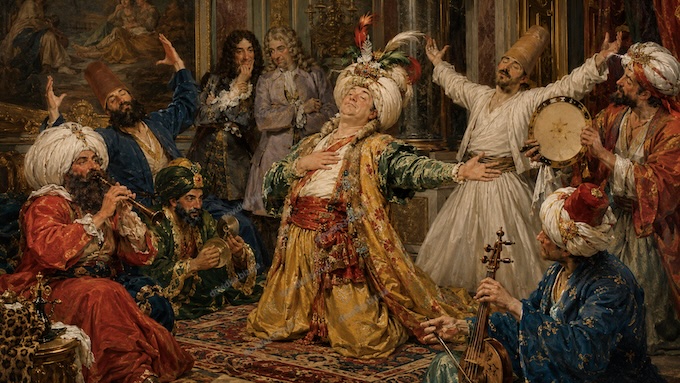
Molière’s The Bourgeois Gentleman, first performed in 1670, is a comedy about a wealthy Parisian merchant who desperately tries to imitate the aristocracy and become a nobleman.
The Bourgeois Gentleman Main Characters analysis
- Monsieur Jourdain — A wealthy merchant who desperately wants to become an aristocrat and imitate the manners, clothing, education, and lifestyle of the nobility.
- Madame Jourdain — Jourdain’s practical wife, who sees through his foolish ambitions and disapproves of his wasteful spending and aristocratic fantasies.
- Lucile — Jourdain’s daughter, who loves Cléonte and hopes to marry him.
- Cléonte — A young bourgeois man who loves Lucile. Jourdain rejects him because he is not of noble birth.
- Covielle — Cléonte’s clever servant and Nicole’s love interest. He devises the elaborate trick that allows Cléonte to marry Lucile.
- Nicole — The Jourdains’ outspoken servant who makes fun of her master’s attempts to become an aristocrat and loves Covielle.
- Dorante — A count who pretends to be Jourdain’s friend while exploiting his desire to impress the aristocracy and borrowing money from him.
- Dorimène — A noblewoman whom Jourdain secretly loves and tries to impress with expensive gifts and an elaborate dinner.
- The Music Teacher — One of Jourdain’s instructors, hired to give him the cultural education he believes is necessary for an aristocrat.
- The Dance Teacher — Another of Jourdain’s instructors, who attempts to teach him aristocratic dancing.
- The Fencing Teacher — A teacher who considers fencing the greatest of all disciplines and becomes involved in a quarrel with the other instructors.
- The Philosophy Teacher — A scholar who teaches Jourdain philosophy and writing before becoming caught up in the quarrel between the other teachers.
- The Tailor — A flattering tradesman who takes advantage of Jourdain’s obsession with aristocratic fashion.
The Bourgeois Gentleman Summary
The events of the comedy take place in the home of a wealthy merchant named Monsieur Jourdain in Paris. Although he is already an older man, Jourdain has decided that he wants to become an aristocrat. He tries to imitate the lifestyle of the nobility in every possible way. He orders a dressing gown for himself and liveries for his servants so that everything in his household will resemble a noble household. His actions and behavior are so absurd and ridiculous that he becomes a laughingstock to everyone around him.
Jourdain hires tailors and teachers of dancing, fencing, music, and philosophy, hoping that they will transform him into a gentleman. Each of them tries to deceive him while showering him with excessive compliments about his taste, talent, and education. Meanwhile, they enjoy a comfortable life at his expense.
The music and dance teachers are waiting for Monsieur Jourdain. He has summoned both of them because he wants to entertain an important lady whom he has invited to dinner. The teachers are pleased with both their payment and the way their employer treats them, although they believe he lacks good taste. The members of his household also suffer considerable inconvenience because of his determination to become an aristocrat.
The teachers compete to persuade Jourdain to study music and dancing, activities they consider appropriate for aristocrats. The musician insists that Jourdain hold weekly concerts at home, and Jourdain likes the idea. The dance teacher immediately wants to teach him the minuet.
However, the elegant movements are interrupted by the fencing teacher, who declares that his subject is the greatest of all sciences. The teachers become so involved in their argument that they even begin fighting one another.
When the philosophy teacher arrives, Jourdain is delighted. Surely a philosopher will know how to make the quarrelsome teachers behave. The scholar readily takes responsibility for reconciling them. He invokes Seneca, warns the opponents against anger, which degrades human dignity, and advises them to study philosophy, the foremost of the sciences. At this point, however, he goes too far. The others begin beating him as well.
Bruised but ultimately unharmed, the philosophy teacher finally manages to begin the lesson. Since Jourdain refuses to study logic because the terminology seems far too complicated, and rejects ethics because he sees no point in learning to control his passions when nothing can stop him once he becomes angry, the scholar decides to introduce him to the secrets of spelling.
While practicing the pronunciation of vowel sounds, Jourdain is delighted like a child. But when his first excitement fades, he reveals a great secret to the philosophy teacher: he, Jourdain, is in love with a certain high-society lady and needs to write her a note. For the philosopher, composing such a message in prose or verse is a simple matter.
Jourdain, however, asks him to avoid both prose and poetry. Little does the respectable bourgeois know that one of the most astonishing discoveries of his life is about to be made. When he shouts to his servant, “Nicole, bring me my slippers and nightcap,” he learns that his ordinary speech is, astonishingly, pure prose.
The tailor brings Monsieur Jourdain his new suit. It has, of course, been made according to the latest fashion. Jourdain does not like the flowers on the suit because they are positioned upside down, but the tailor assures him that all gentlemen wear them that way.
Jourdain notices that the tailor’s clothes are made from the same material as his previous order. Yet the tailor and the teachers flatter him shamelessly, addressing him as “Your Most Illustrious Lordship” and “Your Grace.” Jourdain is so pleased that he even becomes generous with his tips.
Jourdain’s wife, who looks at things realistically, is firmly against her husband walking through the streets of Paris in his new suit because he has already become a laughingstock in the city. The new outfit even makes the servant Nicole laugh.
Jourdain’s attempt to impress his wife and servant with the results of his lessons is unsuccessful. Nicole calmly pronounces the sound “u” without even realizing that she is stretching her lips and bringing her upper jaw closer to the lower one. She also easily gives Jourdain several fencing thrusts with a rapier. He cannot parry them because the uneducated servant does not follow the rules of fencing.
Madame Jourdain considers the money spent on the teachers completely pointless. Why does Jourdain need fencing if he has no intention of killing anyone? Why should he learn to dance when his legs are already close to giving out?
She also sees no benefit in his friendship with aristocrats because they treat him merely as a source of money. But Jourdain refuses to listen to her.
Moreover, he is secretly in love with the Marquise Dorimène, whom his acquaintance Count Dorante has introduced to him. The diamond, the ballet, the fireworks, and the dinner are all intended for her. Jourdain gives Dorante money to purchase gifts for the marquise, but the count deceives him and presents everything to her in his own name.
Jourdain’s supposed friend, Count Dorante, now arrives. Dorante is a fraud and a liar. As soon as he enters the drawing room, he casually mentions that he has spoken about Jourdain in the royal apartments.
The count has already borrowed 15,800 livres from the trusting bourgeois and has now come to borrow another 2,000. Dorante encourages Jourdain to be even more generous because his lady of the heart, Marquise Dorimène, will come to the dinner that evening and personally appreciate the host’s gallantry.
Jourdain has arranged Dorimène’s visit for a time when his wife is supposed to be visiting her sister. Nicole overhears part of the conversation and tells Madame Jourdain.
The woman has other concerns as well, especially the fate of her daughter. A young bourgeois named Cléonte has asked for Lucile’s hand, and the young woman loves him in return.
When Jourdain learns that Cléonte served in the army for six years and is not of noble birth, he refuses to approve the marriage. He dreams of seeing his daughter become a marquise or duchess.
Madame Jourdain argues that it is better to choose a wealthy and honest son-in-law than a penniless nobleman who might later reproach Lucile for not coming from an aristocratic family. But persuading Jourdain is practically impossible.
Cléonte is desperate, but his resourceful servant Covielle, who is also in love with the servant Nicole, decides to help his master. He devises a scheme that he believes will force Jourdain to approve the marriage.
Dorimène and Dorante come to Jourdain’s house. The count has been courting the noblewoman for a long time, and the foolish bourgeois’s extravagant spending works entirely in his favor because Dorante takes credit for it.
He therefore teaches his “friend” that in polite society it is improper even to hint to a lady about one’s gifts or feelings.
Marquise Dorimène happily takes her place at the luxurious table and tastes the exquisite dishes while listening to the extravagant compliments of the eccentric host.
Dorimène is delighted with the reception, but Monsieur Jourdain believes the banquet is not luxurious enough for such a distinguished lady. Dorante agrees and asks the singers to perform a drinking song, which greatly pleases the marquise.
Monsieur Jourdain begins showering the lady with compliments. She is delighted and had not expected him to be so gallant.
Suddenly, Madame Jourdain returns. She now understands where her husband’s money has been going. She reproaches Dorante for encouraging Jourdain’s foolish behavior.
The count claims that he is the one who has paid for everything. Offended by the situation, Dorimène leaves together with Dorante. The married couple continues arguing.
After the aristocrats leave, a new guest appears. It is Covielle in disguise. He introduces himself as an old friend of Jourdain’s father and announces that Jourdain’s father was not a merchant at all, but a genuine nobleman.
Of course, the bourgeois falls for the trick. He is thrilled to learn that he is supposedly a hereditary nobleman and rushes to announce the news to everyone.
After such a declaration, Jourdain is ready to believe almost anything. Covielle tells him that the son of the Turkish sultan has arrived in the capital. Having seen Lucile, the young man has fallen madly in love with her and wants to marry her.
Before the marriage, however, he wishes to initiate his future father-in-law into the Turkish nobility and make him a “mamamouchi,” a title invented specifically for the deception.
The supposed son of the Turkish sultan is Cléonte in disguise. He speaks in a meaningless language, which Covielle solemnly translates into French. The entire ceremony is accompanied by Turkish music, dancing, and singing. According to the ritual, the future mamamouchi is beaten with sticks.
Dorante and Dorimène return to the house and seriously congratulate Jourdain on his prestigious new title. Covielle asks Dorante to play along with the deception and help them fool Jourdain.
Dorante convinces Dorimène that they should participate in the masquerade arranged by Cléonte and Covielle because Cléonte is a good man. Dorimène agrees that he deserves happiness. She also decides to marry Dorante, if only to put an end to his extravagant spending.
Cléonte arrives disguised as a prince. The newly proclaimed “nobleman” Jourdain cannot wait to marry his daughter to the son of the Turkish sultan.
Lucile recognizes her disguised lover and obediently agrees to carry out her father’s wishes. After Covielle whispers the truth to Madame Jourdain, she changes her anger into approval.
The father’s blessing is secured. A messenger is sent for a notary, who will officially formalize the planned marriages of Lucile and Cléonte, Dorante and Dorimène, and Covielle and Nicole.
The guests enjoy a ballet performed by the dance teacher.
Якщо ви не знайшли потрібну відповідь, можете запитати у нашого чат-бота у Телеграм.