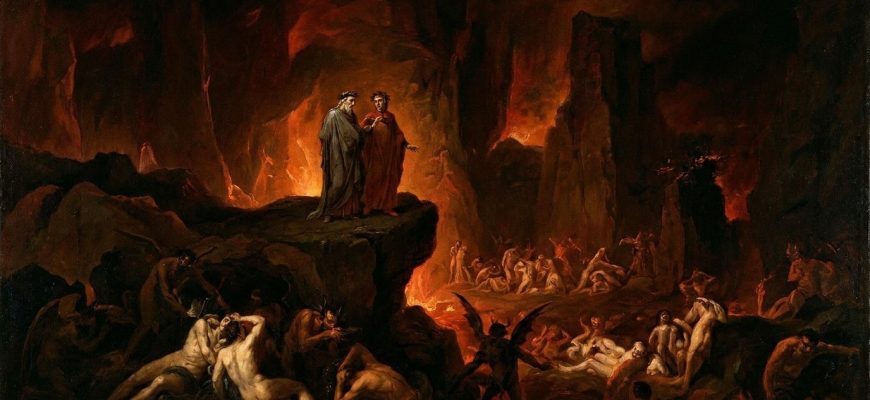
Dante Alighieri’s Divine Comedy is an epic poem written in the early fourteenth century. This summary follows Dante’s journey through the afterlife, from the horrors of Hell to the spiritual purification of Purgatory and the divine glory of Paradise.
Divine Comedy Main Characters analysis
Dante — The poem’s protagonist, who travels through the afterlife in search of spiritual understanding and redemption.
Virgil — The ancient Roman poet who guides Dante through Hell and Purgatory.
Beatrice — Dante’s beloved, who died young and asks Virgil to guide him. She later leads Dante through Paradise.
Lucifer — The ruler of Hell, imprisoned in ice at the center of the Earth.
Charon — The old ferryman who transports the souls of the dead across the Acheron.
Minos — The demon who determines where sinners must go in Hell.
Cato — The guardian of Purgatory.
Statius — The Roman poet who joins Dante and Virgil during their ascent through Purgatory.
Divine Comedy Summary
Divine Comedy Hell Summary
In middle age, Dante became lost in a dark, dense forest that filled him with fear. He tried to reach the mountains gilded by the first rays of sunlight, but failed.
In the forest, Dante saw the spirit of his beloved ancient Roman poet, Virgil, and asked him for help. Virgil proposed a journey through the afterlife, across Hell and Purgatory, to reach the longed-for Paradise.
Dante was afraid to set out, but when he learned that Beatrice—his beloved, who had died young—had asked Virgil to guide him through the afterlife, he agreed to pass through all the circles of Hell. Virgil explained that he would lead Dante through Hell and Purgatory to the abode of the blessed, where a more worthy soul would guide him.
At the gates of Hell, Dante shared his fears with Virgil, but the poet replied that “fear must not give counsel here.” Taking Dante by the hand, he led him inside. Immediately beyond the entrance, miserable souls groaned—those who had done neither good nor evil during their lives.
When they reached the River Acheron, Dante saw the old ferryman Charon transporting the souls of the dead to the opposite bank, where Hell lay.
Hell resembled an enormous funnel formed by concentric circles. Its narrow end reached the center of the Earth. After passing through the vestibule of Hell, inhabited by the souls of worthless and indecisive people, they entered the first circle, known as Limbo. Here dwelt the souls of virtuous pagans who had not known the true God but had come close to discovering Him and were therefore spared the torments of Hell. Dante saw outstanding representatives of ancient culture, including Aristotle, Euripides, Homer, Horace, Ovid, and others.
The second circle of Hell, ruled by the demon Minos, was filled with the souls of those who had violated marital fidelity and once surrendered to uncontrolled passion. Minos determined where each sinner should be sent in Hell. He was displeased by the presence of a living person in Hell, but Virgil calmed him. Among the sinners in the second circle, Dante encountered Cleopatra and Helen of Troy. He also saw Francesca da Rimini and her lover Paolo, who had fallen victim to their forbidden love for one another.
In the third circle, the beast-like dog Cerberus raged and barked at Dante, but Virgil subdued him. Here, the souls of gluttons lay in the mud beneath a downpour of rain and hail.
The demon Plutus guarded the fourth circle, where misers and spendthrifts endlessly rolled enormous stones. (Many members of the clergy—popes and cardinals—were also found in this circle.)
In the fifth circle, Dante saw the souls of those consumed by laziness and anger.
Soon, the travelers came upon the city of Dis, whose entrance was guarded by demons. After a brief conversation, the demons allowed the brave travelers to enter.
Here, Dante encountered Medusa the Gorgon. Warned by Virgil, he managed to close his eyes in time. It was “terrible to see the face of the Gorgon,” whose gaze could blind a person forever.
In the sixth circle of Hell, Dante saw tombs engulfed in flames, from which the groans of heretics could be heard.
Near the descent from the sixth circle to the seventh, Virgil explained to Dante how the last three circles of Hell were arranged. They lay in the lowest region of Hell, near the very center of the Earth, and each punished particular sins.
The seventh circle was enclosed by mountains and guarded by the half-bull demon Minotaur. Dante and Virgil saw a river of boiling blood in which tyrants and robbers were submerged, while centaurs on the banks shot arrows at them. The centaur Nessus became their guide, told them about the punished rapists, and helped them wade across the boiling river.
In the second ring of the seventh circle, Dante saw nothing but thorny plants. He accidentally broke a branch, and black blood began to flow from it as the trunk groaned. It turned out that the bushes were the souls of suicides. The infernal birds known as Harpies pecked at them, while passing spirits trampled them, causing unbearable pain. One of the trampled bushes asked Dante to gather its broken twigs and return them to it.
In the third ring of the seventh circle, blasphemers suffered as a “fiery storm” descended upon their defiant heads.
Then Dante and Virgil encountered the souls of other sinners, burned by fire. Among them, I could barely recognize my esteemed teacher, Brunetto Latini. He was among those guilty of same-sex love. We began talking. Brunetto predicted that Dante would achieve fame in the world of the living, but would also face hardships that he would have to endure. The teacher urged him to preserve his principal work, The Treasure.
Three more sinners, guilty of the same sin, were dancing in the flames. They were all Florentines and had once been respected citizens. Dante spoke with them about the misfortunes of their native city. They asked him to tell their living fellow citizens about their encounter.
Then Virgil led Dante to a deep chasm descending into the eighth circle. The infernal beast Geryon, a monstrous creature with a colorful tail, carried them down. While Geryon prepared for the descent, Dante looked at the last sufferers of the seventh circle: usurers, tormented in a whirlwind of burning dust. Multicolored purses bearing various coats of arms hung from their necks.
Dante and Virgil then climbed onto Geryon and flew into the chasm, toward new torments. As soon as they reached the bottom, Geryon immediately flew away.
The eighth circle was divided into ten trenches known as the Malebolge, or Evil Pockets. In the first trench, pimps and seducers of women were punished; in the second, flatterers. Horned demons brutally whipped the pimps, while the flatterers sat in a liquid mass of foul-smelling excrement whose stench was unbearable. One prostitute, incidentally, was punished not for her promiscuity but for flattering her lover by telling him how much she enjoyed being with him.
The next trench, the third Malebolgia, was paved with stone and dotted with round holes. The burning feet of high-ranking church officials who had traded ecclesiastical positions protruded from these holes. Their heads and bodies were trapped inside the stone wall. When their successors died, they would occupy the same places, kicking their burning feet while being completely buried in the stone above their predecessors. Pope Orsini explained this to me, initially mistaking me for his successor.
In the fourth trench, soothsayers, astrologers, and sorceresses suffered. Their necks were twisted so that, as they wept, their tears flowed down their backs rather than their chests. I myself wept at such cruelty toward human beings, but Virgil reproached me: it was sinful to pity sinners! Nevertheless, he compassionately told me about his compatriot, the prophetess Manto, after whom Mantua—the birthplace of my illustrious mentor—was named.
The fifth trench was filled with boiling pitch. Black, winged devils threw corrupt officials into it and made sure they did not emerge. If a sinner surfaced, the demons would seize him with hooks and torment him mercilessly. The devils had nicknames such as Evil-Tail, Crooked-Wing, and others. The travelers would have to cover part of their journey in this terrible company. The demons mocked and made faces, sticking out their tongues, while their leader produced a deafening and indecent sound with his backside.
Dante and Virgil walked alongside the ditch with the demons. They watched sinners dive into the pitch and hide beneath its surface. One sinner lingered too long and was immediately dragged out with hooks. The demons were about to torment him, but allowed the travelers to speak with him. The poor fellow cunningly lulled the demons into a false sense of security and plunged back into the pitch. They failed to catch him. Enraged, the demons began fighting among themselves, and two of them fell into the boiling pitch.
Virgil and Dante ran to the sixth trench, where hypocrites suffered beneath the weight of gilded leaden robes. Here lay a Jewish high priest, crucified—nailed to the ground with stakes—because he had insisted on Christ’s execution. The hypocrites trampled him underfoot.
The journey along the rocky path to the seventh trench was difficult. Thieves lived here, tormented by terrible poisonous snakes. Their bites reduced the sinners to dust, but they immediately came back to life. Among them was Vanni Fucci, who had stolen from a sacristy and blamed someone else for the crime. He was a crude and blasphemous man who cursed God, raising both middle fingers toward the sky. The snakes immediately attacked him.
The eighth trench was inhabited by treacherous advisers. Among them was Ulysses (Odysseus), whose soul was imprisoned in a flame capable of speaking! Ulysses recounted his death: yearning to discover the unknown, he sailed with a handful of brave companions to the far end of the world, suffered a shipwreck, and drowned together with his friends.
Another speaking flame concealed the soul of a cunning adviser who refused to reveal his name. He told Dante about his sin: he had helped the Roman pope commit an unjust act, hoping that the pope would absolve him of his own wrongdoing. Heaven is more forgiving toward a simple sinner than toward those who expect to escape punishment through repentance.
Dante and Virgil entered the ninth trench, where sowers of discord—those who instigated bloody conflicts and religious strife—were punished. The devil mutilated them with a heavy sword, cutting off their noses and ears and splitting their skulls. Here were Muhammad, Curio, who had urged Caesar to wage civil war, and the decapitated warrior and troubadour Bertrand de Born, who carried his own head in his hand like a lantern.
Dante then encountered a relative who was angry with him because his violent death had gone unavenged. Afterward, the travelers entered the tenth trench, where alchemists suffered from eternal itching. One of them had been burned for jokingly boasting that he could fly and had become the victim of a false accusation. Yet he had ended up in Hell not for that boast, but for being an alchemist. Those who impersonated other people, counterfeiters, and liars were also punished here. Two of them fought and then argued bitterly for a long time: Master Adam, who adulterated gold coins with copper, and the ancient Greek Sinon, who had deceived the Trojans.
The journey through the Malebolge came to an end. The travelers approached a well that led from the eighth circle of Hell into the ninth. Ancient giants, the Titans, stood there. Among them was Nimrod, who angrily shouted something in an incomprehensible language, and Antaeus, who, at Virgil’s request, lowered them into the bottom of the well on his enormous palm.
The heroes had reached the bottom of the universe, near the center of the Earth. Before them lay an icy lake in which those who had betrayed their relatives were frozen. Their suffering was unbearable…
At the center of the Earth, the ruler of Hell, Lucifer, was frozen in ice. Cast down from Heaven, he had hollowed out the abyss of Hell when he fell. He was hideously deformed and had three faces. Judas protruded from his first mouth, Brutus from the second, and Cassius from the third. Lucifer chewed them and tore at them with his claws. The worst torment was reserved for Judas, the most despicable of all traitors.
Passing through a narrow corridor connecting the center of the Earth with the opposite hemisphere, Dante and Virgil emerged onto the surface of the Earth.
Divine Comedy Purgatory Summary
The guardian of Purgatory, the old man Cato, greeted the travelers unkindly. A boat guided by an angel was approaching from the distant sea. It carried the souls of the dead who had been fortunate enough to avoid Hell. They landed, and the angel sailed away. The newly arrived spirits gathered around the travelers, and Dante recognized one of them as his friend, the singer Casella. He tried to embrace him, but a shadow has no body, so he embraced himself instead. Casella began singing about love, and everyone listened in rapt attention. Then Cato appeared, shouted at them all, and they hurried toward the mountain of Purgatory.
The newly arrived souls noticed that Dante was not a shadow and that light did not pass through him. They were astonished. Virgil explained everything to them, and they continued toward the foot of the mountain of Purgatory. But were they all in such a hurry? Did everyone really want to climb so urgently? Near a large stone stood a group of souls who were in no particular rush to ascend. Among these idlers, Dante recognized his friend Belacqua, who had been in no hurry even during his lifetime.
In the foothills of Purgatory, Dante spoke with the souls of those who had died violent deaths. Many of them had been considerable sinners, but they had sincerely repented before dying and therefore had not ended up in Hell.
Not far away, the travelers saw the majestic spirit of Sordello. Recognizing one another as fellow poets from Mantua, he and Virgil embraced. Sordello agreed to guide them through Purgatory. For him, helping the esteemed Virgil was a great honor. As they conversed solemnly, the travelers approached a fragrant valley in bloom, where the spirits of high-ranking figures—European rulers—had settled for the night.
Evening came. Exhausted, Dante lay down on the grass and fell asleep. In his dream, he was carried to the gates of Purgatory. An angel guarded them and marked his forehead seven times with the same letter, the first letter of the word “sin.” These letters represented the seven deadly sins and would be erased one by one as he climbed the mountain of Purgatory. Dante and Virgil entered the second realm of the afterlife, and the gates closed behind them.
The ascent began. In the first circle of Purgatory, the proud were atoning for their sin. To teach them humility, statues had been erected depicting great acts of selflessness. Dante then saw the souls who had suffered from pride during their lives. As punishment, they bent beneath the weight of enormous stone slabs.
“Our Father…” the bent souls sang this prayer. Among them was the miniature painter Oderisi, who had once boasted of his widespread fame. Now, he said, he understood that there was nothing to boast about: everyone was equal in the face of death, whether an old man or an infant. The sooner one understands this, finds the strength to restrain one’s pride, and learns humility, the better. An angel appeared and erased one of the seven letters from Dante’s forehead, signifying that he had overcome the sin of pride.
They climbed to the second circle. Here were the envious, temporarily blinded so that their former “envious” eyes could see nothing. One woman had wished evil upon her fellow citizens out of envy and rejoiced at their misfortunes… Dante realized that he would spend little time purifying himself in this circle after death, since he had rarely and only seldom envied anyone. There they were: the blinded sinners whose blood had once burned with envy. Virgil explained that the eternal light above was inaccessible to those consumed by envy and captivated by earthly temptations. They passed through the second circle. The angel appeared again, and now only five letters remained on Dante’s forehead, which he would have to shed in the circles ahead.
In the third circle, those consumed by anger underwent purification. Even the darkness of Hell had not been as black as the gloom of this circle, where the wrathful were humbled. One of them, Marco the Lombard, spoke with me and expressed the view that not everything happening in the world should be understood as the result of the influence of heavenly powers. Such a belief would deny the freedom of human will and absolve people of responsibility for their actions. Dante felt an angel’s wing touch his forehead, and another letter was erased.
The travelers climbed to the fourth circle, illuminated by the last rays of the setting sun. Here the slothful were purified. They had to run swiftly, allowing themselves no indulgence in the sin that had consumed them during their lives. When they completed the circle, another letter disappeared from Dante’s forehead.
They ascended to the fifth circle, where the misers and spendthrifts were punished. Avarice, greed, and an insatiable desire for gold were repulsive vices. Once, molten gold had been poured down the throat of a man consumed by greed: “Drink to your health!” I felt uncomfortable among the misers, and then an earthquake occurred. Why? I was too ignorant to know… It turned out that the mountain was shaking with joy because one of the souls had been purified and was ready to ascend. It was the Roman poet Statius, an admirer of Virgil, who rejoiced at being able to accompany us on our journey to the summit of Purgatory. Another letter, representing the sin of avarice, was erased from Dante’s forehead.
In the sixth circle, the gluttons were being purified. Those who had once indulged in overeating had to endure the torments of hunger: they were emaciated, reduced to skin and bones. Among them, Dante saw his deceased friend and fellow Florentine, Forese. They talked about their lives, criticized Florence, and Forese spoke disapprovingly of the city’s licentious women. Dante told his friend about Virgil and his hope of seeing his beloved Beatrice in the afterlife.
Dante also spoke with one of the gluttons, a former poet of the old school, about literature. He admitted that Dante’s fellow poets, the adherents of the “sweet new style,” had achieved far more in love poetry than he and the masters close to him. Meanwhile, the penultimate letter was erased from Dante’s forehead, and the path to the seventh and highest circle of Purgatory opened before him.
Dante remembered the emaciated, hungry gluttons and wondered how they had become so thin. After all, they were shadows, not bodies, and surely they should not have to suffer hunger. Virgil explained that although the souls were incorporeal, they nevertheless retained the full outlines of their bodies.
In the seventh circle, lovers were purified by fire. They burned, sang, and praised examples of restraint and chastity.
The lovers engulfed in flames were divided into two groups: those who had indulged in same-sex love and those who had failed to observe moderation in heterosexual relations. Among the latter were the poets Guido Guinizelli and the Provençal Arnaut, who greeted the travelers with elegant words in his dialect.
Now the travelers had to pass through a wall of fire. Dante was afraid, but his guide told him that this was the path to Beatrice, to the Earthly Paradise located at the summit of the mountain of Purgatory. The three of them—Dante, Virgil, and Statius—passed through the flames. Evening was approaching, and they stopped to rest. Dante slept, and when he awoke, Virgil addressed him with his final words of encouragement and approval…
Divine Comedy Paradise Summary
From the Earthly Paradise, Dante and Beatrice flew together into the Heavenly Paradise, ascending to mortal heights beyond human understanding.
“Can I really do this while still alive?” Dante wondered. Beatrice was not surprised: a person who had been spiritually purified and freed from sin had a spirit lighter than ether.
They arrived in the first heaven of Paradise, the Heaven of the Moon, which Beatrice called the first star. Within the Moon, they encountered the souls of nuns who had been abducted from their convents and forcibly married. Through no fault of their own, they had failed to keep the vows of chastity they had made upon taking their vows, and therefore could not ascend to the higher heavens.
“Still, I wonder: why are they guilty when they submit to violence? Why can’t they rise above the sphere of the Moon? The victim should be blamed neither for the crime nor for the violence committed against her—the perpetrator should be blamed!” But Beatrice explained that a victim also bears responsibility for the violence inflicted upon her if she fails to demonstrate heroic steadfastness while resisting it.
According to Beatrice, a broken vow can scarcely be compensated for by good deeds; an enormous number of good deeds would be required to atone for the offense.
Then they flew to the second heaven of Paradise, Mercury, where the souls of righteous people who had been ambitious during their lives resided. Unlike the shadows of the previous inhabitants of the afterlife, these souls were radiant lights, shining and glowing. One of them suddenly blazed especially brightly, rejoicing at the opportunity to speak with Dante. It turned out to be the Roman emperor and lawgiver Justinian. He understood that dwelling in the sphere of Mercury, rather than ascending higher, was his limit because ambitious people had performed good deeds for their own glory. By loving themselves above all else, they had neglected the light of true love for God.
Justinian’s light merged with a procession of other radiant lights—the souls of the righteous. Dante began to reflect, and his thoughts led him to a question: why had God the Father sacrificed His Son? Could He not simply have forgiven humanity for Adam’s sin through His supreme will? Beatrice explained that the highest justice required humanity to atone for its own guilt. Humanity was incapable of doing so, and therefore God had to impregnate an earthly woman so that her son, Christ, combining human and divine natures, could accomplish this redemption.
We flew to the third heaven, Venus, where the souls of those who had loved passionately during their lives rejoiced, shining in the fiery depths of the star. One of these radiant spirits was Charles Martel, the Hungarian king. Speaking with Dante, he expressed the view that people could fulfill their abilities only by acting according to the needs of their nature. It was wrong, for example, for a born warrior to become a priest…
The other loving souls glowed with sweet radiance. How much blissful light and heavenly laughter there was here! Below, in Hell, the shadows gathered gloomily and without joy…
The fourth star was the Sun, the dwelling place of the wise. There shone the spirit of the great theologian Thomas Aquinas. He warmly greeted Dante and showed me the other sages. Thomas told me about Francis of Assisi. Following Francis’s example, monks, including his closest disciples, began walking barefoot. Francis had lived a holy life and died—a naked man on bare earth—in the embrace of Poverty.
Not only Dante but also the radiant spirits of the wise listened to Thomas’s speech, ceasing their singing and dancing. Then the Franciscan Bonaventure spoke. In response to the praise that the Dominican Thomas had bestowed upon his own teacher, Bonaventure praised Thomas’s teacher, Dominic, the laborer and servant of Christ. Who had continued Dominic’s work? There were no worthy successors.
Thomas spoke again. He reflected on the great virtues of King Solomon. Solomon had asked God for intelligence and wisdom—not to resolve theological questions, but to govern his people wisely. In other words, he had requested royal wisdom, and that was what God granted him.
“People, do not judge one another hastily! One person is engaged in good deeds, another in evil ones, but what if the first should fall and the second rise?”
What would happen to the inhabitants of the Sun on Judgment Day, when their spirits regained their bodies? They were so radiant and spiritual that it was difficult to imagine them becoming material beings.
Dante and Beatrice flew to the fifth heaven, Mars, where the shining spirits of warriors who had fought for the faith were arranged in the shape of a cross, accompanied by a sweet hymn.
One of these radiant spirits was that of my valiant great-great-grandfather, the warrior Cacciaguida. Dante was proud of his ancestor and his lineage. It turned out that such pride could be experienced not only on the vanity-filled Earth but also in Paradise! Cacciaguida told Dante about himself and his ancestors, who had been born in Florence, whose coat of arms—a white lily—was now stained with blood.
Dante asked the prophet about his future. Cacciaguida replied that Dante would be exiled from Florence. During his miserable wanderings, he would learn the bitterness of eating another man’s bread and the difficulty of climbing another man’s stairs. In the end, however, Dante’s opponents would be disgraced, and he would triumph.
From red Mars, the travelers moved to white Jupiter, where the souls of just rulers dwelled. Their radiant lights formed letters, which first spelled out a call for justice and then transformed into the shape of an eagle. The eagle symbolized the just imperial authority, unknown to the sinful and suffering Earth but established in Heaven.
The majestic eagle began speaking with Dante. It referred to itself as “I,” yet Dante heard “we,” because just authority was collective!
The eagle understood something Dante could not: why was Paradise open only to Christians? What was wrong with a virtuous Hindu who knew nothing of Christ? I could not understand it either. And indeed, the eagle admitted, a foolish Christian was worse than a noble Persian or Ethiopian.
The eagle embodied the idea of justice. Its most important feature was neither its claws nor its beak, but its all-seeing eye, formed from the most worthy radiant spirits. The pupil was the soul of King David, the psalmist, while the eyelashes shone with the souls of righteous people who had lived before Christianity.
They ascended to the seventh heaven, Saturn, the dwelling place of theologians and monks, the contemplatives.
Beatrice became even more beautiful and radiant. She did not smile, for otherwise she would have completely scorched and blinded Dante. The blessed spirits of the contemplatives remained silent and did not sing, because otherwise they would have deafened him. This was explained by the holy luminary, the theologian Peter Damian. The spirit of Benedict, after whom one of the monastic orders was named, angrily condemned the self-serving monks of his own time.
After hearing him, the travelers ascended to the eighth heaven, to the constellation Gemini, under which I was born, first saw the Sun, and breathed the air of Tuscany. Dante looked down, and his gaze passed through the seven heavenly spheres he had visited before falling upon the ridiculously tiny Earth, that handful of dust with all its rivers and mountain peaks.
Thousands of lights blazed in the eighth heaven: the triumphant spirits of great righteous people. Fascinated by them, Dante’s vision grew stronger, and even Beatrice’s smile no longer blinded him. She smiled wonderfully and once again encouraged Dante to look toward the radiant spirits, who were singing a hymn to the Queen of Heaven, the Holy Virgin Mary.
Beatrice asked the apostles to speak with Dante. How deeply had he penetrated the mysteries of sacred truth?
The Apostle Peter questioned him about the nature of faith. Dante answered that faith was evidence in favor of the unseen. Mortals could not see with their own eyes what was revealed in Paradise, but they should believe in the miracle even without visible proof of its truth. Peter was satisfied with the answer he received.
The Apostle James asked Dante about the nature of hope. The poet replied that hope was the expectation of future glory, both deserved and granted by God. James rejoiced and glowed with delight.
Next came the question of love, posed by the Apostle John. In his answer, Dante also remembered to say that love turns us toward God and the word of truth. Everyone rejoiced. The examination—What are Faith, Hope, and Love?—was successfully completed.
Dante saw the soul of Adam, the forefather of humanity, who had lived briefly in the Earthly Paradise before being expelled to Earth. After his death, he had long languished in Limbo before finally moving here.
Four lights shone before Dante: the three apostles and Adam. Suddenly, Peter turned red and exclaimed:
“My earthly throne has been usurped! My throne, my throne!”
Peter despised his successor, the Roman pope. After this, the travelers ascended to the ninth heaven, the highest and crystalline sphere.
The first thing I saw in the ninth heaven was a dazzling point, the symbol of God. Around it revolved nine concentric circles of angelic lights. The closest to God, and therefore the smallest, were the seraphim and cherubim. The farthest away and largest were the archangels and ordinary angels. On Earth, people were accustomed to thinking that the greater was larger than the lesser, but here everything seemed to be the opposite.
Beatrice explained to Dante that the angels were as old as the universe itself. Their rapid rotation was the source of all motion throughout the cosmos. Those who had hastened to fall away from their celestial host had been cast into Hell, while those who remained continued to circle joyfully in Paradise. They had no need to think, desire, or remember: they were entirely content!
The final ascent was to the Empyrean, the highest region of the universe. Everywhere there were sparks and flowers: angels and blessed souls. They merged into a radiant river and then took the shape of an enormous heavenly rose.
As Dante contemplated the rose and began to understand the overall structure of Paradise, he wanted to ask Beatrice something. But instead of her, he saw a white-haired elder with clear eyes. Beatrice had meanwhile returned to the eternal sanctuary, to her place in Paradise.
The white-haired elder was Saint Bernard. From that moment onward, he became Dante’s guide. Together they contemplated the rose of the Empyrean. The souls of innocent infants shone within it.
This was understandable, but why were there also infant souls in Hell? Surely they could not be sinful, unlike the souls here? God alone knew what potential for good or evil was hidden within each child’s soul. Bernard explained this and began to pray.
Bernard prayed to the Virgin Mary on Dante’s behalf, asking her to help him. Then he signaled Dante to look upward. There he saw the supreme and brightest light. He was not blinded by it but discovered the highest truth. He contemplated God in His radiant Trinity…
Якщо ви не знайшли потрібну відповідь, можете запитати у нашого чат-бота у Телеграм.