Homer’s The Odyssey is an ancient Greek epic traditionally dated to around the eighth century BC. It tells the story of Odysseus, king of Ithaca, and his long, perilous journey home after the Trojan War. Along the way, he encounters terrifying monsters, powerful gods, and enchantresses, while his wife, Penelope, struggles to resist the suitors who seek to take his place. This The Odyssey summary follows the main events of Odysseus’s adventures and his eventual return to Ithaca.
- The Odyssey Main Characters analysis
- The Odyssey Summary
- The Journey of Odysseus
- The Cicones and the Lotus-Eaters — Summary
- Odysseus and the Cyclops Polyphemus — Summary
- Odysseus on the Island of Aeolus — Summary
- Odysseus and the Laestrygonians — Summary
- Odysseus and the Enchantress Circe — Summary
- Odysseus Descends into the Kingdom of Hades — Summary
- Odysseus and the Sirens — Summary
- Between Scylla and Charybdis — Summary
- Odysseus on the Island of Helios, Thrinacia — Summary
- Odysseus on Calypso’s Island — Summary
- Odysseus on the Island of the Phaeacians
- Odysseus and the Suitors
- Odysseus’s Return to Ithaca
- Odysseus and Penelope’s Suitors
- Odysseus’s Dispute with the People of Ithaca
- Odysseus’s Final Journey and Death
The Odyssey Main Characters analysis
Odysseus — The king of Ithaca and the central hero of the epic. Clever, resourceful, and determined, he struggles to return home after the Trojan War.
Penelope — Odysseus’s faithful wife, who resists the suitors attempting to marry her and claim the throne.
Telemachus — The son of Odysseus and Penelope, who seeks news of his missing father and eventually helps him defeat the suitors.
Athena — The goddess who supports Odysseus and Telemachus, guiding and protecting them.
Poseidon — The god of the sea, who persecutes Odysseus after the hero blinds his son, the Cyclops Polyphemus.
Polyphemus — A monstrous one-eyed Cyclops and son of Poseidon who traps Odysseus and his men in his cave.
Circe — A powerful enchantress who transforms Odysseus’s companions into pigs before eventually helping the hero.
Calypso — A nymph who keeps Odysseus on her island for seven years while he longs to return to Ithaca.
Eumaeus — Odysseus’s loyal old swineherd, who welcomes the disguised king.
The suitors — A group of 112 noble young men who court Penelope, consume Odysseus’s wealth, and plot against Telemachus.
Aeolus — The ruler of the winds, who gives Odysseus a bag containing the dangerous winds.
Tiresias — The famous Theban prophet whose spirit reveals Odysseus’s future.
Hermes — The messenger god who gives Odysseus a magical plant to protect him from Circe’s enchantments.
Laertes — Odysseus’s elderly father.
Argus — Odysseus’s faithful hunting dog, who recognizes his master when he returns home in disguise.
The Odyssey Summary
The Journey of Odysseus
The Cicones and the Lotus-Eaters — Summary
After the destruction of Troy, Odysseus sailed from the coast of Asia Minor toward his native Ithaca. At first, he landed near Troy, in the territory of the Cicones. He captured their city of Ismarus and killed all its inhabitants. However, the Cicones who lived farther inland launched a surprise attack on the Greeks celebrating their victory. They killed many of them, and only a few managed to escape.
After reaching the island of Cythera, off the coast of Laconia, Odysseus intended to sail around the Peloponnese. A powerful wind unexpectedly drove his ships south instead. Nine days later, the Greeks arrived near Libya, in a region inhabited by people who ate the fruit of the lotus and were known as the Lotus-Eaters.
The sweet lotus fruit had a terrible property: anyone who tasted it would forget their homeland forever. After landing, Odysseus sent three men to explore the area. The Lotus-Eaters welcomed them and offered them lotus fruit. Once they had eaten it, Odysseus’s companions forgot why they had been sent there. When the men failed to return, Odysseus set out with a small group to search for them. They found the missing sailors, forcibly brought them back to the ship, tied them up, and sailed away.
Odysseus and the Cyclops Polyphemus — Summary
Soon, Odysseus’s fleet reached an island where numerous goats grazed. The Greeks enjoyed a hearty meal of goat meat. The following day, Odysseus set out with one ship to explore the island.
They soon discovered that it was inhabited by savage giant Cyclopes, each of whom had a single eye in the middle of his forehead. The Cyclopes were shepherds. They had no cities, government, or laws and lived separately, each in his own cave among the rocks.
Seeing the entrance to one such cave, Odysseus and his companions went inside without realizing that it belonged to Polyphemus, a fierce man-eating Cyclops and the son of Poseidon, god of the sea. The Greeks lit a fire, roasted some young goats they found in the cave, and ate cheese stored in baskets hanging along the walls.
That evening, Polyphemus suddenly appeared. He drove his flock into the cave and blocked the entrance with a stone so enormous that the Greeks could not move it. Looking around, the Cyclops noticed the strangers. Odysseus explained that he and his men were returning home from the Trojan War and asked for hospitality. But Polyphemus growled, seized two of Odysseus’s companions by the legs, smashed their heads against the ground, and devoured them without leaving even their bones.
After his savage feast, the Cyclops fell asleep, snoring loudly. The Greeks could not escape because the enormous stone blocked the entrance. When Polyphemus rose the next morning, he smashed the heads of two more of Odysseus’s companions, ate them for breakfast, and went out to tend his flock, sealing the Greeks inside the cave with the same stone.
While the Cyclops was away, Odysseus took a trunk of wild olive wood, sharpened its end, hardened it in the fire, and hid it beneath a pile of dung. That evening, Polyphemus returned and ate two more of Odysseus’s men for supper. Pretending to be polite, Odysseus offered him a full cup of strong wine. The Cyclops had never tasted wine before and greatly enjoyed the intoxicating drink. After drinking another cup, Polyphemus asked Odysseus his name.
“My name is Nobody,” Odysseus replied.
“Then, Nobody, to show my gratitude, I will eat you last,” Polyphemus laughed.
The drunken Cyclops soon fell asleep. Odysseus and his companions heated the sharpened olive-wood stake until it was burning, drove it into the giant’s single eye, and began to twist it.
Polyphemus roared in pain. The other Cyclopes rushed to his cave, asking what had happened to him.
“Nobody, my friends! My own foolishness is destroying me. Nobody is hurting me by force!” Polyphemus cried.
“If nobody is hurting you,” the other Cyclopes replied, “why are you roaring like that? If you are ill, ask your father, Poseidon, for help.”
The Cyclopes left. In the morning, Polyphemus removed the stone from the cave entrance, stood beside it, and began letting his flock out. As the animals passed, he felt around with his hands, hoping to catch the Greeks if they tried to escape.
Odysseus tied the rams together in groups of three and fastened one of his men beneath each group. He himself positioned himself beneath the belly of the leading ram, gripping its wool with his hands.
As Polyphemus released the rams, he felt their backs to make sure no one was riding on top of them. It never occurred to him to reach underneath their bellies. Odysseus and his companions escaped from the cave beneath the animals and made their way to the ship.
As they sailed away, Odysseus shouted to Polyphemus that, now blind, he would no longer be able to devour helpless travelers. Enraged, the Cyclops hurled an enormous rock into the sea. It fell in front of the ship, creating a wave that nearly swept the vessel back toward the shore. Once they had pushed away from land, Odysseus shouted:
“Know this, Cyclops: the man who blinded you is Odysseus, the sacker of cities, king of Ithaca!”
Polyphemus begged his father, Poseidon, god of the sea, to make Odysseus suffer countless hardships on his journey home. The Cyclops hurled another rock after the Greeks, and the resulting wave drove Odysseus’s ship farther out to sea. Gathering the other ships around him, Odysseus left the island of the Cyclopes. But Poseidon had heard his son Polyphemus’s plea and swore to carry it out.
Odysseus on the Island of Aeolus — Summary
The heroes of The Odyssey soon arrived on the island of Aeolus, the god who ruled the winds. Aeolus entertained the sailors for an entire month. Before they departed, he gave Odysseus a leather bag tied with a silver cord. Inside it, Aeolus had confined all the violent winds under his control, except for the gentle west wind, Zephyrus, which was supposed to carry Odysseus’s ships toward his native Ithaca.
Aeolus warned Odysseus not to untie the silver cord until he had reached home.
The voyage was peaceful. Odysseus was already approaching Ithaca and could even make out the fires burning there. At that moment, however, exhaustion overcame him, and he fell asleep.
His companions believed that the bag contained valuable gifts Aeolus had given their leader. Secretly, they untied the silver cord. The winds burst free and rushed back toward Aeolus’s home, driving Odysseus’s ship ahead of them. Before long, the heroes of The Odyssey found themselves back on Aeolus’s island. They begged him for help, but the angry god drove them away.
Odysseus and the Laestrygonians — Summary
After leaving Aeolus, Odysseus sailed into the land of the terrifying giant Laestrygonians. Like the Cyclopes, they were man-eaters.
Unaware of where they had arrived, the Greeks entered a bay with a narrow entrance, surrounded by sharp cliffs. They moored their ships near a road that ran down to the water. Out of caution, Odysseus kept his own ship outside the bay. He sent three men to find out what kind of island they had reached.
Homer relates that the men encountered a gigantic young woman who led them to the house of her father, Antiphates, the leader of the Laestrygonians.
Inside the house, a crowd of giants attacked Odysseus’s three companions. They devoured one of the men, while the other two escaped. The man-eaters pursued them and began hurling rocks from the cliffs at the ships in Odysseus’s fleet.
All the vessels moored close to shore were destroyed. The Laestrygonians came down to the beach, impaled the dead sailors like fish on spits, and carried them away to eat. Odysseus barely escaped with his own ship, which had been anchored outside the bay. Desperate to avoid death, he and his companions rowed with all their strength.
Odysseus and the Enchantress Circe — Summary
Heading east across the sea, Odysseus and his companions soon reached the island of Aeaea, where the sorceress Circe lived. She was the daughter of Helios, the sun god.
Through her father, she was the sister of Aeetes, the treacherous king of Colchis from whom the Argonauts had sought the Golden Fleece. Like her brother and her niece Medea, Circe was skilled in magic and disliked human beings.
Odysseus’s companion Eurylochus and twenty-two other men went to explore the island. In the center, on a broad clearing, they discovered Circe’s palace. Wolves and lions roamed around it. Yet the predators did not attack Eurylochus’s men. Instead, they approached them affectionately, wagging their tails. The Greeks did not know that the animals had once been human beings whom Circe had enchanted.
Circe herself came out to greet the Greeks. Smiling warmly, she invited them to a feast. Everyone accepted except the cautious Eurylochus, who stayed outside the house and peered through the windows to see what was happening inside.
The goddess served the travelers delicious food mixed with a magical potion. According to Homer’s poem, once the Greeks had tasted it, Circe touched them with her wand, transformed them into pigs, and drove them into a pigsty with a malicious grin.
In tears, Eurylochus returned to Odysseus and told him what had happened. Odysseus rushed to rescue his companions. Along the way, the god Hermes appeared and gave him a remedy that could protect him from Circe’s magic. It was a fragrant white flower called moly, with a black root.
When Odysseus reached Circe’s house, she invited him to the table as well. Following Hermes’s advice, however, he kept smelling the magical flower as he ate her food.
Circe touched Odysseus with her wand and commanded, “Go and wallow in the filth like a pig!”
But her spell had no effect. Odysseus sprang up and raised his sword over her. The enchantress begged for mercy, promising to treat him well and share her bed with him.
After making Circe swear that she would do him no harm, Homer’s hero lay with her. He refused to respond to her loving advances until she had lifted her spells not only from his companions but also from all the other sailors she had previously enchanted.
Odysseus lived on Circe’s island for a long time. She bore him three sons: Agrius, Latinus, and Telegonus.
Odysseus Descends into the Kingdom of Hades — Summary
Longing for Ithaca and his wife Penelope, Odysseus eventually decided to leave Circe. She advised him first to visit the underworld, the realm of the dead ruled by Hades, and ask the shade of the famous Theban prophet Tiresias about his future and his prospects of returning home.
Homer’s poem describes how Odysseus and his companions, carried along by a favorable wind sent by Circe, sailed north toward the edge of the world. There, in thick mist and darkness, lived the Cimmerians.
At the place where the underworld rivers Cocytus and Phlegethon flowed into the Acheron, Odysseus followed Circe’s instructions and sacrificed a cow and a black ram to Hades and his wife, Persephone. The souls of the dead immediately gathered to drink the sacrificial blood. Circe had warned Odysseus to keep all the shades away with his sword until the spirit of Tiresias arrived to drink.
The first to appear at the place of sacrifice was the shade of Elpenor, one of Odysseus’s companions. A few days earlier, Elpenor had fallen drunkenly from the roof of Circe’s palace and died.
Odysseus was surprised that Elpenor had reached the kingdom of Hades before the companions who were sailing there on a swift ship. Strictly following Circe’s instructions, Odysseus overcame his pity and drove Elpenor’s shade away from the blood of the slaughtered cow and ram. He even kept away the shade of his own mother, Anticleia, who had arrived where her son stood.
At last, Tiresias appeared. After drinking his fill of blood, he told Odysseus that Poseidon would persecute him mercilessly for blinding his son, the Cyclops Polyphemus.
Tiresias urged Odysseus to do everything possible to prevent his companions from stealing the cattle of the sun god Helios on the island of Thrinacia, identified with Sicily. He warned that great troubles awaited Odysseus on Ithaca, although the hero would succeed in taking revenge on those who had plundered his property.
Yet Odysseus’s travels would not end even after his return home. He would have to take a ship’s oar and journey inland until he met people who had never seen the sea. His wanderings would end in the place where someone mistook his oar for a shovel. There, he would have to offer a sacrifice to Poseidon before returning to Ithaca. After living there to a ripe old age, Odysseus would meet his death from the sea.
After hearing Tiresias’s prophecy, Odysseus finally allowed his mother to drink the blood. The shades of the wives and daughters of famous heroes then gathered around her. According to Homer, Odysseus saw among them the renowned Antiope; Leda, the mother of Helen of Troy; Theseus’s wives Phaedra and Ariadne; and Eriphyle, whose actions had brought about the campaigns of the Seven Against Thebes and the Epigoni.
Odysseus also spoke with the souls of his fallen comrades from the Trojan War, including Agamemnon and Achilles. Ajax, son of Telamon, who bore Odysseus a grudge, refused to speak with him and departed in gloomy silence.
Odysseus witnessed Minos, the judge of the underworld, passing judgment on the dead. He saw Orion hunting, Tantalus and Sisyphus suffering their torments, and the mortal shade of the great Heracles.
Odysseus and the Sirens — Summary
Before continuing his journey to Ithaca, Odysseus returned to Circe’s island. The enchantress warned him that he would have to sail past the island of the Sirens, bloodthirsty female creatures with the bodies and legs of birds. Some legends, however, describe them as having fishlike bodies and tails.
With their beautiful, enchanting songs, the Sirens lured sailors to their magical island and brought them to a terrible death, tearing them apart. According to legend, the goddess of love, Aphrodite, had transformed the proud maidens into birds because they refused to surrender their virginity to anyone. Piles of human bones could be seen on the meadow of their island.
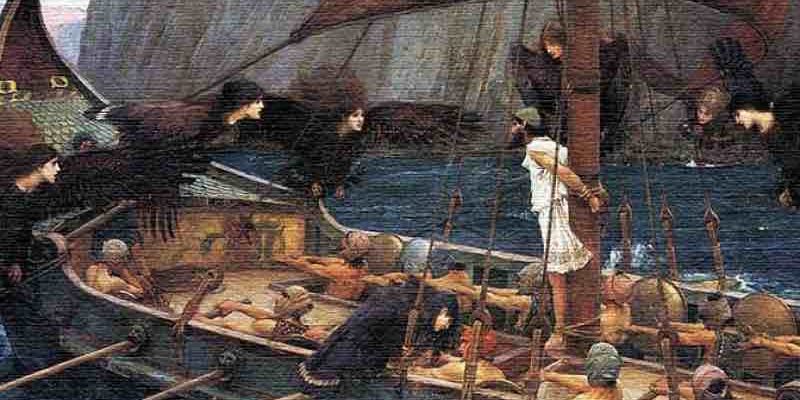
Circe advised Odysseus to fill his men’s ears with wax so they would not hear the Sirens’ songs. If he wished to enjoy their enchanting music himself, he should order his companions to tie him tightly to the mast and refuse to release him, no matter how desperately he begged.
Odysseus’s ship soon approached the island of the Sirens. He followed Circe’s instructions: his crew sealed their ears with wax, and he ordered them to bind him to the mast.
The Sirens sang sweetly, tempting Odysseus to steer his ship toward their island. Homer describes how the hero struggled against his ropes and begged his companions to untie him. But remembering his earlier orders, they bound him even more tightly.
The ship passed the Sirens safely. Enraged by their failure to lure the sailors to their deaths, the Sirens took their own lives.
Between Scylla and Charybdis — Summary
Odysseus now had to pass between two cliffs standing close together in the middle of the sea. Each was home to a hideous monster, Scylla and Charybdis.
Charybdis, whose name means “whirlpool,” was the enormous daughter of Poseidon. Three times a day, she swallowed vast quantities of water and then spewed them out again with a terrifying roar.
On the opposite cliff lived Scylla, the daughter of the monstrous Echidna and Typhon. She was a hideous creature with six terrifying dog heads and twelve legs. Screeching wildly and terrifying the surrounding area, Scylla leaned out from her cliff, snatched sailors passing below, crushed their bones, and devoured them.
To escape Charybdis, Odysseus steered his ship a little closer to Scylla. The monster seized six of his companions in her six jaws. The unfortunate men dangled in the air, stretching out their hands toward Odysseus and crying out, but there was nothing he could do to save them.
Odysseus on the Island of Helios, Thrinacia — Summary
Soon, the sailors sighted Thrinacia, identified with Sicily, the island of the sun god Helios. There, he kept seven herds of magnificent cattle and numerous flocks of sheep.
Remembering the prophecy of Tiresias, Odysseus made his companions swear not to steal a single bull or ram. But, according to Homer, the Greeks remained on Thrinacia for a long time. Unfavorable winds blew for thirty days, their food supplies ran out, and hunting and fishing yielded almost nothing.
One day, while Odysseus was asleep, his companion Eurylochus, tormented by hunger, persuaded the others to slaughter several fine bulls. He argued that, in gratitude, they would build a temple to Helios on Ithaca. The sailors caught several bulls, killed them, and ate their fill.
When Odysseus awoke and learned what had happened, he was horrified. Helios complained to Zeus about the travelers’ defiance. As Odysseus’s ship left Thrinacia and entered the open sea, Zeus sent a powerful wind and struck the deck with a thunderbolt.
The ship sank, and everyone aboard except Odysseus drowned, just as Tiresias had foretold in the kingdom of Hades.
Odysseus tied the mast and keel together with a strap and clung to them. Soon, he realized that the waves were carrying him toward Charybdis’s cliff. Grabbing the roots of a fig tree growing on the precipice, he hung there until Charybdis swallowed the mast and keel along with the water and later spat them back out.
Odysseus seized the mast again, began paddling with his hands, and escaped the whirlpool.
Odysseus on Calypso’s Island — Summary
Nine days later, Odysseus reached the island of Ogygia, home of the nymph Calypso. The island was covered with meadows of flowers and grain. Calypso lived in an enormous cave overgrown with poplars, cypresses, and wild grapevines.
The beautiful nymph welcomed Odysseus, fed him, and took him to her bed. Soon, she gave birth to twin sons by the sailor, Nausithous and Nausinoüs.
Odysseus lived with Calypso on Ogygia for seven years. Yet he never stopped longing for his native Ithaca and often sat on the shore, gazing out across the sea.
At last, Zeus ordered Calypso to release Odysseus. When he learned of the decision, Odysseus built a raft, said farewell to the hospitable nymph, and set sail for home.
But his light vessel was spotted by his enemy Poseidon, who was traveling across the sea in a winged chariot. Poseidon sent an enormous wave crashing against the raft, sweeping Odysseus overboard. The hero barely managed to reach the surface and climb back onto the raft.
Then the merciful goddess Leucothea, also known as Ino, descended from the sky in the form of a diving bird. In her beak, she carried a miraculous veil that could save anyone wrapped in it from drowning in the depths of the sea.
Poseidon struck Odysseus’s raft with a second wave of terrifying height. Believing that the hero could no longer escape death, Poseidon returned to his underwater palace. Yet Leucothea’s veil prevented Odysseus from drowning.
Odysseus on the Island of the Phaeacians
After two days of struggling against the sea until he was completely exhausted, Odysseus reached the island of Drepane, inhabited by the Phaeacians. There, on the shore, he fell into a deep sleep.
The following morning, Nausicaa, the daughter of the Phaeacian king and queen, Alcinous and Arete, came to a stream with her attendants to wash clothes. After finishing their work, the girls began playing ball. They shouted loudly when the ball fell into the water, and their cries awakened Odysseus.
Covering his nakedness with branches, he approached the girls and used a skillful speech to win Nausicaa’s sympathy. The princess led him to the palace to meet her parents.
King Alcinous listened to the story of Odysseus’s travels, gave him gifts, and ordered that the hero be transported by sea to Ithaca.
When they were already near his native island, Odysseus fell asleep again. The Phaeacians accompanying him did not wake the sailor. Instead, they carried him ashore while he slept and placed Alcinous’s gifts beside him.
As the Phaeacians sailed back to their harbor, Poseidon became furious that they had helped Odysseus. He struck their ship with his palm, turning it and its crew to stone. He also threatened Alcinous, warning that he would destroy every harbor on the Phaeacians’ island by burying them beneath the fragments of a great mountain.
Odysseus and the Suitors
Odysseus’s Return to Ithaca
When Odysseus awoke on Ithaca, he walked inland, away from the shore, and encountered the goddess Athena, who had taken the form of a shepherd.
Unaware that he was speaking to Athena, Odysseus invented a story about himself. He claimed to be a Cretan who had fled his homeland after committing murder and had arrived on Ithaca by chance.
Athena laughed and revealed her true identity. She helped Odysseus hide King Alcinous’s gifts in a cave and disguised him so that no one would recognize him. His skin became wrinkled, his head grew bald, and his clothes turned into miserable rags.
In this disguise, Athena led him to the hut of Eumaeus, the loyal old swineherd who served the kings of Ithaca.
Shortly before this, Telemachus, the son of Odysseus and Penelope, had traveled to Sparta to visit Menelaus, the Spartan king and one of Odysseus’s comrades in the Trojan War. Menelaus had also endured many adventures and misfortunes on his return from Troy, even traveling to Egypt. Telemachus asked him whether he had heard any news of Odysseus.
On Ithaca, everyone believed that Odysseus had died. One hundred and twelve noble young men from the island and neighboring islands had begun brazenly courting his wife, Penelope. Each hoped that marrying her would allow him to claim the local throne. The suitors hated Telemachus and planned to kill him when he returned from Sparta.
According to Homer, the suitors repeatedly asked Penelope to choose one of them as her husband. At first, she firmly refused, insisting that Odysseus was undoubtedly still alive. But the young men persisted so relentlessly that she eventually appeared to agree to choose a new husband.
She declared, however, that she would make her choice only after weaving a shroud for Laertes, Odysseus’s elderly father, in case he died. For three years, Penelope worked at the shroud. Remaining faithful to her husband while deceiving the suitors, she wove during the day and secretly unraveled her work each evening.
Throughout those three years, the suitors feasted in Odysseus’s palace. They drank his wine, slaughtered and ate his livestock, and plundered his property.
Eumaeus welcomed Odysseus warmly, but the king did not reveal his real name. Instead, he introduced himself as a foreign traveler.
At that time, Telemachus returned to Ithaca from Sparta. Athena had inspired him to hurry home and then led him to Eumaeus’s hut, where his father was staying.
During their meeting, Athena temporarily restored Odysseus’s former appearance, and father and son recognized each other. Odysseus decided to take the suitors by surprise, so he forbade Telemachus from telling anyone who he really was. Telemachus was not even to reveal the secret to his mother, Penelope.
Odysseus and Penelope’s Suitors
Once again disguised as a wandering beggar, Odysseus went to his own house, where the suitors were feasting. No one recognized him along the way, and the rude goatherd Melanthius even insulted the rightful king of Ithaca.
In the palace courtyard, Odysseus saw his faithful hunting dog, Argus. Once strong and swift, the dog was now dying of old age on a heap of dung. Recognizing his master, Argus wagged his tail and moved his muzzle—and then died.
Eumaeus led Odysseus into the hall where the suitors were feasting. Telemachus was there too, but pretended not to know the newcomer and kindly invited him to the table.
Still disguised as a beggar, Odysseus moved along the table, asking the suitors for scraps of food. These greedy, insolent young men rudely drove him away. The most shameless of them, Antinous, threw a stool at Odysseus—the very stool on which he had previously rested his feet.
A local beggar named Ir, afraid that the stranger would compete with him for the leftovers, also tried to drive Odysseus out of the hall. Hoping to appear brave, Ir challenged him to a fistfight.
When Antinous heard this, he burst out laughing and promised to reward the winner with goat stomachs. Odysseus pulled off the upper part of his rags and faced Ir. When the beggar saw Odysseus’s powerful muscles, he was terrified. Odysseus knocked him to the ground with a single punch.
The suitors nearly died laughing as they watched the two old vagabonds fight. Then they continued feasting and went home that evening. When the hall was empty, Odysseus ordered Telemachus to remove the weapons hanging on the walls and hide them in the storeroom.
Meanwhile, Penelope had heard about the stranger and summoned him. She asked whether he had received any news of her missing husband, Odysseus. Odysseus still did not reveal his identity. He merely told her that her husband was alive and would soon return.
Penelope ordered Eurycleia, Odysseus’s elderly nurse, to wash the traveler’s feet. When Eurycleia brought the water, she suddenly noticed an old scar on Odysseus’s thigh that she recognized. She cried out in joy and astonishment, but Odysseus pressed a finger to her lips to show that the time had not yet come to reveal his presence to Penelope.
The following day, the suitors gathered to feast again and loudly demanded that Penelope make her final choice and name one of them as her husband.
Penelope announced that she would marry the man who could string her former husband Odysseus’s powerful bow and shoot an arrow so accurately that it passed through the openings in twelve axes.
The bow had once been given to Odysseus by Iphitus, the son of Eurytus, a hero who had competed against Heracles himself in archery.
Several suitors tried to bend the bow but failed. Telemachus could have done it, but Odysseus signaled him with a look to set it aside. Odysseus then took the bow himself. Telemachus led his mother out of the hall into the inner rooms, took up the bow, strung it with ease, and fired an accurate shot. His arrow passed through the openings in all twelve axes.
Odysseus stood by the entrance to the hall with his bow and arrows, while Telemachus stood beside him with a spear and sword.
With his next shot, Odysseus killed Antinous and revealed his true identity to the suitors. They rushed to the walls to retrieve their heavy weapons, only to discover that they had been removed. Most of them still had swords, however. Drawing their blades, they attacked Odysseus, but he struck them down with extraordinary accuracy using his arrows.
Telemachus brought shields, spears, and helmets from the storeroom for his father and two loyal servants, Eumaeus and Philoetius. Once they recognized their master, the two servants joined him in the fight.
One by one, Odysseus killed all the suitors except Medon, the herald, and Phemius, the singer. Several palace maids were also killed because they had behaved immorally with the suitors and helped them plunder Odysseus’s property.
Odysseus’s Dispute with the People of Ithaca
Homer goes on to tell how Odysseus went to Penelope, revealed himself to her, and recounted his adventures. He also reunited with his elderly father, Laertes.
But the next morning, a group of rebellious Ithacans arrived at the palace. They were relatives of Antinous and the other dead suitors.
Odysseus, Telemachus, and Laertes fought against them. The battle ended only when the goddess Athena intervened.
The relatives of the slain suitors then brought a legal case against Odysseus. The dispute was referred to Neoptolemus, the king of Epirus and son of the great Achilles, for judgment.
Neoptolemus ruled that Odysseus must leave Ithaca for ten years as punishment for the killings. In return, the heirs of the suitors were required to compensate Telemachus during that period for the damage the insolent young men had inflicted on the royal household while courting Penelope.
Odysseus’s Final Journey and Death
Later legends relate that Odysseus decided to spend his years of exile trying to appease Poseidon, who had still not forgiven him for blinding his son, the Cyclops Polyphemus.
Following the advice he had received from Tiresias in the kingdom of Hades, Odysseus set out on a journey carrying a ship’s oar on his shoulder. His route led through the mountains of Epirus.
When he reached the inland city of Thesprotia, far from the sea, the local people, who had never seen an oar before, asked what kind of shovel he was carrying on his shoulder.
Odysseus offered a sacrifice of gratitude to Poseidon, and the god forgave him. However, his exile from his native island had not yet ended. Unable to return to Ithaca for the time being, Odysseus married Callidice, queen of the Thesprotians. She bore him a son named Polypoetes.
Nine years later, Polypoetes inherited the kingdom of the Thesprotians, and Odysseus finally set out for Ithaca, which was now ruled by Penelope.
Telemachus left the island because Odysseus had received a prophecy that he would die at the hands of his own son.
As Tiresias had foretold, Odysseus’s death came from the sea and was indeed caused by a son—but not by Telemachus. Instead, it was Telegonus, the son Odysseus had fathered with the enchantress Circe.
While traveling the seas in search of his father, Telegonus attacked Ithaca without knowing which island it was. Odysseus went out to repel the invader, and Telegonus struck his own father with a spear whose point was made from the spine of a stingray.
Having gained the favor of the gods because he had killed Odysseus unintentionally, Telegonus married Penelope, while Telemachus married Circe, the mother of Telegonus.
Якщо ви не знайшли потрібну відповідь, можете запитати у нашого чат-бота у Телеграм.