James Aldridge’s The Last Inch, first published in 1957, is a story about a pilot and his young son whose struggle to survive a shark attack brings them closer together.
The Last Inch Main Characters analysis
- Ben — a 43-year-old pilot who works over the Egyptian deserts searching for oil and later films sharks in the Red Sea. He is tough, reserved, and often distant from his son, but the crisis forces him to take responsibility for Davy and seek a way to reach his heart.
- Davy — Ben’s ten-year-old son, a quiet, lonely, and withdrawn boy who is afraid of his father. Despite his fear and lack of experience, he proves capable of flying the plane and saving his injured father.
- Ben’s wife — She leaves Ben and returns to Massachusetts because she cannot tolerate life in a foreign settlement in Arabia. She takes no interest in Davy and leaves the boy with his father.
- The sharks — The dangerous predators in Shark Bay, particularly the catshark that attacks Ben, become the immediate threat that forces father and son to depend on each other.
The Last Inch Summary
Working in Canada on an old DC-3 gave Ben good training. Because of this experience, in recent years he had been flying a Fairchild over the Egyptian deserts, searching for oil for an oil-exporting company. To land geologists, Ben could put the plane down almost anywhere: “on sand, on scrub, on the rocky beds of dried-up streams, and on the long white shallows of the Red Sea,” each time “fighting for the last inch above the ground.”
But now this job had also come to an end: the company management had abandoned its attempts to find a major oil field. Ben was forty-three years old. His wife, unable to endure life in a “foreign settlement in Arabia,” had returned to her home in Massachusetts. Ben had promised to join her, but he understood that at his age he would no longer be able to find work as a pilot, while a “respectable and decent” job did not appeal to him.
Now Ben had only his ten-year-old son, Davy, whom his wife had not considered worth taking with her. The boy was withdrawn, lonely, and lost. His mother took no interest in him, while he was afraid of his father, a harsh and taciturn man. To Ben, his son was a strange and incomprehensible child, and he had not even tried to find a common language with him.
Even now, Ben regretted bringing his son with him. The rented Oster was being tossed about badly, and the boy was sick. Taking Davy to the Red Sea had been another one of Ben’s generous impulses, which rarely ended well. During one such impulse, he had tried to teach the boy to fly the plane. Although Davy was an intelligent child, his father’s rough shouting eventually reduced him to tears.
Ben had come to an isolated shore of the Red Sea because he wanted to make some money: he had been hired to film sharks. A television company paid well for every meter of film showing them. As he landed the plane on a long sandy shoal, Ben made his son watch and learn, even though the boy was feeling very sick. “It’s all a matter of the last inch,” the pilot instructed him.
The shoal formed Shark Bay, named for its toothy inhabitants. After giving his son several sharp orders, Ben disappeared into the water. Davy spent the morning sitting on the shore, staring at the deserted sea and wondering what would happen to him if his father did not return.
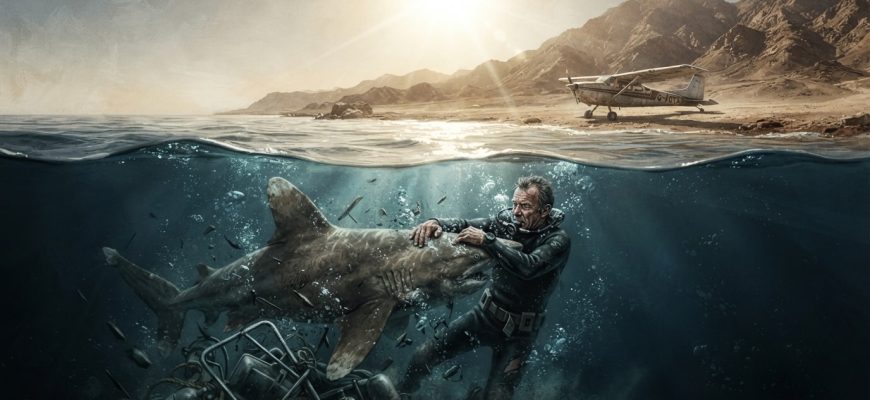
The predators were not very active that day. Ben had already filmed several meters of footage when a catshark became interested in him. It came too close, and Ben hurried back to shore.
At lunchtime, he discovered that he had brought only beer. Once again, he had failed to think about his son, who did not drink beer. The boy asked whether anyone knew about their trip. Ben said that the bay could only be reached by air. He did not understand that the boy was not afraid of unwanted visitors but of being left alone.
Ben hated and feared sharks, but after lunch he dived again, this time with bait—a horse’s leg. He hoped to use the money he would earn from the film to send Davy to his mother. The predators gathered around the meat, but the catshark suddenly lunged at the man.
Drenched in blood, Ben made it back to the sand. When Davy ran to him, it became clear that the shark had almost torn off Ben’s right arm and badly injured his left. His legs were also covered with deep cuts and wounds. The pilot realized that his condition was extremely serious, but Ben could not die: he had to fight for Davy’s sake.
Only now did the father try to find a way to reach the boy, calm him, and prepare him to fly the plane on his own. Losing consciousness every minute, Ben lay on a towel and pushed himself along the sand with his feet while his son dragged him toward the Oster. So that his father could get into the passenger seat, Davy piled stones and pieces of coral in front of the aircraft door and pulled his father up the makeshift ramp. Meanwhile, a strong wind had risen and darkness was beginning to fall. Ben deeply regretted that he had never managed to get to know this gloomy boy better and that he could no longer find the right words to encourage him.
Following his father’s instructions, Davy struggled to get the plane into the air. The boy remembered the map, knew how to use a compass, and knew that he had to fly along the coast to the Suez Canal and then turn toward Cairo. Ben was unconscious for almost the entire journey. He regained consciousness as they approached the airfield. “Ben knew that the last inch was approaching and everything was in the boy’s hands.” With incredible effort, he raised himself in his seat and helped his son land the aircraft. In the process, they narrowly avoided a huge four-engine plane.
To the astonishment of the Egyptian doctors, Ben survived, although he lost his left arm and with it the ability to fly airplanes. Now he had one concern—to find a way into his son’s heart and overcome the final inch that separated them.
Якщо ви не знайшли потрібну відповідь, можете запитати у нашого чат-бота у Телеграм.