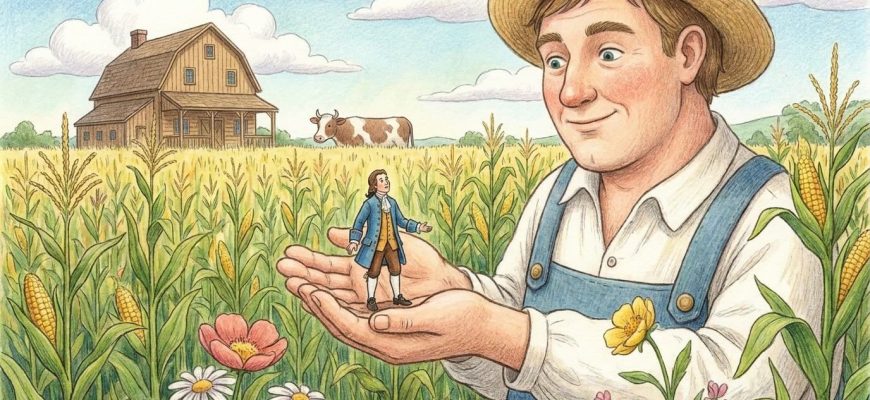
Jonathan Swift’s Gulliver’s Travels, first published in 1726, follows Gulliver’s second voyage to the land of Brobdingnag, where he encounters giants and observes human society from a radically different perspective.
Gulliver’s Travels Main Characters analysis
- Lemuel Gulliver — The English traveler and narrator who reaches Brobdingnag, a land inhabited by giants. He becomes a curiosity at first and later a protected member of the royal court.
- The Reaper — A giant farm worker who discovers Gulliver hiding among the enormous crops and takes him home.
- The Farmer — The giant who becomes Gulliver’s owner and initially exhibits him for money in towns and at fairs.
- The Farmer’s Daughter — A nine-year-old girl who takes care of Gulliver, makes him clothes and a bed, and teaches him the language of the giants.
- The Farmer’s Wife — She initially fears Gulliver but soon becomes accustomed to his presence and protects him from their enormous animals and child.
- The King of Brobdingnag — A wise and just ruler who listens to Gulliver’s account of European history and politics and harshly criticizes the corruption and vices he hears about.
- The Queen of Brobdingnag — She purchases Gulliver and keeps him at court as a curious and intelligent miniature companion.
Gulliver’s Travels Summary
Part 2. A Voyage to Brobdingnag Summary
On June 20, 1702, the Adventure sailed into the open sea. The ship headed under full sail toward the Cape of Good Hope, where the crew was forced to spend the winter. At first, the delay was caused by leaks in the ship, and then by the illness of the captain, who was unable to continue the voyage. It was not until March of the following year that the ship set sail again.
One day, a violent storm arose. The hurricane raged for many days, but the crew, under the captain’s command, bravely handled the ship, fighting against the waves and the wind. The Adventure emerged victorious. The only serious problem was that the ship was running out of fresh water. During the storm, the ship had been carried so far east that even the most experienced sailors could not say what part of the world they had reached.
At last, the cabin boy standing in the rigging cried out that he could see land. Soon the crew could also make out deserted, rocky shores that were unfamiliar even to the experienced captain. Afraid to take his ship into an unknown bay, he ordered the anchor dropped and sent a boat with ten well-armed sailors toward the shore. Gulliver asked the captain for permission to go ashore.
The shore was deserted and silent. The sailors scattered in search of fresh water. Gulliver remained alone and wandered aimlessly through the unfamiliar land. Everywhere he saw only a barren, rocky wilderness, so the doctor soon turned back. When he reached the water, he was astonished to see the sailors rowing back toward the ship with all their strength.
The traveler wanted to shout loudly, but he seemed to freeze in place. A man of enormous stature suddenly emerged from behind a rock and chased after the boat. The water reached the giant’s knees. He nearly caught the boat, but sharp rocks beneath the water prevented him from doing so. The giant merely waved his hand and returned to shore.
Gulliver fell to the ground and crawled between the rocks before running headlong without knowing where he was going. At last, the shore was far behind him. The traveler found himself in a grove and followed a broad road. When he looked upward, he realized that the smooth trunks of the trees were actually enormous stalks of barley.
The road brought Gulliver to a high fence. The only way to reach the field on the other side was by climbing four steps, each of which was much higher than Gulliver himself. Suddenly, a man even taller than the giant Gulliver had seen on the shore appeared on the highest step. The doctor rushed back into the barley as fast as he could.
The giant shouted something, and to Gulliver it sounded as though thunder had burst from the sky. Several answering roars came from a distance, and soon several more men of the same enormous size appeared nearby. They were dressed more poorly and were most likely laborers. After listening to their master, the giants began cutting the grain not far from Gulliver.
Afraid that he might be struck by one of their enormous sickles, the doctor rushed deeper into the stalks. The barley grew densely, making it difficult for him to move between the stems. At last, his path was blocked by a thick stalk that had been pressed to the ground by wind and rain. Beyond it were several more stalks tangled together, and Gulliver could no longer get through. In despair, he lay down in a furrow.
Suddenly, a dark object appeared directly above him.
The doctor realized that it was the shoe of one of the laborers. He shouted, and the reaper heard him. The young man bent down and began examining the grain beneath his feet. At last, he grasped Gulliver by the sides with two fingers and lifted him up to eye level so that he could get a better look at the strange little creature.
The traveler clasped his hands pleadingly and spoke to the giant in a trembling voice. The giant could not understand anything the tiny creature was saying, but he realized that the little man was speaking. He lifted the flap of his coat and carefully placed his discovery in his pocket.
Within a few minutes, Gulliver was being examined by the reaper’s master. All the workers gathered around to look at the little man. The giant placed him on the ground, and the doctor proudly began walking between the enormous legs. He waved his hat, bowed, and loudly delivered a greeting in four languages. The listeners looked at one another and shook their heads in astonishment.
Then the farmer placed a handkerchief on his palm and gestured for the doctor to sit on it. Afraid of falling, Gulliver lay face down on the broad palm. The giant carefully wrapped him in the handkerchief like a blanket and carried him home.
When the doctor was brought into the enormous house, the farmer’s wife was setting lunch on a huge table. At first, she was frightened when she saw the tiny man, but she soon calmed down after noticing how carefully he walked among the plates, took off his hat, and bowed.
Finally, the whole family gathered around the table. A small piece of meat and a slice of bread were placed in front of Gulliver as well. He took his traveling utensils—a fork and a knife—from their case and began to eat.
Then his hosts placed the smallest liqueur glass they had in front of him, filled with some kind of liquid. Gulliver took the glass, which was about the size of a small pitcher, and drank from it after approaching the farmer’s wife. The giants found this amusing, and the children even began clapping their hands, deafening the doctor with the noise.
One of the children, a boy, suddenly grabbed Gulliver by the legs and lifted him so high that his head began to spin. Fortunately, his father immediately snatched the little man from the boy’s hands and placed him on the table.
When the doctor, exhausted by all these adventures, sat down on the tablecloth and leaned against the saltcellar, he suddenly heard a deep rumbling sound. He turned around and saw the enormous face of a terrifying animal.
It was merely an ordinary house cat, purring on the farmer’s wife’s lap. Gulliver remembered that predators attacked only those who were afraid of them. Deliberately, he approached the animal’s face several times without showing any fear. The cat merely flattened its ears and backed away. At last, it jumped completely off the woman’s lap.
At the end of lunch, the nurse brought in a one-year-old child who let out a deafening scream when she saw the little man. The mother placed Gulliver directly in front of her. The baby grabbed the living toy and pulled it toward her mouth.
This time, the doctor screamed just as loudly as the child. The baby became frightened and dropped the toy. Gulliver would have been killed by the fall if the farmer’s wife had not caught him in her apron.
She carried the little man to her room and placed him on her bed, covering him with a clean handkerchief. Two hours later, Gulliver woke up and saw before him a long-faced, whiskered animal about the size of a large mongrel dog. Another creature of the same kind was approaching him from the other side.
They were rats.
Both attacked Gulliver at once. He drew his sword and, with a single blow, ripped open the belly of one of the rats. The other ran away, but the traveler chased it and cut off its tail. The farmer’s wife entered the room and was terrified to see Gulliver covered in blood, but he pointed toward the dead animal.
The farmer had a daughter, a nine-year-old girl who took charge of the little man. She made him a bed and clothes. She also began teaching Gulliver to understand the giants’ language and to speak it himself. Within a few weeks, the traveler could communicate reasonably well with his protectors on his own.
News that the farmer had discovered a strange creature in his field spread throughout the surrounding area. One day, an old friend of the farmer came to visit and advised him to display his discovery for money at the market.
The girl confirmed the doctor’s fears. At first, the traveler was upset at the thought of being displayed at fairs like a performing monkey, but then another idea occurred to him. He began looking forward to his first journey, hoping that traveling from one town to another might somehow improve his situation.
A few days later, the farmer, his daughter, and Gulliver set off for the city. The young man could see nothing along the way because he was kept inside a dark box that the farmer had specially built for him. The girl placed her quilted doll’s blanket inside it, but it did little to protect the doctor from the jolts and blows caused by every bump in the road.
When the horse stopped and the girl opened the door of the box, Gulliver could barely stand. His whole body ached, and green circles swam before his eyes. However, the farmer gave the traveler no time to rest.
At the inn, he rented the largest room, placed a table in the middle, and hired a town crier who was to run through the city announcing the performance and inviting people to come. The public flocked to the inn.
At the girl’s command, Gulliver marched across the table, drew his sword and waved it around, and performed various exercises with a straw. At the end, the doctor took a thimbleful of wine and drank to the health of those present.
The room could hold only about thirty people, but suddenly the whole city wanted to see the little man. The performances followed one after another. By evening, after the twelfth show, Gulliver felt completely exhausted. He could barely move his legs, and his tongue was stumbling over his words from fatigue.
From then on, every market day Gulliver was taken to the fair, where he ran around on the table from morning until evening entertaining the spectators. Before long, neighbors began coming directly to the farmer’s house, demanding that he show them the strange little man.
Soon the farmer decided to travel with Gulliver through all the major cities of the giants.
After a series of unpleasant and humiliating adventures, Gulliver is purchased by the Queen of Brobdingnag, who keeps him at court as an amusing and intelligent miniature curiosity. Between small but potentially fatal adventures—such as fighting giant wasps, being carried across rooftops in the paws of a monkey, and so on—he discusses European politics with the king, who responds ironically to his stories.
Here, as in Part 1, human and social customs are satirically criticized, but this time the criticism is not presented allegorically under the mask of the Lilliputians. Instead, it is expressed directly through the words of the King of the Giants.
My historical account of our country over the past century greatly astonished the king. In our history, he saw nothing but conspiracies, rebellions, murders, executions, revolutions, and banishments—the worst consequences of greed, discord, hypocrisy, treachery, cruelty, rage, madness, malice, envy, debauchery, and pride. Then he took me into his hands and, gently stroking me, addressed me in words that I shall never forget, any more than I shall forget the tone in which they were spoken:
“My little friend Grildrig, you have given here a splendid panegyric upon your country. You have clearly shown that the qualities most necessary for a lawgiver are ignorance, laziness, and corruption; and that the best interpreters and administrators of the laws are those whose interests and abilities are directed toward twisting, confusing, and neglecting them. In your institutions I have noticed some things that are useful in themselves, but half of them have been neglected, while the other half have been stained and corrupted by the general venality.
“From what you have told me, it does not appear that virtue is ever truly rewarded with high position in your society. Still less does it appear that people are given titles for their virtues; that priests are promoted for piety and learning; soldiers for courage and loyalty to their oath; judges for incorruptibility; senators for love of their country; or ministers for wisdom.
“You yourself,” continued the king, “having spent most of your life traveling, have, I hope, escaped many of the faults of your people. Yet, after considering everything I have heard from you, together with your answers to my questions—which I found so difficult to obtain from you—I cannot help concluding that the majority of your countrymen must be a race of disgusting vermin, the most harmful of all those that have ever crawled upon the earth.”
The King of the Giants is one of the few noble characters in Swift’s book. He is kind, perceptive, and governs his country skillfully and justly. When Gulliver suggests using gunpowder for wars of conquest, the king rejects the proposal with indignation and forbids any mention of the devilish invention on pain of death.
In Chapter VII, the king delivers the famous statement: “Whoever can make two ears of corn or two blades of grass grow where only one grew before would deserve better of mankind and do more essential service to his country than the whole race of politicians put together.”
The land of the giants possesses certain features of a utopia.
The education of this people is very limited: they study only ethics, history, poetry, and mathematics, although they have achieved perfection in these fields. Mathematics, however, is used only for practical purposes—for improving agriculture and technology—and therefore, by our standards, it remains at a relatively low level.
No law in that country should contain more words than there are letters in their alphabet, which consists of twenty-two characters, and even laws of that length are rare. All their laws are expressed in the briefest and clearest terms. The people there are incapable of the kinds of tricks that allow one law to be interpreted in different ways, and anyone who writes commentaries on the laws is punished by death.
The final paragraph brings to mind the Agreement of the People, a political project of the Levellers during the English Revolution that had been discussed almost a century earlier. It stated:
The number of laws should be reduced so that all the laws could fit into a single volume. The laws should be written in English so that every Englishman could understand them.
During a journey to the coast, the box specially designed for Gulliver to live in while traveling was seized by a giant eagle. The eagle later dropped it into the sea, where Gulliver was rescued by sailors and eventually returned to England.
Якщо ви не знайшли потрібну відповідь, можете запитати у нашого чат-бота у Телеграм.