Life of Galileo is a play by German playwright Bertolt Brecht. It portrays the life of the Italian astronomer Galileo Galilei, focusing on his revolutionary discoveries, his conflict with the Catholic Church, and the consequences of his decision to recant his scientific beliefs. The play explores the relationship between science, power, truth, and personal responsibility.
Life of Galileo Main Characters analysis
- Galileo Galilei – An Italian astronomer and physicist whose observations challenge the traditional understanding of the universe. He believes in the power of human reason and scientific investigation, but ultimately recants his discoveries under the threat of torture. Despite this, he secretly continues his work.
- Andrea Sarti – Galileo’s young pupil, the son of Mrs. Sarti. He admires his teacher and initially believes in the power of science. After Galileo’s recantation, Andrea feels betrayed, but later learns that Galileo secretly completed his scientific work.
- Mrs. Sarti – Galileo’s housekeeper and Andrea’s mother. She worries about her son’s involvement in scientific experiments and fears the consequences of Galileo’s conflict with the Church.
- Virginia Galilei – Galileo’s daughter. She remains devoted to her father and supports him, even when his scientific activities threaten her personal happiness and marriage.
- Ludovico Marsili – A wealthy young man who initially comes to Galileo for lessons, although he is more interested in horses than science. He becomes engaged to Virginia but eventually breaks off the relationship because of Galileo’s controversial position.
- Sagredo – Galileo’s friend, who understands the importance of his discoveries but fears the consequences of challenging the Church and its established beliefs.
- The Little Monk – A young religious scholar who initially studies astronomy but abandons it after the Church condemns Copernican theory. His concerns arise from the suffering and beliefs of ordinary people.
- Cardinal Bellarmine – A senior Church official who informs Galileo that the Copernican doctrine has been declared absurd and heretical.
- Cardinal Barberini / Pope Urban VIII – A Church official who once studied mathematics and astronomy and later becomes Pope. Although he recognizes Galileo’s scientific abilities, he eventually allows the Inquisition to pressure him.
- The Cardinal Inquisitor – A representative of the Inquisition who seeks to make Galileo abandon his scientific position.
- The Curator of the University – An official in Padua who is concerned primarily with the university’s financial interests and the practical value of scientific inventions.
- Christopher Clavius – The chief astronomer of the papal college in Rome, whose examination of Galileo’s discoveries confirms their accuracy.
Life of Galileo Summary
I
The year is 1609. Morning in Galileo’s modest study in Padua. Galileo is washing himself when Andrea brings him a glass of milk and a bread roll. The boy passes on his mother’s request that Galileo pay for the milk, since the milkman will soon be making his rounds.
Galileo shows Andrea a model of Ptolemy’s solar system, which represents the traditional belief that the Earth is stationary. However, Galileo is convinced that nothing in the universe, or in human consciousness, is motionless. People are beginning to question old truths, and science offers a way to test them. By moving the chair on which Andrea is sitting around the room, Galileo demonstrates how the Earth moves in relation to the Sun.
Mrs. Sarti enters and asks Galileo not to fill her son’s head with nonsense. Otherwise, priests will come to complain to her that the boy is spreading heresy.
Mrs. Sarti announces the arrival of a wealthy young man who wishes to take lessons from Galileo. She asks the scientist not to turn the prospective pupil away, because otherwise they will have nothing to live on.
Ludovico Marsili enters. He comes from a wealthy family, and his mother has sent him to see the world. While in Holland, he heard about Galileo. His mother believes that studying science will do him no harm, so he has come to learn from Galileo, although, to be honest, he is more interested in horses than in science.
Ludovico then tells Galileo about a remarkable tube with two lenses that he saw in Holland. Galileo immediately understands how it works and sketches its design. He had been about to refuse to take the young man as a pupil, but, noticing Mrs. Sarti as she enters the room, he schedules the lesson for Tuesday.
The university curator arrives. Galileo owes him money and sends Andrea to the optician. The curator explains that he has come in response to Galileo’s request for an increase in salary to one thousand scudi. Unfortunately, he cannot support the request before the university council because mathematics brings the university no income.
Galileo complains that he cannot live on five hundred scudi. He is forced to spend all the time he could devote to scientific research giving paid lessons instead.
The curator reminds him that the Republic, although it pays less than some princes, guarantees freedom of research. Unlike other cities, theirs is not ruled by the Inquisition.
Galileo objects that freedom of science is of little use if he has no time to take advantage of it. He suggests that the curator pay him for his research into the laws of falling bodies.
The curator replies that this remarkable law brings the university prestige, not money. He advises Galileo to invent something with practical applications.
Galileo looks at the sketch of the telescope and says that perhaps he will soon invent something similar. The curator agrees that this would be an excellent solution. Calling Galileo a great man, he leaves.
Some time later, Andrea returns with the lenses. Galileo asks the boy not to tell anyone about Copernicus’s teaching and invites him to look through the lenses out of the window. Andrea is astonished that distant objects now appear so close that he can even read the inscription on a church bell.
II
In the Great Arsenal in the harbor of Venice, the councillors have gathered under the leadership of the Doge. Galileo’s friend Sagredo is present, as is Galileo’s daughter Virginia, who holds the telescope on a velvet cushion.
Standing on a platform, Galileo delivers a speech in which he assures the audience that he has always tried to serve the Republic of Venice. As proof, he presents a new instrument — a telescope — manufactured in the famous Arsenal on the basis of the highest scientific and Christian principles. He describes it as the fruit of seventeen years of work.
To applause, Galileo steps down from the platform and stands beside Sagredo. Quietly, he tells his friend that the whole affair is a waste of time. Sagredo quietly replies that at least it will enable him to pay the butcher.
The curator steps onto the platform and speaks about the instrument’s enormous importance for military affairs. To music, Virginia hands the telescope to the curator, who has it mounted on a tripod.
The Doge and the councillors look through it. They are delighted by what they can see: what people are eating in a distant boat and how ladies are washing themselves on the roof of their house.
Meanwhile, Galileo tells Sagredo that he looked at the Moon through the telescope the previous evening and discovered that it shines without emitting its own light.
He is so absorbed in his conversation with his friend that he does not even hear the councillors addressing him.
When the embarrassed Ludovico approaches, Galileo tells him that he has improved the Dutch invention. Ludovico replies that he has noticed: Galileo has made the telescope’s casing red, whereas the Dutch version was green.
The Doge approaches and congratulates Galileo on his new invention, for which he will receive five hundred scudi.
III
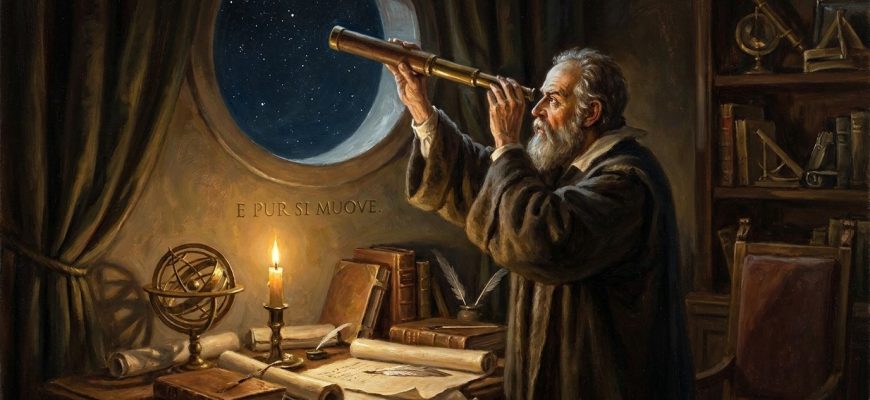
January 10, 1610. Night in Galileo’s study in Padua. Galileo and Sagredo, wearing warm cloaks, stand in front of the telescope.
They look at the Moon and see that its surface shines unevenly. Like the Earth, it has mountains and valleys.
Galileo declares that the Moon and the Earth are stars that reflect the light of the Sun. Sagredo objects that this contradicts two thousand years of astronomical knowledge. He reminds Galileo of the fate of Giordano Bruno, who was burned at the stake for making similar claims.
But Galileo joyfully declares that on this day humanity can write in its chronicle: there is no heaven.
Sagredo is horrified.
The curator rushes in, greatly agitated. He announces that Galileo’s telescope can be thrown away because five hundred identical instruments, made in Holland, are being unloaded in the harbor at that very moment. They will soon be available for purchase at any street corner for just a few scudi.
Sagredo unsuccessfully tries to calm the curator by pointing out that Galileo has made an important discovery in the world of the stars using this telescope.
Galileo also tries in vain to explain the new possibilities the telescope offers for navigation and the creation of new star charts. The furious curator slams the door and storms out.
Sagredo asks his friend whether he has heard about the Dutch invention. Galileo admits that he has, but insists that his own instrument is much more sophisticated. However, he is overwhelmed by debt. He complains that mathematics lectures are paid less than the driver who transports barrels of wine. He dreams of having five years of uninterrupted time for his research.
Galileo shows Sagredo the stars surrounding Jupiter through the telescope. Yesterday there were four of them, but today there are only three: one has disappeared behind Jupiter. This proves that nothing in the heavens is permanent and that everything is moving. There are no crystal spheres to which the stars are attached.
Galileo is extraordinarily excited by his discovery. Sagredo trembles with fear and asks where God is, then.
Galileo replies that God is either in each of us or nowhere.
Sagredo cries out that these are the words of the man who was burned almost ten years ago.
Galileo objects that this would not have happened if Giordano Bruno had possessed the evidence that can now be discovered with the help of a telescope.
Galileo expresses his faith in humanity and in the power of the human mind.
When Virginia enters, Galileo tells her that they may be able to move to Florence if the Grand Duke agrees to appoint him court mathematician.
Sagredo tries to dissuade his friend from taking this step. The Church has a very strong position in Florence. But Galileo refuses to listen to his advice.
IV
Galileo’s house in Florence. Mrs. Sarti is preparing his study for the arrival of guests. She mutters to herself that ever since they moved to Florence, there has been no end to the flattery. The whole city passes through the room to look through the telescope, and afterward she has to wash the floors.
She doubts that today’s demonstration will bring anything good. Tomorrow, she will once again be unable to look the milkman in the eye.
There is a knock at the door. The guests enter: Cosimo de’ Medici, the Grand Duke of Florence; the court administrator; and two ladies of the court.
Galileo is still at the university.
Cosimo goes into Galileo’s study, where Andrea is working. The Grand Duke looks at the telescope, but Andrea forbids him even to touch it.
Soon, an argument breaks out between the boys. The young Duke cannot understand why Andrea has two models of the universe.
At that moment, Galileo arrives with university professors. He respectfully greets Cosimo and invites everyone to look through the telescope at the stars he has discovered — the moons of Jupiter, which he has named in honor of Duke Cosimo de’ Medici.
However, the philosopher begins a discussion about whether such stars can exist at all.
Galileo tries in vain to persuade the professors, who continually appeal to Aristotle’s authority, to trust their own eyes and confirm that the stars are there. Not one of the guests approaches the telescope.
The court administrator gives a signal, and the Grand Duke bows before leaving. The courtiers hurry out after him.
The court administrator assures Galileo that they will certainly ask Christopher Clavius, the chief astronomer of the papal college in Rome, for his opinion about the discovery.
V
A
An epidemic of plague breaks out in the city.
Galileo orders Mrs. Sarti to leave the city with the children. He himself stays behind because three months of observations will be worthless if he does not continue his research for another two or three nights.
Now the plague is everywhere.
After placing the children in the carriage sent by the Grand Duke for Galileo, Mrs. Sarti returns to the house. Someone must prepare food for the scientist.
B
Galileo comes out of his house into the street. He does not know where his housekeeper has gone and asks a man who used to bring bread to the house about her.
A window opposite opens, and a woman leans out, shouting that there is plague in Galileo’s house. His housekeeper is ill and has gone out into the infected street to save Galileo from danger and anxiety.
Soldiers stretch a rope across the street.
Suddenly, Andrea appears beside it. He has run away along the road. In the morning, he knocked at the door, but nobody let him in. People told him that his mother was in a convent. He went there, but they would not allow him to see her because she was very ill.
Unable to resist the boy’s tears, Galileo tells him about his discovery: Venus revolves around the Sun.
Men appear in the street, using a long pole to pass bread to people through their windows. Galileo asks them to bring some more the next time they come.
VI
The year is 1616. Night in a hall in Rome where the Collegium Romanum, the Vatican’s research institute, is meeting.
The hall is filled with senior clergy, monks, and scholars. Galileo stands apart from the others.
The atmosphere is relaxed, and cheerful laughter can be heard even before the scene begins. A fat prelate, a scholar, and a monk laugh and joke about Galileo’s theory.
Two astronomers appear. The monk cheerfully asks whether they are still conducting their investigations. One of the astronomers angrily replies that it is not they who are doing the research, but the chief astronomer, Clavius, who is sitting in front of a telescope.
Everyone is astonished by this news.
The monks quote the Bible and ask whether Holy Scripture can really be wrong.
An old cardinal becomes indignant. He declares that there is no need to spend so much time examining such a trivial matter: the Earth is stationary, and he, the cardinal, stands firmly upon solid ground.
Before he can finish his speech, he faints.
At that moment, the doors open, and Clavius emerges accompanied by the astronomers. In deathly silence, he walks through the hall. As he is leaving, he tells one of the monks that everything is correct.
Everyone leaves in confusion. The Little Monk quietly whispers Clavius’s words to Galileo: now the theologians will have to work out how to repair the distortions in the heavens.
Galileo has won. Galileo corrects the monk: no, it is reason that has won. He heads for the exit. Coming toward him is the Cardinal Inquisitor, who is going to look through the telescope.
VII
March 5, 1616. Cardinal Bellarmine’s house in Rome. A ball is in full swing. In the vestibule, two monk-secretaries are playing chess and keeping a record of the guests. Galileo enters accompanied by Virginia and her fiancé, Ludovico Marsili. They are greeted with applause. Galileo remains in the vestibule to wait for the cardinal.
Cardinal Bellarmine and Cardinal Barberini enter, their faces concealed by masks representing a lamb and a dove. Barberini describes the conversation they are about to have with Galileo as a friendly discussion among scholars. Even the secretaries are ordered not to record it.
During the conversation, it becomes clear that the Church has no objection to sailors using star charts based on the new theory if those charts make navigation easier. However, the Church does not approve of theories that contradict Holy Scripture. The cardinals try to convince Galileo that the Church promotes charity, while he is trying to catch God making mistakes in astronomy.
Galileo replies that people can be mistaken in their reasoning not only about the movement of the stars but also about the Bible. Bellarmine says that it would be better to leave the interpretation of the Bible to theologians. He then signals to the secretaries and announces that the Holy Office has decided to regard Copernicus’s teaching as absurd and heretical. Galileo is therefore asked to abandon these views.
Galileo is concerned about the future of his scientific research. The cardinal assures him that nobody will interfere with his work and that he will be allowed to use his theory as a mathematical hypothesis.
The cardinals put their masks back on and lead Galileo into the ballroom. The Cardinal Inquisitor enters, takes the protocol from the secretaries, and reads it. Virginia then appears. The cardinal gently begins talking to her about her engagement. He tells her how good it is that she is always by her father’s side, because Galileo will need her very much.
VIII
The palace of the Florentine ambassador in Rome.
Galileo is talking to the Little Monk, who had whispered the conclusions of the papal astronomer to him after the meeting of the Collegium.
The monk has also studied astronomy, but after understanding the wisdom of the papal decree, he has decided to abandon his studies.
The Little Monk tells Galileo about his parents. They have worked hard and suffered all their lives, but they believed that their existence had a higher purpose.
Galileo’s theory, however, contradicts Holy Scripture, which explains why people must submit to their earthly lot. If the theory is accepted, his parents will lose even the hope of receiving a reward from God after death.
That is why the Little Monk sees the decision of the Holy Congregation as a noble act of maternal compassion. Galileo is outraged by this point of view.
He says that the Church places the Earth at the center of the universe so that the throne of Saint Peter will always stand at the center of the Earth and exhausted peasants will continue bending their backs in the fields.
Galileo rejects this kind of charity. Must he really lie to people? The Little Monk asks whether truth might perhaps find its own way without their help.
But Galileo is convinced that as much truth enters the world as people themselves bring into it. The victory of reason can only be the victory of reasonable people. Galileo points to his manuscripts, which explain the causes of the tides. The monk must not know about them, but a physicist… The Little Monk becomes absorbed in the manuscript.
IX
Eight years later. Galileo’s house in Florence. Galileo’s pupils — Federzoni, the Little Monk, and Andrea — have gathered for an experimental lesson. Virginia and Mrs. Sarti are sewing linen for Virginia’s dowry.
Galileo has not written any books for eight years. He receives many letters asking for his opinion about sunspots discovered by Dutch scientists, but he does not answer anyone and stays out of the discussion.
Galileo’s pupils are also discussing the nature of sunspots, but Galileo does not even take part in this friendly conversation. Instead, he is conducting experiments with floating bodies. In these experiments, Galileo and his pupils rely on Aristotle’s authority. Their results convincingly demonstrate that this authority is not infallible: Aristotle could not even correctly explain why a needle sinks in water while ice does not. Ludovico Marsili enters. Galileo does not recognize him at first.
Virginia joyfully throws her arms around her fiancé’s neck. She then rushes off to put on her wedding dress so that she can show it to Ludovico. He brings news that the Pope is seriously ill. If he dies, Cardinal Barberini will take his place. Barberini himself once studied mathematics and astronomy.
For eight years, Ludovico’s parents have refused to let him marry Virginia because Galileo has been under suspicion by the Inquisition. But now, everything may change. Ludovico passes on his mother’s message: she is pleased with Galileo’s conduct because he has stayed out of the disputes concerning sunspots. However, Galileo, who hopes that the new Pope will not obstruct scientific research, immediately returns to his investigations.
In fact, he has been secretly conducting them for a long time. These experiments have begun to damage his eyesight, which is why he failed to recognize Ludovico immediately.
Realizing that Galileo intends to break his promise not to interfere in the controversy over the Earth’s movement around the Sun, Marsili orders his servant to put the luggage in the carriage. He is going home.
Mrs. Sarti intervenes in the conversation. She tells Galileo that she has kept silent while watching her son become entangled in the sins of scientific experiments. She has seen how he, just like Galileo himself, secretly conducts research despite all the warnings. But Galileo has no right to destroy his daughter’s happiness. Galileo refuses to listen and returns to his experiments.
When the screen is filled with the burning reflection of the Sun, Virginia rushes in wearing her wedding dress. Realizing that her father has driven her fiancé away, she faints.
Andrea and the Little Monk rush to help her, while Galileo stares at the screen and repeats: “I must, I must find out!”
X
During the following decade, Galileo’s teaching spreads among the people. Pamphleteers and ballad singers take up the new ideas.
During the carnival of 1632, many Italian towns choose astronomy as the theme for their carnival processions.
A half-starved married couple of wandering singers, accompanied by a five-year-old girl and an infant, comes into the marketplace, where a crowd is waiting for the carnival procession. They begin singing a song called The Terrifying Teaching of the Court Physicist Galileo Galilei, or The Herald of the Future.
The song tells the following story: When God created the heavenly bodies, He ordered the Sun to move around the Earth, just as servants move around their masters. The same arrangement was established on Earth.
But then Galileo came along, took his telescope, and ordered the Sun to stand still. Now everything is supposed to be the other way around: the master himself must revolve. But what kind of future will that bring? Everyone will have to work for themselves.
Using a crude representation of the Sun and a pumpkin representing the Earth, the woman and the girl demonstrate how the Earth revolves around the Sun. The carnival procession begins. It also makes fun of Galileo and his opponents.
XI
The year is 1633. The antechamber and staircase of the Medici Palace in Florence. Galileo and his daughter are waiting for an audience with the Grand Duke.
Virginia notices a man who has been following them everywhere for several days and tells her father. Galileo reassures her, joking that they are among Corsican bandits. Rector Tafone passes by and barely nods in greeting.
The foundryman Vanni approaches. Galileo once drew up plans for a smelting furnace for him.
Vanni warns Galileo that he is being blamed for the pamphlets against the Bible that were performed during the carnival. He offers to help if danger arises and is ready to take Galileo to Venice immediately, where there are fewer monks.
But Galileo refuses even to listen. He hopes to receive support from the Grand Duke, who was once his pupil, and from the Pope.
The Cardinal Inquisitor descends the staircase and politely bows to Galileo and his daughter. Cosimo de’ Medici follows him.
The Grand Duke becomes embarrassed when Galileo approaches him. Pretending not to notice that the scientist is offering him his new book, he walks past. Galileo tells his frightened daughter that they will not go home now. Instead, they will go to the glassmaker Volni, who will take them out of the city in empty wine barrels.
But it is too late. Another official comes down the stairs and announces an order from the Holy Inquisition requiring Galileo to be brought to Rome for interrogation.
XII
The Pope’s apartments in the Vatican.
Pope Urban VIII, formerly Cardinal Barberini, receives the Cardinal Inquisitor. Outside, the sound of many shuffling feet can be heard. Professors from every faculty, representatives of all the holy orders, and members of the clergy have gathered.
The Inquisitor says that everyone waiting outside expects the Pope to confirm the truth of Holy Scripture. He tries to convince the Pope that the terrible unrest increasingly spreading through society has been caused by the interest that even ordinary people have begun to show in scientific discoveries.
All of Italy, under the influence of this Florentine, is talking about the phases of Venus.
For the moment, none of these people has begun to think about how much in their lives burdens them, or about all the things that have been sanctified by the Church.
This scoundrel knows exactly what he is doing when he writes his astronomical works not in Latin, but in the language of fishmongers.
All the cities of northern Italy are demanding new star charts, but the Inquisitor is prepared to make concessions on that point. These are commercial interests.
The Pope observes that the charts themselves are based on a theory that is offensive to God. One cannot condemn a doctrine and at the same time make use of the charts based on it.
“Why not?” the Inquisitor wonders. There is no other choice.
Almost in despair, the Pope says that Galileo is the greatest physicist of their time. Moreover, Galileo has friends: the court of Versailles and the court of Vienna. They will say that the Holy Church has become a cesspool of rotten superstitions. The Inquisitor replies that there will be no need to go that far. It will be enough to show Galileo the instruments of torture. He knows very well how to use them.
XIII
June 22, 1633.
In the palace of the Florentine ambassador in Rome, Galileo’s pupils are waiting for news. Virginia is in a corner, kneeling and saying her prayers. Galileo’s pupils are convinced that their teacher will not recant his beliefs.
A man who had followed Galileo in Florence enters. He announces that Galileo is expected to appear before the Inquisition at five o’clock and make his recantation. The great bell of Saint Mark’s Cathedral will announce the event, and the text of the recantation will be read publicly.
Andrea unexpectedly begins speaking about all his teacher’s discoveries. Everyone watches the sundial in the garden. Andrea and the Little Monk cover their ears. The sundial shows five o’clock, but there is no sound of bells. The pupils rejoice and embrace one another. They are convinced that a new age is about to begin — the age of science.
At that very moment, the bell rings. Everyone is stunned. Only Virginia is happy: her father has not been condemned. The stage grows dark. When it is illuminated again, Galileo’s pupils are still there.
Andrea says: “Unhappy is the land that has no heroes.”
Galileo enters. He is almost unrecognizable after the ordeal of interrogation. The pupils step away from him. Andrea accuses Galileo of betrayal, then collapses into a chair, feeling ill.
Galileo calmly asks someone to bring Andrea some water. The pupils move toward the door.
Galileo says: “Unhappy is the land that needs heroes.”
XIV
From 1633 to 1642, Galileo lives in a suburb of Florence under the supervision of the Inquisition.
A large room. Almost blind, Galileo is conducting an experiment with a wooden ball rolling down an inclined, curved track while sitting at a table.
A monk sits on guard in the antechamber. Galileo continues working in exile on his book Discourses on Two New Sciences: Mechanics and the Fall of Bodies. However, he is not allowed to write independently. Virginia records everything under his dictation and then hands the manuscripts over to the monks.
He also dictates a weekly letter to the archbishop, in which he answers the questions put to him.
Unexpectedly, Andrea Sarti arrives. He is leaving for Holland to pursue scientific work there and has come to see Galileo so that he can tell people in Amsterdam about him.
Virginia remains in the room because she also wants to hear what their visitor has to say.
Andrea asks Galileo about his circumstances in a restrained manner. But Galileo does not want to talk about himself. Instead, he asks what effect his recantation has had on the scientific community.
Andrea says that it has set science back several steps. Since Galileo submitted, not a single work presenting new ideas has been published in Italy. Descartes, in Paris, has even hidden his treatise on the nature of light.
Galileo sends his daughter to the kitchen.
Andrea prepares to leave, but Galileo stops him and reveals that he is working on his Discourses and handing everything over to the monks.
Andrea is horrified. The Discourses are in the hands of the monks, even though people in Amsterdam, London, and Prague are eagerly waiting for them.
However, Galileo has risked losing the last of his comforts. For many months, he has used every clear night to make a copy of his work. He is now ready to give it to Andrea.
Andrea is overjoyed and begins reproaching himself for having misunderstood Galileo’s intentions. He now believes that Galileo preserved his life so that he could finish the book that only he could have written.
But Galileo sadly objects:
“I was simply afraid of torture.”
Galileo goes on to say that he has thought a great deal about what happened to him and has reached certain conclusions about himself and the world of science in general.
Scientific work requires extraordinary courage.
The only purpose of science is to make human life easier. If scientists, intimidated by a power driven by self-interest, content themselves with acquiring knowledge for its own sake, science will become crippled, and scientific progress will only take it further away from ordinary people.
Galileo realizes that he had a unique opportunity. Under the circumstances of that time, the steadfastness of a single person could have caused an upheaval.
If he had stood firm then, scientists might have been able to take an oath similar to the Hippocratic Oath, promising to use their knowledge for the benefit of humanity.
Moreover, he has become convinced that he was not truly in danger. He possessed the same power as the authorities, but he handed his knowledge over to them so that they could use it for their own interests.
Virginia enters.
Andrea says goodbye and leaves.
XV
The year is 1637. Dawn in a small Italian border town.
Children are playing near the barrier.
Andrea and a coachwoman are waiting while the guard checks their documents. Andrea is sitting on a chest and reading Galileo’s manuscript.
The guard asks Andrea why he is leaving Italy. Andrea gives a brief answer: “I am a scholar.”
The luggage begins to be inspected.
The guard asks what he is reading. Andrea assures him that it is a book by Aristotle.
The clerk checks whether it contains anything about religion and then returns the manuscript.
Andrea is invited into a house, where he must sign a document confirming that everything has been inspected.
When he comes back, he picks up the chest and prepares to leave. But the border guard notices it and asks what is inside.
Andrea replies that it contains books.
Seeing how many books there are, the guard and the clerk decide that they cannot cause much trouble and that they will miss breakfast if they try to inspect every one of them.
Andrea crosses the border.
On the other side, he answers the questions of the boys who have been trying to find out from him whether a witch can fly through the air on a broomstick.
He tells them that flying on a broomstick is impossible unless a machine is attached to it. But such a machine does not yet exist and perhaps never will.
People still know very little.
They still have everything ahead of them.
Якщо ви не знайшли потрібну відповідь, можете запитати у нашого чат-бота у Телеграм.