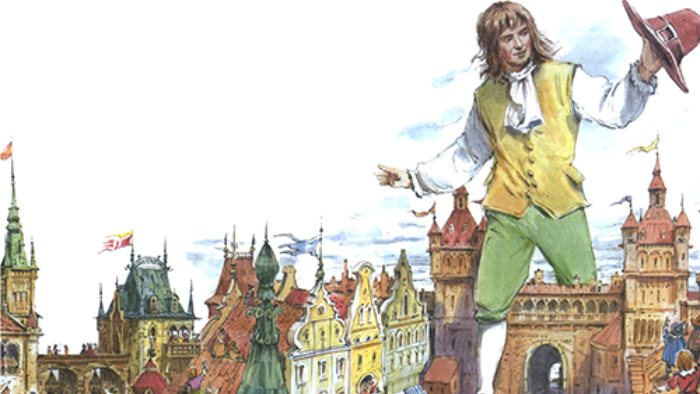
Jonathan Swift’s Gulliver’s Travels, first published in 1726, is a satirical novel about Lemuel Gulliver’s extraordinary voyages, including his adventures among the tiny people of Lilliput.
- Gulliver’s Travels Main Characters analysis
- Gulliver’s Travels Summary
- Chapter 1 – A Voyage to Lilliput Summary
- Chapter 2 – A Voyage to Lilliput Summary
- Chapter 3 – A Voyage to Lilliput Summary
- Chapter 4 – A Voyage to Lilliput Summary
- Chapter 5 – A Voyage to Lilliput Summary
- Chapter 6 – A Voyage to Lilliput Summary
- Chapter 7 – A Voyage to Lilliput Summary
- Chapter 8 – A Voyage to Lilliput Summary
Gulliver’s Travels Main Characters analysis
- Lemuel Gulliver — The protagonist and narrator, a surgeon and sailor who travels to distant lands and becomes involved in the political affairs of Lilliput.
- The Emperor of Lilliput — The ruler of Lilliput who initially treats Gulliver favorably, granting him freedom and rewarding his service, but later turns against him.
- Admiral Skyresh Bolgolam — A powerful Lilliputian official who opposes Gulliver’s release and later helps bring accusations against him.
- Reldresal — A principal secretary and trusted adviser to the Emperor who explains Lilliput’s internal political divisions and its conflict with Blefuscu.
- Lord High Chancellor Flimnap — An important Lilliputian official who becomes jealous of Gulliver because of his wife’s frequent visits to Gulliver and is hostile toward him.
- The Emperor of Blefuscu — The ruler of the rival empire of Blefuscu who welcomes Gulliver and helps him prepare to return home.
Gulliver’s Travels Summary
Chapter 1 – A Voyage to Lilliput Summary
Gulliver was the son of a small landowner from Nottinghamshire and had studied at college from the age of fourteen. Later, he apprenticed under a famous surgeon and studied medicine in the city of Leiden.
After completing his education, Gulliver became a ship’s surgeon. Several times he tried to settle on land, but he always returned to the sea.
One day, Gulliver’s ship was wrecked, and he was the only survivor. He reached the shore and fell asleep from exhaustion.
When Gulliver awoke, he discovered that he was tied down with very small ropes, which bound him from head to toe. A tiny person climbed onto him. Gulliver cried out, and the little man ran away. All around him were many other tiny people, and they were all shouting something.
Gulliver pulled one of his hands free, and immediately a shower of arrows flew toward him. He decided it was better to remain still and heard a strange knocking sound for a long time. It turned out that the Lilliputians had built a platform nearby and several of them had climbed onto it. One of them delivered a long speech, but Gulliver could not understand a word. He used signs to show that he wanted something to eat and drink.
The Lilliputians fed Gulliver tiny dishes and miniature loaves of bread. They also brought him barrels of drink, which Gulliver emptied in a single breath.
The Lilliputians explained to Gulliver that he was their prisoner and that they had orders to take him to the Emperor’s palace. Gulliver wanted to object, but changed his mind and fell asleep because the wine they had given him contained a sleeping drug.
The Lilliputians built an enormous carriage and transported Gulliver to the capital. There, they placed him in the largest building, a former temple whose doorway was large enough for Gulliver to crawl through. They chained Gulliver down and cut the ropes that had bound him.
Huge crowds of Lilliputians came to see the extraordinary giant.
Chapter 2 – A Voyage to Lilliput Summary
The next day, the Emperor himself arrived to see Gulliver, accompanied by his numerous attendants. Gulliver lay down so that he could see and hear better, but he could not understand the language of the Lilliputians, and they understood none of the languages known to Gulliver.
After the Emperor left, curious onlookers began climbing over Gulliver, but soldiers drove them away. The following day, the Emperor informed Gulliver that he would remain a prisoner for the time being, but that he would be provided with everything he needed. Gulliver promised to behave well, and the Emperor promised that he would eventually set him free.
The Lilliputians made an inventory of Gulliver’s belongings, and he had to surrender his sword, pistols, and gunpowder. The sound of the pistol shots made a powerful impression on the Lilliputians.
However, the Lilliputians failed to discover his spyglass and spectacles, which he had kept in a hidden pocket.
Chapter 3 – A Voyage to Lilliput Summary
Gulliver watched the Lilliputians’ rope-dancing performances and learned that anyone who could jump higher on the rope than the others was rewarded with a vacant government position. Ministers also performed on the rope to demonstrate that they had not lost their agility.
Another Lilliputian entertainment involved jumping over a stick. The Emperor and a minister held the stick, raising and lowering it alternately. The person who performed the best received a blue thread, the second-place performer received a red thread, and the third received a green thread. The Lilliputians wore these threads as belts.
Gulliver also decided to entertain the Lilliputians. He stretched a handkerchief between special poles, and cavalrymen began performing military maneuvers on it. Everyone enjoyed the spectacle until one of the horses tore the cloth. Gulliver then decided to put an end to the entertainment.
A couple of weeks later, a mysterious black object was brought in from the seashore. It turned out to be Gulliver’s hat, and he was delighted to have it back.
The Emperor also staged several parades between Gulliver’s legs.
Gulliver repeatedly asked to be granted his freedom, and eventually it was given to him, despite the opposition of Admiral Skyresh Bolgolam. Gulliver had to sign the conditions of his release, but in return the Lilliputians agreed to provide him with enough food to feed 1,728 Lilliputians.
Chapter 4 – A Voyage to Lilliput Summary
After gaining his freedom, Gulliver decided to explore Mildendo, the capital of Lilliput. He could easily step over the buildings. The city was rectangular in shape and had a population of about five hundred thousand people. The houses were three or four stories high.
The Emperor’s palace stood in the center of the city and was surrounded by a low wall. Beyond it, however, were three rows of inner buildings that were so tall that Gulliver could not step over them.
To inspect the Emperor’s apartments, Gulliver had to make two stools from enormous trees and step from one stool to the other over the tall buildings.
In this way, Gulliver was able to examine the Emperor’s rooms and even kiss the Empress’s hand.
Two weeks later, Reldresal, the principal secretary, came secretly to visit Gulliver and told him that Lilliput was facing two major problems.
The first was an internal one. There were two rival political parties, the Tramecksans and the Slamecksans, who differed in the height of the heels they wore. The Emperor belonged to the Low-Heels, while the heir to the throne favored the High-Heels. The two parties hated each other.
But there was also an external enemy: Blefuscu, an island empire hostile to the Lilliputians.
The people of Blefuscu still followed the old practice of breaking boiled eggs at the blunt end, even though the current Emperor’s grandfather had ordered his subjects to break their boiled eggs only at the pointed end. A constant war had therefore continued between Blefuscu and Lilliput.
Now Blefuscu had assembled a huge fleet and was preparing to invade Lilliput.
Gulliver told the secretary that he was ready to defend the country, but he would not interfere in the disputes between the political parties.
Chapter 5 – A Voyage to Lilliput Summary
The island of Blefuscu was separated from Lilliput by a narrow strait whose greatest depth was no more than six feet. Looking through his spyglass, Gulliver saw fifty ships waiting for a favorable wind so that they could attack Lilliput.
Gulliver took fifty ropes with hooks, crossed the strait, and, under a shower of arrows, tied all the ships together. He had to put on his spectacles so that the arrows would not strike his eyes. Then Gulliver cut the anchors and pulled the entire fleet toward Lilliput.
The Emperor was waiting on the shore for the expedition to end. He could see the approaching fleet but could not see Gulliver in the water. For a short time, this caused panic. However, Gulliver shouted, “Long live the Emperor of Lilliput!” and the panic came to an end.
For this operation, Gulliver received the title of Nardac, the highest rank in the country.
The Emperor wanted Gulliver to capture the rest of Blefuscu’s ships in the same way, but Gulliver refused because he did not want to become responsible for enslaving an entire people.
After this, the Emperor began treating Gulliver coldly.
Soon, a favorable peace was concluded between Lilliput and Blefuscu. The ambassadors from Blefuscu spoke highly of Gulliver and repeatedly invited him to visit their country.
Not long afterward, Gulliver managed to extinguish a fire in the Imperial Palace in a very unusual way. The flames threatened to destroy the entire building, so Gulliver urinated on the fire and put it out.
However, the Empress became resentful toward Gulliver after the incident and refused to return to the rooms that had been saved from the fire in such an extravagant manner.
Chapter 6 – A Voyage to Lilliput Summary
The inhabitants of Lilliput stood a little over six inches tall, and everything else in the country was equally small. They buried their dead with their heads pointing downward and wrote diagonally across the page. The Lilliputians disliked informers, and if an accusation proved false, the informer faced severe punishment. They disliked fraudsters even more than thieves and usually punished them with death.
On the other hand, strict obedience to the law was rewarded, and law-abiding Lilliputians received financial rewards.
When choosing a person for any position, greater importance was placed on moral qualities than on intelligence. Ingratitude was considered a serious crime in Lilliput.
Children in the country were raised in educational institutions, and it was believed that children owed their parents nothing. Although parents were required to pay for their children’s education, they were allowed to visit them twice a year. Boys and girls were educated separately, except for the children of workers and farmers, who received no education at all.
A new suit was made for Gulliver, and he was served by three hundred cooks. One day, the Emperor came to dine with him, accompanied by Lord High Chancellor Flimnap, who cast hostile looks at Gulliver. Flimnap was unhappy about the expenses required to maintain Gulliver.
Moreover, Flimnap was jealous of Gulliver because his wife often came to visit Gulliver. Of course, his suspicions were completely unfounded.
Chapter 7 – A Voyage to Lilliput Summary
One day, an important official came to Gulliver and told him about the accusations that Bolgolam and Flimnap had brought against him. He was accused of extinguishing the fire in the palace, refusing to capture the entire fleet of Blefuscu, and communicating with the Blefuscu embassy—in other words, of treason.
The accusers demanded Gulliver’s death, but the Emperor mercifully decided that it would be enough simply to put out his eyes. After lengthy arguments, a decision was made to blind Gulliver and gradually starve him to death.
To avoid this unpleasant fate, Gulliver decided to visit Blefuscu. He untied one of the ships, placed his clothes on it, and quickly made his way to Blefuscu.
There, he was warmly received by the Emperor of Blefuscu himself. However, Gulliver did not tell the Emperor about his intentions.
Chapter 8 – A Voyage to Lilliput Summary
Three days later, Gulliver noticed an overturned boat in the sea. With the help of an entire fleet, he managed to bring the boat ashore and examine it. The boat was undamaged. Gulliver rowed it to the capital of Blefuscu and asked the Emperor to help him equip it with sails and provide him with provisions so that he could return home.
The Emperor of Blefuscu agreed to help Gulliver.
Meanwhile, the Emperor of Lilliput demanded that Gulliver be returned to him bound hand and foot so that he could be executed. The Emperor of Blefuscu replied that he could not do this, but told him about the boat and explained that Gulliver intended to return home, in which case the problem would resolve itself.
The Emperor of Blefuscu asked Gulliver whether he would like to enter his service, but Gulliver refused. He learned that the Emperor was very pleased with his decision.
A month later, everything was ready for the voyage. Gulliver loaded the boat with a large quantity of provisions and, among other things, took six live cows, two bulls, and sheep and rams so that he could breed them in his homeland.
At last, Gulliver sailed away in the boat and, several days later, encountered an English ship. The ship carried him back to England.
The cows and sheep took a liking to the English grass and multiplied.
Gulliver did not stay home for long. His desire to travel never left him. Two months later, he said goodbye to his wife, son, and daughter and set sail once again.
Якщо ви не знайшли потрібну відповідь, можете запитати у нашого чат-бота у Телеграм.