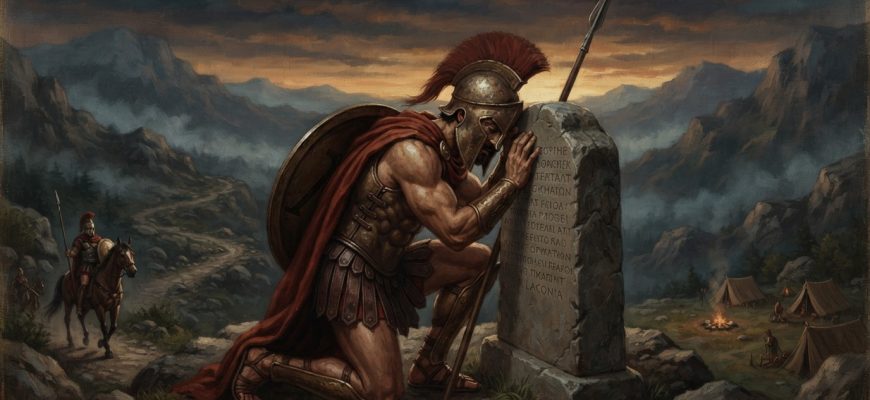
Heinrich Böll’s “Stranger, Bear Word to the Spartans We…” (Wanderer, Come to Spa…) is a 1950 short story about a severely wounded soldier who is brought to a makeshift field hospital in his former school, where familiar surroundings gradually reveal his identity and fate.
Wanderer, Come to Spa… Main Characters analysis
- The wounded soldier — The unnamed protagonist, a severely injured young man who is carried into a makeshift hospital established in a school he left only three months earlier. As he recognizes familiar objects and places, he gradually realizes where he is.
- Birgeler — The old school caretaker, whom the protagonist remembers from his school days. He is eventually recognized as the firefighter caring for the wounded soldiers.
- The doctor — The physician treating the wounded soldiers in the makeshift hospital. He examines the protagonist and prepares to operate on him.
- The wounded soldier beside the protagonist — Another injured man lying in the improvised hospital. He helps confirm that the building is in Bendorf.
- The drawing teacher — The teacher whose lessons and handwriting exercises remain connected to the protagonist’s memories of the school.
Stranger, Bear Word to the Spartans We… Summary
The vehicle comes to a stop, although its engine continues to rumble for a while. Somewhere nearby, a large gate opens. Light pours through the shattered window, and the wounded soldier notices that the light bulb beneath the ceiling has also been completely destroyed. Only a few flickering wires and fragments of glass remain in the socket.
After the engine finally falls silent, voices outside begin determining where the dead and the living should be taken. The driver does not know how many of the people being transported have died. Someone points out that there is little point in maintaining a blackout when the entire city is already burning. The dead are ordered to be taken elsewhere, while the survivors are to be carried upstairs to the drawing room.
The protagonist is still alive, so he belongs to the group of survivors and is carried upstairs.
At first, the orderlies take him through a long, dimly lit corridor. The walls are painted with green oil paint, and black, crooked, old-fashioned coat hooks are fixed into them. Soon they pass doors marked as classrooms 6-A and 6-B. Between the doors hangs Feuerbach’s Medea, softly reflecting light beneath glass in a black frame, with Medea gazing into the distance. Farther on are the doors of classes 5-A and 5-B, with Boy Removing a Thorn hanging between them, a beautiful picture with a reddish sheen in a brown frame.
They reach a column near the entrance to the stairway. Behind it stretches a long, narrow frieze of the Parthenon, an artistic yellowish plaster reproduction intended to represent the ancient original. Other familiar objects appear as well: a Greek hoplite, fully armed from head to toe, bristling with menace and resembling an angry rooster.
On the landing, against a yellow-painted wall, hang portraits of rulers extending from the Great Elector to Hitler. In a narrow corridor, where the stretcher briefly becomes level, the protagonist sees an especially striking portrait of Old Fritz. He is depicted in a sky-blue uniform, with radiant eyes and a large, bright gold star on his chest.
The stretcher tilts again, and more images pass before the wounded man’s eyes. He sees supposed examples of Aryan types: a Nordic captain with an eagle-like gaze and foolish-looking mouth, a female model from the Moselle region who appears somewhat thin and bony, a Baltic type with a bulbous nose, and a long, coarse mountain-dweller’s profile familiar from films.
The corridor continues. For another brief moment, the stretcher becomes level, and before the orderlies begin climbing to the third floor, the protagonist sees a memorial plaque bearing the names of the fallen. It is surrounded by a stone laurel wreath and topped by a large golden Iron Cross.
Everything passes before him extremely quickly. He is not heavy, and the orderlies are in a hurry. It is therefore possible, he thinks, that some of what he sees is only an illusion. His entire body is burning with fever. His head, arms, and legs hurt, and his heart is pounding wildly. In such a state, almost anything might appear real.
Yet after they pass the idealized Aryan figures, more familiar objects come into view. Three busts stand side by side beneath the wall: Caesar, Cicero, and Marcus Aurelius. They are excellent yellow copies of ancient statues. When the orderlies turn the corner, a column representing Hermes appears. Farther down the corridor, which is painted pink, a huge image of Zeus hangs above the doors to the drawing room.
Through a window on the right, the protagonist sees the glow of the fire. The entire sky is red, and thick black clouds of smoke move slowly across it.
He glances to the left again and sees doors marked 01-A and 01-B. Between the brown doors, which seem saturated with the stale atmosphere of the old building, he notices Nietzsche’s moustache and the tip of his nose in a gold frame. The other half of the portrait is covered by a sheet of paper bearing a notice about light surgery.
The protagonist begins to think that he is about to see something else he recognizes. Then the landscape of Togo comes into view. It is a large, bright, flat picture resembling an old engraving, a fine oleograph. In the foreground, in front of colonial houses, local Black inhabitants, and a German soldier standing awkwardly with a rifle, there is a large bunch of bananas depicted almost life-size. Something has been scratched onto one of the bananas in the right-hand bunch. The protagonist recognizes the handwriting and suspects that he himself once made the inscription.
At last, the doors to the drawing room swing open. The stretcher is carried inside beneath the image of Zeus, and the protagonist immediately closes his eyes. He does not want to see anything else.
The drawing room smells of iodine, feces, gauze, and tobacco, and the room is filled with noise.
The orderlies place the stretcher on the floor. The protagonist asks them to take a cigarette from his upper left pocket and put it into his mouth. Someone searches his pocket, strikes a match, and gives him the lit cigarette. He takes a drag and expresses his thanks.
Still, he does not regard any of what he has seen as conclusive proof. After all, any grammar school might have a drawing room, corridors with green and yellow walls, and crooked old-fashioned coat hooks. The fact that Medea hangs between classrooms 6-A and 6-B does not necessarily prove that he is in his own school.
He considers the possibility that such arrangements might be determined by regulations governing classical grammar schools in Prussia. Perhaps Medea is supposed to hang between those particular classrooms, while Boy Removing a Thorn belongs there as well. Caesar, Marcus Aurelius, and Cicero might be displayed in the corridor, while Nietzsche might be placed higher up, where philosophy is taught.
The Parthenon frieze and the colorful landscape of Togo also fail to convince him. Boy Removing a Thorn and the Parthenon frieze could simply be old school furnishings passed from one generation of students to another. He may not have been the only student tempted to scratch a joke onto a banana. Even the jokes might be the same in every grammar school.
Besides, the protagonist considers the possibility that his fever has begun to make him hallucinate.
By now he no longer feels pain. The journey in the vehicle had been extremely difficult. Whenever the vehicle jolted over potholes, he could do nothing but scream. The large craters in the road had actually been easier because the vehicle rose and fell over them like a ship on waves.
Now, however, the injection he had received somewhere in the darkness seems to be taking effect. He remembers the needle piercing his skin and then feels warmth spreading somewhere as far as his leg.
He cannot believe that what he suspects is possible. The vehicle could not have traveled such a great distance, perhaps thirty kilometers. There is another problem as well: none of his senses tells him where he is. Only his eyes recognize things. None of his other senses confirms that he is in his own school, the school he left only three months earlier.
Eight years spent in one place should mean something. Surely, after studying there for eight years, he would not recognize his school through his eyes alone.
Lying with his eyes closed, the protagonist sees everything again. The images move through his mind like scenes from a film: the green-painted corridor below, the yellow-painted stairs, the memorial plaque with the names of the fallen, then the corridor and stairs again. Caesar, Cicero, Marcus Aurelius, Hermes, Nietzsche’s moustache, Togo, and the image of Zeus return one after another.
He spits out the cigarette and begins to scream. Screaming makes him feel somewhat better, so he screams harder and harder. Someone bends over him. He keeps his eyes closed and notices an unfamiliar breath carrying the warm, nauseating smell of tobacco and onions.
He asks for something to drink and another cigarette from his upper pocket. Someone searches his pocket again, strikes another match, and puts a lit cigarette into his mouth.
The protagonist then asks where they are. He is told that they are in Bendorf. He thanks the person and takes another drag.
Perhaps, he thinks, he really is in Bendorf, his home. If he were not suffering from such a terrible fever, he could be certain that he was in some kind of classical grammar school. At the very least, there can be no doubt that he is in a school.
He remembers that someone downstairs ordered the survivors to be taken to the drawing room. He was one of those survivors, and therefore he must be among them. He is now lying in the drawing room. If his hearing has not deceived him, why should his eyes have deceived him as well?
He recognizes Caesar, Cicero, and Marcus Aurelius. Such figures belong in a classical grammar school, where ancient statues might indeed stand along the corridors.
Finally, the man who has been helping him brings him some water. Once again, the protagonist notices the smell of tobacco and onions. He involuntarily opens his eyes and sees the tired, old, unshaven face of a man wearing a firefighter’s uniform.
The firefighter encourages him to drink. The protagonist begins drinking. It is only water, but water seems like a wonderful drink to him. He tastes the metal of the canteen against his lips and takes pleasure in knowing how much water remains.
Suddenly, however, the firefighter takes the canteen away and walks off. The protagonist calls after him, but the firefighter does not turn around. He only shrugs tiredly and continues on his way.
The wounded man lying beside the protagonist explains that there is little point in making a fuss because the firefighters have almost no water left.
The protagonist can see what is happening behind the blackout curtains. Red light glows and flickers behind them, black against red like the inside of a stove when coal is added. He realizes that the city is burning.
He asks the wounded man beside him which city they are in, and the man confirms that it is Bendorf. The protagonist thanks him.
He looks straight ahead, at rows of windows and occasionally at the ceiling. The ceiling is still untouched, white and smooth, with a narrow classical molding. Yet ceilings with such moldings exist in drawing rooms throughout schools, at least in good old classical grammar schools.
By now it seems impossible to doubt that he is lying in the drawing room of some classical grammar school in Bendorf. There are three classical grammar schools in the city: the Frederick the Great Grammar School, the Albert Grammar School, and the Adolf Hitler Grammar School.
He wonders whether the Frederick the Great Grammar School really had such a bright, beautiful, enormous portrait of Old Fritz on its staircase. He studied there for eight years. Yet surely an identical portrait could hang in another school in exactly the same place, so striking that it would immediately catch the eye upon reaching the second floor.
Now he hears heavy artillery firing somewhere in the distance.
Otherwise, everything is almost peaceful. Occasionally, flames flare up more brightly behind the dark curtain, and the front of a building falls into the darkness.
The artillery fires steadily and rhythmically. The protagonist finds the sound strangely reassuring. He thinks of the guns almost with affection, although he knows that such a reaction is shameful. Their deep, stern rumble has something calming about it, almost like solemn organ music. To him, there is something noble about the sound of artillery, even when the guns are firing.
The sound reminds him of the wars described in illustrated books.
He begins thinking about how many names might eventually appear on the memorial plaque for the fallen. He imagines that the new plaque will be decorated with an even larger golden Iron Cross and an even larger laurel wreath.
Suddenly it occurs to him that if he really is in his own school, his own name might also be carved into the stone. The school calendar could eventually record that he had left school for the front and fallen for some cause.
Yet he does not even know what that cause would be. Nor does he know for certain that he is actually in his own school. The memorial plaque offers no distinctive proof. It could simply be a standardized plaque supplied by a central authority to many schools.
He looks around again. The paintings have been removed. What could he possibly determine from a few desks stacked in a corner or from the tall, narrow windows placed close together, as would be appropriate in a drawing room where as much light as possible is needed?
His heart gives no response.
He wonders whether his heart would respond even if he were truly lying in the room where he had spent eight years drawing vases and practicing different forms of lettering. The teacher had always placed elegant vases on a stand in front of the students, beautiful copies of Roman originals. They also practiced various styles of lettering, including rondo, regular, Roman, and Italian scripts.
The protagonist had hated those lessons more than anything else at the grammar school. He had spent hours dying of boredom and had never once managed to draw a vase properly or write a letter correctly.
Now he wonders where his old curses and burning hatred of those faded, hated walls have gone. Nothing inside him responds. He simply shakes his head.
He repeatedly erases and sharpens his pencil, then erases again. Nothing changes.
The protagonist does not remember how he was wounded. He knows only that he cannot move his arms or his right leg, while he can move the left leg only slightly. At first, he wonders whether his arms have simply been tied so tightly against his body that he cannot move them.
He spits his second cigarette into the passage between the straw mattresses and tries to move his arms. A terrible pain shoots through him, and he begins screaming again. He keeps screaming because it seems to make things easier, but he is also furious because he cannot move his arms.
Finally, a doctor appears in front of him. The doctor removes his glasses and silently looks at the wounded man, blinking. Behind him stands the firefighter who gave the protagonist water.
The firefighter whispers something to the doctor. The doctor puts his glasses back on. Through the thick lenses, the protagonist clearly sees the doctor’s large gray eyes and their slightly trembling pupils.
The doctor studies him for a long time, so long that the protagonist turns his eyes away. The doctor then quietly tells him that his turn will come soon.
Afterward, the orderlies lift the wounded man lying beside the protagonist and carry him behind a partition. They move the boards apart, place one across the opening, and hang a sheet between the board and the wall. Bright light shines behind the partition.
Nothing can be heard from behind it until the sheet is pulled aside again and the protagonist’s neighbor is carried out. The orderlies take him toward the doors with tired, indifferent expressions.
The protagonist closes his eyes again and realizes that he must find out how serious his wound is and whether he is really in his own school.
Everything around him seems distant and indifferent, as though he has been brought into a museum in a city of the dead, a world that is deeply foreign and uninteresting to him. For some reason, however, his eyes recognize it. Only his eyes seem to understand what they are seeing.
It seems impossible that only three months have passed since he sat in this very place, drawing vases and practicing lettering. During breaks, he would take his bread with jam and slowly walk downstairs, passing Nietzsche, Hermes, Togo, Caesar, Cicero, and Marcus Aurelius. He would then pass Medea and continue to the caretaker Birgeler to drink milk in the small, dim room where he could occasionally risk smoking a cigarette, although smoking was strictly forbidden at the grammar school.
He imagines that his wounded neighbor has probably been carried downstairs, to the place where the dead are kept. Perhaps the dead are taken to Birgeler’s small, dim room, where the smell of warm milk, dust, and cheap Birgeler tobacco once filled the air.
Soon the orderlies enter the drawing room again. This time they lift the protagonist and carry him behind the partition.
As he passes the doors for the second time, he notices another unmistakable sign. A cross once hung above one of the doors, back when the grammar school was still called St. Thomas’s School. The cross was later removed, but a fresh, dark yellow mark remained on the wall where it had been.
The mark was so clear that it was perhaps even more visible than the small, old, modest cross itself had been. It stood out sharply against the faded paint.
The entire wall was later repainted in an attempt to conceal it, but the effort failed because the painter could not match the color properly. The outline of the cross appeared again, brownish and distinct against the pink background.
The people responsible had been angry, but nothing they did could change the result. The dark, unmistakable cross continued to stand out against the lighter wall. The protagonist imagines that they may even have exhausted their entire paint budget without managing to conceal it.
Looking more closely, he can still make out an uneven mark at the right end of the crossbar, where a beech branch had hung for years. The caretaker Birgeler used to attach the branch to the cross back when crosses were still permitted in schools.
All of this passes through the protagonist’s mind in the brief moment while the orderlies carry him behind the partition, where a bright light is shining.
They place him on the operating table. In the clear glass of the lamp above him, he sees himself, small and almost shortened, like a narrow white roll of gauze, a strange and delicate cocoon. He realizes that it is his reflection.
The doctor turns his back to him and bends over the table, searching among the instruments. The old, heavy firefighter stands opposite the partition and smiles at him. His smile is tired and sorrowful, and his unshaven, unwashed face looks as though he has been asleep.
Then, behind the firefighter’s shoulder, on the other side of the board, the protagonist sees something that finally causes his heart to respond. For the first time since he arrived in this dead house, he feels a deep and terrible fear, and his heart begins pounding in his chest.
There is writing on the board, and it is in his own handwriting.
It appears in the highest line. The protagonist knows his handwriting. Seeing one’s own writing can be more disturbing than seeing one’s own reflection, and there is little room for doubt when it comes to recognizing one’s own hand.
At last, he has undeniable proof.
Everything else could still have been explained away. Medea, Nietzsche, the mountain-dweller’s profile from the films, the bananas from Togo, and even the mark left by the cross above the door could all have existed in other schools.
But it is unlikely that another school would have writing in his own hand on its blackboard.
The words are still there, the sentence the students had once been ordered to write in that hopeless life that had ended only three months earlier: Wanderer, come to Spa…
The protagonist remembers the exercise clearly. There had not been enough space on the board because he had chosen letters that were too large. His drawing teacher had scolded him for failing to calculate the space properly and then had written the same sentence underneath in the same lettering.
The sentence had been written seven times, in different styles: by the protagonist in Latin script, Gothic script, cursive, Roman, Italian, and rondo lettering.
When the doctor quietly calls to the firefighter, the man steps away from the board, allowing the protagonist to see the entire sentence. It is slightly distorted because the protagonist had miscalculated the space and chosen letters that were too large.
The protagonist suddenly feels a needle enter his left thigh. He tries to raise himself onto his elbows but cannot. Nevertheless, he manages to look at himself and realizes that he has already been unwrapped.
He sees that both his arms and his right leg are missing. He immediately falls onto his back because there is now nothing left to support himself with.
He cries out. The doctor and the firefighter look at him in alarm, but the doctor merely shrugs and continues pressing the syringe plunger downward, slowly and firmly.
The protagonist wants to look at the board one more time, but the firefighter is now standing very close and blocks his view. He holds the wounded man firmly by the shoulders.
The protagonist can smell only the smoke and dirt coming from the firefighter’s uniform. He sees the man’s tired, sorrowful face and suddenly recognizes him.
It is Birgeler, the caretaker from his former school.
The protagonist quietly asks him for milk.
Якщо ви не знайшли потрібну відповідь, можете запитати у нашого чат-бота у Телеграм.