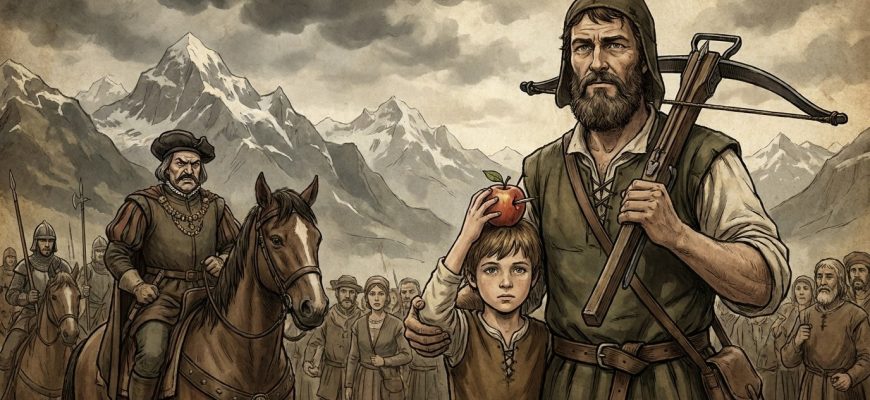
Wilhelm Tell is a historical drama by the German playwright Friedrich Schiller. Set in Switzerland during the late thirteenth century, the play depicts the struggle of the local population against the oppressive rule of the Austrian Habsburgs. Through the story of the legendary marksman Wilhelm Tell and the formation of an alliance among three Swiss cantons, Schiller explores the themes of freedom, resistance to tyranny, courage, and national unity.
Wilhelm Tell Main Characters analysis
- Wilhelm Tell — A courageous Swiss marksman who initially stays out of the political struggle but becomes a symbol of resistance after the Austrian governor forces him to shoot an apple from his son’s head.
- Gessler — An Austrian governor whose cruelty and arrogance provoke the Swiss people into rebellion.
- Werner Stauffacher — A respected peasant from Schwyz who helps organize resistance against Austrian rule.
- Arnold Melchthal — A young man from Unterwalden whose family suffers the cruelty of the Austrian authorities. He becomes one of the leaders of the uprising.
- Werner Fürst — A respected man from Uri who provides shelter to Melchthal and takes part in organizing the alliance.
- Hedwig — Wilhelm Tell’s wife, who worries about her husband’s safety and fears the consequences of his encounters with Gessler.
- Walter — Wilhelm Tell’s young son, who bravely agrees to stand with an apple placed on his head during Gessler’s cruel test.
- Baron Attinghausen — An elderly nobleman who opposes Austrian rule and supports the Swiss people’s struggle for independence.
- Rudenz — Attinghausen’s nephew, who initially considers entering Austrian service but eventually pledges loyalty to his homeland.
- Bertha von Bruneck — A wealthy Austrian heiress whom Rudenz loves and later rescues from the burning castle of Rossberg.
- Baumgarten — A peasant from Unterwalden who kills a castle commander after the latter attempts to dishonor his wife.
- Melchthal’s father — An elderly man who is blinded by the Austrian authorities as punishment for his son’s resistance.
- Johann of Swabia — The emperor’s nephew, who murders Emperor Albrecht and later seeks shelter in Tell’s house.
Wilhelm Tell Summary
The action of the play takes place in the three forest cantons of Switzerland: Schwyz, Uri, and Unterwalden. In 1291, these cantons united and laid the foundations of the Swiss Confederation in their struggle against the Austrian domination of the Habsburgs.
Life is difficult for ordinary people, who suffer under the arbitrary rule of the Austrian emperor’s governors, known as bailiffs or Vogts.
In Unterwalden, a peasant named Baumgarten faces a terrible injustice. The commander of a local fortress attempts to dishonor his wife. Baumgarten kills the commander and is forced to flee from the soldiers of the Austrian governor.
During a violent storm, a brave marksman named Wilhelm Tell risks his life to help Baumgarten cross the lake. Thanks to Tell’s courage, the fugitive escapes his pursuers.
Meanwhile, in the canton of Schwyz, a peasant named Werner Stauffacher is deeply troubled. The local governor threatens to take away his home and farm simply because he dislikes the comfortable life Stauffacher leads.
Werner’s wife advises him to travel to Uri, where he will surely find others dissatisfied with the rule of the foreign Austrian governors. Although she is a woman, she understands that people must unite against a common enemy if they hope to defeat it.
In the house of Werner Fürst, a respected man from Uri, Arnold Melchthal from Unterwalden is hiding from the governor, Landenberg.
On the governor’s orders, soldiers had attempted to seize a pair of Melchthal’s oxen. When Arnold resisted, he struck an Austrian soldier and broke one of his fingers. He was then forced to flee his home like a criminal.
As punishment for his son’s actions, the authorities had Melchthal’s elderly father blinded. They confiscated everything he owned, gave him a walking stick, and sent him wandering from house to house, begging for shelter.
But the people’s patience has finally run out.
At Werner Fürst’s house, Melchthal, Stauffacher, and their host agree that they must begin acting together. Each man will return to his own community and discuss the situation with the local inhabitants. Then ten trustworthy men from each canton will meet in the mountains, in the meadow of Rütli, where the borders of the three cantons meet, to decide on a common course of action.
Baron Attinghausen, a powerful local nobleman, also opposes the rule of the Austrian governors. He tries to persuade his nephew Rudenz not to enter Austrian service.
The elderly baron suspects the real reason behind his nephew’s shameful decision: Rudenz is in love with Bertha von Bruneck, a wealthy Austrian heiress. However, Attinghausen insists that love is not a serious enough reason for a man to betray his homeland.
Embarrassed by his uncle’s insight, Rudenz cannot find an answer. Nevertheless, he leaves the castle.
The Alliance at Rütli
Peasants from Schwyz, Unterwalden, and Uri gather in the meadow of Rütli. There, they establish an alliance.
Everyone understands that peaceful negotiations with the Austrian governors are impossible. A precise military plan must therefore be prepared.
The first objective is to capture the castles of Rossberg and Sarnen.
The fortress at Sarnen will be relatively easy to enter on Christmas Day, when the governor traditionally receives gifts from the local inhabitants.
Melchthal knows a servant who can show the way into Rossberg. Once both castles have been captured, signal fires will be lit on the mountain peaks. These fires will serve as a signal for the popular militia to rise up.
When the Austrian governors see that the Swiss people are armed and united, they will be forced to leave the country.
The peasants swear an oath of loyalty to one another and to the struggle for freedom before going their separate ways.
Wilhelm Tell and the Apple
Wilhelm Tell lives in the mountains, far from the main political events taking place in the villages. He continues to concern himself with ordinary household matters.
After repairing his gate, he prepares to travel with one of his sons to visit his father-in-law, Walter Fürst, in Altdorf.
His wife, Hedwig, is unhappy about the journey. Gessler, the emperor’s governor, lives there, and she knows that he dislikes the Tell family.
Not long before, Tell had unexpectedly encountered Gessler alone during a hunting expedition. He witnessed the governor’s fear and humiliation, and Hedwig believes that Gessler will never forget the incident.
Tell’s journey brings him to the main square in Altdorf. There, a hat has been placed on a pole by order of the governor, Gessler. Everyone passing by is required to bow before it as a sign of respect for Austrian authority.
The Alpine marksman and his son walk past without noticing the hat. However, the soldiers standing guard stop them. Because Tell has failed to show respect, they threaten to take him to prison.
The peasants try to defend him, but Gessler soon arrives with his entourage.
After learning what has happened, the governor proposes a cruel test. Tell must shoot an apple off his son’s head with an arrow. If he fails, both father and son will face death.
The peasants and Walter Fürst, who has also arrived, beg Gessler to reconsider. The governor remains unmoved.
Then Tell’s son Walter steps forward of his own accord and places the apple on his head.
Wilhelm Tell takes aim and shoots. The arrow strikes the apple and knocks it off the boy’s head.
Everyone is relieved and moved by the successful shot. But Gessler notices that Tell had taken two arrows from his quiver before aiming.
The governor demands to know why.
Tell honestly admits that if his first arrow had killed his son, the second would have pierced Gessler himself.
Enraged by this confession, the governor orders the marksman to be arrested.
Tell’s Escape
Gessler and his soldiers take Tell aboard a boat to transport him across the lake to the canton of Küssnacht.
A violent storm suddenly breaks out. The governor’s soldiers become frightened and abandon their oars.
Gessler then orders Tell, the experienced marksman and boatman, to take control of the vessel.
Tell is untied and begins steering the boat. He guides it closer to the shore, then leaps onto the rocks and escapes.
He now intends to cross the mountains on foot and make his way to Küssnacht.
The Death of Baron Attinghausen
Meanwhile, Baron Attinghausen lies dying in his castle. Peasants from all three mountain cantons have gathered around him.
They love their lord because he has always been a reliable protector and supporter.
The old baron says that he is leaving this world with a heavy heart. After his death, he fears, his peasants will become orphans, left without anyone to defend them against foreign oppression.
The people then reveal their secret: they have formed an alliance among the three cantons at Rütli and intend to fight together against imperial tyranny.
The baron is overjoyed to learn that his homeland may finally become free. The indifference of the nobility toward the struggle troubles him, but he dies with the hope that the knights, too, will eventually swear allegiance to Switzerland.
His nephew Rudenz arrives too late to see him alive. However, standing beside his uncle’s body, he swears loyalty to his people.
Rudenz reveals that he knows about the decision made at Rütli but believes that the uprising must begin sooner than planned.
Tell has already become the first victim of the delay, and Rudenz’s beloved, Bertha von Bruneck, has also been kidnapped.
He asks the peasants to help him find and rescue her.
The Death of Gessler
Tell waits in ambush on a mountain path leading to Küssnacht. Other peasants are also gathered nearby, hoping to receive answers from the governor to their petitions.
Gessler finally appears.
A woman rushes toward him, begging him to release her husband from prison. At that moment, Tell’s arrow strikes the governor.
Gessler dies with the words: “This is Tell’s shot!”
The people rejoice at the death of the tyrant.
The Swiss Uprising
Signal fires begin burning on the mountain peaks. The people of Uri take up their weapons and rush to capture the fortress of Uri in Altdorf, a symbol of Austrian authority and the power of the foreign governors.
Walter Fürst and Melchthal appear in the streets. Melchthal reports that during the night, Ulrich Rudenz led a surprise attack and captured the castle at Sarnen.
As planned, Rudenz then led his detachment into Rossberg, captured the fortress, and set it on fire.
It turned out that Bertha von Bruneck was inside one of the castle rooms. Rudenz rushed into the flames and managed to carry his beloved to safety. The moment he brought her out, the burning roof beams collapsed.
Melchthal also managed to catch Landenberg, the man responsible for having his father blinded. He wanted to kill his enemy, but his father begged him to spare the criminal’s life.
Landenberg has now escaped and is already far away.
The people celebrate their victory. The hat on the pole, which once symbolized submission to Austrian authority, now becomes a symbol of freedom.
The Emperor’s Murderer
A messenger arrives carrying a letter from Elizabeth, the widow of Emperor Albrecht.
The emperor has been murdered, and his killers have managed to escape. Elizabeth asks the Swiss people to hand over the criminals. The principal suspect is the emperor’s own nephew, John, Duke of Swabia.
However, no one knows where he is hiding.
Later, a traveling monk asks for shelter in Tell’s house. When he learns that Wilhelm Tell is the marksman who killed the emperor’s governor, the monk removes his religious robe.
He reveals that he is the emperor’s nephew and that he himself murdered Albrecht.
John expects Tell to help him, but the marksman is ready to send him away. Tell explains that a selfish murder committed to seize a throne cannot be compared with an act of self-defense undertaken to protect one’s child.
Nevertheless, kind-hearted Tell cannot bring himself to abandon the desperate man completely.
In response to John’s repeated pleas for help, Tell points out a route through the mountains toward Italy. He advises the fugitive to seek the help of the Pope in Rome, believing that only the Pope can help the criminal find a path toward consolation and forgiveness.
The Ending of Wilhelm Tell
The play concludes with a great popular celebration.
The peasants of the three cantons rejoice in their newly won freedom and thank Wilhelm Tell for helping them rid themselves of the Austrian governor.
Bertha announces to Rudenz that she agrees to marry him. In celebration of the people’s victory, Rudenz also grants freedom to all his serfs.
The Swiss people have finally broken the power of foreign oppression and secured the freedom of their homeland.
Якщо ви не знайшли потрібну відповідь, можете запитати у нашого чат-бота у Телеграм.