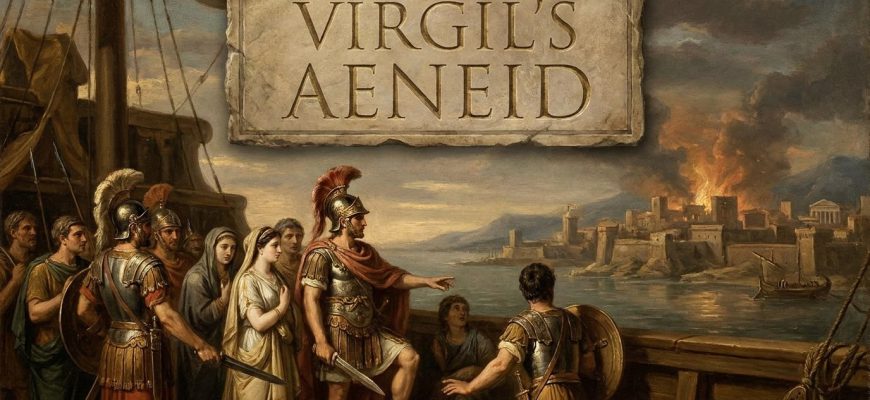
The Aeneid is an epic poem by the ancient Roman poet Virgil. It consists of twelve books divided into two major parts. The first six books recount Aeneas’s adventures as he travels from the fallen city of Troy to Italy. The remaining six describe the wars between the Trojan newcomers and the Italian tribes. The first half echoes Homer’s Odyssey, while the second resembles the Iliad.
Virgil did not manage to complete the poem during his lifetime. Some lines remained unfinished, and certain episodes contained contradictions. Unwilling to have The Aeneid published in an unpolished form, Virgil reportedly ordered that it be burned before his death.
- The Aeneid Main Characters analysis
- The Aeneid Summary
- Book I. The Aeneid Summary
- Book II. The Aeneid Summary
- Book III. The Aeneid Summary
- Book IV. The Aeneid Summary
- Book V. The Aeneid Summary
- Book VI. The Aeneid Summary
- Book VII. The Aeneid Summary
- Book VIII. The Aeneid Summary
- Book IX. The Aeneid Summary
- Book X. The Aeneid Summary
- Book XI. The Aeneid Summary
- Book XII. The Aeneid Summary
- What Happens After the Events of The Aeneid?
The Aeneid Main Characters analysis
- Aeneas — A Trojan hero who escapes the destruction of Troy and leads his people toward their destined homeland in Italy.
- Dido — Queen of Carthage, who welcomes Aeneas and falls in love with him.
- Juno — A goddess hostile to the Trojans who repeatedly tries to prevent Aeneas from reaching Italy.
- Venus — Aeneas’s mother and divine protector, who helps him throughout his journey.
- Jupiter — The supreme god, who confirms that Aeneas is destined to establish a new kingdom in Italy.
- Anchises — Aeneas’s elderly father, who shares important prophecies about the future of the Trojan people.
- Ascanius — Aeneas’s son, who accompanies his father on the journey and takes part in the battles in Italy.
- Turnus — The leader of the Rutulians and Lavinia’s former suitor, who becomes Aeneas’s principal enemy in Italy.
- Evander — A king from Greek Arcadia who settles on the Palatine Hill and becomes an ally of Aeneas.
- Pallas — Evander’s son, who fights alongside Aeneas.
- Latinus — The elderly king of Latium, who agrees to give his daughter Lavinia in marriage to Aeneas.
- Camilla — A courageous warrior from the Volscian tribe who fights on Turnus’s side.
The Aeneid Summary
Book I. The Aeneid Summary
Juno, the goddess hostile to the Trojans, pursues Aeneas as he sails toward Italy after the fall of Troy. At her request, Aeolus, the god of the winds, unleashes a terrible storm that nearly destroys the Trojan fleet. Only the intervention of Neptune, ruler of the sea, saves seven of Aeneas’s ships. They reach the coast of North Africa and arrive in wealthy Carthage.
Venus, Aeneas’s mother and divine protector, appeals to Jupiter, asking him to help her son fulfill his destiny and establish a kingdom on Italian soil. Jupiter agrees. Later, Venus appears to Aeneas in the form of a huntress and encourages him, while the god Mercury persuades the Carthaginians to welcome the arriving Trojans with honor.
In Carthage, Aeneas becomes the guest of Queen Dido, who organizes a magnificent banquet in his honor. Her wisdom and generosity are famous among the neighboring peoples. Dido had once lived in the Phoenician city of Tyre and was the daughter of King Belus. Before his death, he had ordered that Dido and her brother Pygmalion rule the city together. However, the greedy Pygmalion murdered Dido’s husband, leaving her no choice but to flee by sea with a group of loyal Tyrian followers.
After arriving in North Africa, Dido approached the Numidian king Hiarbas and purchased as much land as could be enclosed by an oxhide. She cut the hide into thin strips and used them to surround an entire hill. In this way, she founded the fortress of Byrsa, whose name means “hide” in Phoenician. A city soon grew around it: Carthage, whose name translates as “New City.”
Book II. The Aeneid Summary
In Book II, Aeneas tells Dido’s guests about the fall of Troy. He vividly describes the Greeks’ deception after their long and exhausting war: they resorted to the famous trick of the wooden horse. Greek warriors hidden inside it emerged during the night and attacked the sleeping Trojans.
Aeneas recounts the dramatic episode involving Laocoön, the Trojan priest who had urged his fellow citizens not to bring the Greek-built horse into the city. He and his two sons were strangled by enormous serpents that emerged from the sea.
During the attack by the Greeks who had emerged from the horse, the ghost of the fallen Hector appeared to Aeneas in a dream. Hector told him that Troy could no longer be saved and that those Trojans who were able to escape should seek a new home across the sea.
During the nighttime fire that consumed Troy, Aeneas fought heroically against the enemy. Before his eyes, the elderly King Priam was killed, and the famous prophetess Cassandra was captured by the Greeks. Aeneas’s wife, Creusa, also perished.
Finally, the goddess Venus persuaded Aeneas to abandon the hopeless struggle and save what remained of the Trojan people. Taking the city’s household gods, his son Ascanius, and carrying his elderly father Anchises on his shoulders, Aeneas escaped from the burning city with a small group of Trojans. They took refuge on nearby Mount Ida. During the winter, Aeneas and his companions managed to build fifty ships.
Book III. The Aeneid Summary
In Book III, Aeneas continues recounting his adventures.
After leaving Troy, he first landed on the coast of Thrace, where he intended to build a new city. However, when Aeneas and his companions began cutting young trees to decorate the altars of the gods, blood started dripping from their roots. They discovered that the place was the grave of Polydorus, the son of the Trojan King Priam, who had been murdered by the Thracians. The voice of Polydorus emerged from the earth and revealed what had happened. Aeneas regarded this as a bad omen, and his fleet left Thrace and sailed farther south.
Soon afterward, the Trojans reached Delos, the sacred island of Apollo. The oracle at Apollo’s sanctuary instructed Aeneas to sail to the ancient motherland of all Trojans but did not name the country. At first, the refugees assumed that it was the island of Crete, from which their ancestor Teucer had once migrated to Asia Minor.
Aeneas and his companions reached Crete, landed, and began building a city called Pergamea. However, a terrible heat soon dried up the land, and a plague killed many people. The gods then appeared to Aeneas and informed him that the Trojans had made a mistake. They had to leave Crete and sail to Italy, because that was the homeland of Dardanus, the founder of their people.
In the Ionian Sea, Aeneas’s fleet was caught in a terrible storm and barely managed to reach one of the Strophades Islands. There, herds of cattle and goats grazed unattended. The Trojans slaughtered several animals and began preparing a meal, but suddenly dreadful Harpies swooped down from every direction. These creatures were half-woman and half-bird and gave off a disgusting stench. They had settled on the island after the Argonauts had once driven them away from King Phineus. The Harpies tore apart all the Trojans’ food.
Aeneas and his companions tried to defend themselves with their swords. Then the Harpy Celaeno perched on a rock and delivered a prophecy: before the Trojans could establish their new city, they would suffer such terrible hunger that they would even eat their own tables.
The Trojans continued their journey and reached Epirus. There they learned that the ruler was Helenus, the son of Priam and brother of Hector, who had married Andromache, the widow of his fallen brother. Helenus welcomed Aeneas and his companions warmly. As a prophet, he told them that their new homeland awaited them in western Italy, near the River Tiber.
After leaving Epirus, Aeneas’s fleet sailed toward the eastern coast of Sicily. There, the travelers encountered the blind Cyclops Polyphemus, whom Odysseus had once blinded. The giant heard the sound of their oars and let out a terrifying roar. Other Cyclopes gathered in response to his call, but the Trojans managed to escape safely.
Aeneas did not dare to sail through the Strait of Sicily, where the terrifying monsters Scylla and Charybdis lay in wait. They had nearly destroyed Odysseus during his journey. Instead, the Trojans sailed around the southern coast of Sicily.
On the western side of the island, Aeneas’s father, Anchises, died. Before his death, he urged his son to trust the prophecy: the Trojan exiles were destined to establish a new city that would surpass the greatness and power of the old Troy.
Book IV. The Aeneid Summary
Book IV of The Aeneid is devoted to the famous mythological story of the love affair between Dido and Aeneas.
Queen Dido, captivated by Aeneas’s heroic deeds, wishes to marry him. During a hunting expedition, Dido and Aeneas take shelter from a storm in a mountain cave. There, amid flashes of lightning, they become lovers.
However, the gods have destined Aeneas for a great future in Italy, and he cannot remain with Dido. Jupiter himself sends Mercury to Aeneas in a dream to urge him to leave Africa and sail toward the Apennine Peninsula.
Dido’s attempts to keep her beloved in Africa prove futile. When Aeneas’s fleet sails away from the African coast, Dido curses him and foretells future wars between Rome and Carthage. She then throws herself onto a burning funeral pyre and runs herself through with a sword that Aeneas had given her.
Book V. The Aeneid Summary
Aeneas arrives in Sicily once again, where he organizes athletic games in honor of his deceased father, Anchises.
The goddess Juno, who continues to oppose Aeneas, incites the Trojan women to set fire to the ships so that the Trojans will be unable to continue their journey. However, Jupiter sends rain that extinguishes the flames and saves the fleet.
Afterward, Aeneas founds the city of Segesta in Sicily and eventually sails toward the shores of Italy.
Book VI. The Aeneid Summary
Aeneas arrives in Italy, at the city of Cumae. There, in the temple of Apollo, he consults the prophetess Sibyl, who advises him to descend into the underworld. He must meet his deceased father, Anchises, there in order to receive an important prophecy.
Guided by the Sibyl, Aeneas passes through the realm of the dead. He encounters terrifying monsters, crosses the River Styx with the ferryman Charon, puts the three-headed dog Cerberus to sleep, and meets the souls of fallen heroes.
Finally, he reaches Elysium, the land of the blessed, where the righteous live. There, Aeneas finds Anchises. His father shows him the illustrious descendants who will bring glory to Rome and gives him advice on how to act in the future wars against the Italian tribes. Afterward, Aeneas leaves the underworld.
The second part of The Aeneid depicts Aeneas’s wars in Italy, fought to establish the foundations of the future Roman state.
Book VII. The Aeneid Summary
Aeneas and his army land at the mouth of the River Tiber, in the territory of Latium. Exhausted and hungry after their long voyage, the Trojans gather fruit in the forest to satisfy their hunger. Since they have neither dishes nor tables, they place their food on thin bread cakes and eventually eat those as well.
Aeneas and his son Ascanius realize that the prophecy of the Harpies has come true: the Trojans have “eaten their own tables.” This means that they have finally reached the land destined by the gods to become their new homeland. Their interpretation is confirmed by a sign: three peals of thunder sent by Jupiter himself. Aeneas orders his warriors to establish a fortified camp near the sea.
Latium is ruled by an elderly king named Latinus. Many neighboring rulers seek the hand of his daughter Lavinia, especially Turnus, the leader of the neighboring Rutulian tribe.
However, Latinus receives advice from the god Faunus that he should give his daughter in marriage to a hero who will arrive from a distant land. The descendants of Lavinia and this hero are destined to rule the entire world.
When Latinus learns of the Trojans’ arrival, he understands that Aeneas is the hero described in the prophecy. The elderly king arranges Lavinia’s betrothal to Aeneas and grants the Trojan refugees land on which to settle.
But Juno, who is hostile to Aeneas, drives Turnus, Lavinia’s former suitor, and her mother Amata, who is Turnus’s aunt, into a frenzy of anger. During a hunt, Aeneas’s son Ascanius kills a tame deer that is greatly cherished by the people of Latium. This leads to a clash between the Latin youths, Ascanius, and the Trojans.
Amata begins stirring the people against the newcomers. King Latinus is unable to calm his agitated subjects.
Turnus takes advantage of the situation and joins forces with Mezentius, a king who had been driven out of Etruria. Together, they march against Aeneas. Fourteen more Italian tribes join them, taking the side of Aeneas’s enemies.
Book VIII. The Aeneid Summary
Aeneas is deeply troubled by the large number of enemies who have risen against the Trojans.
In Book VIII, the god of the River Tiber, Tiberinus, appears to him. He advises the hero to form an alliance with King Evander, a native of Greek Arcadia who has settled on the Palatine Hill, one of the seven hills of the future Rome.
Aeneas secures the support of Evander and his son Pallas. At Venus’s request, her husband, Vulcan, the divine blacksmith, forges magnificent weapons and a shield for Aeneas. The shield is decorated with images depicting Rome’s future victories and glory.
Book IX. The Aeneid Summary
Learning that Aeneas is away from the camp, Turnus decides to attack the Trojans. Aeneas’s warriors bravely repel the assault. Turnus then attempts to set fire to the Trojan ships anchored near the shore. But as he brings the flames close, Jupiter transforms the ships into sea nymphs. They break free from their moorings, dive into the water, and disappear into the sea.
Unable to capture the camp by storm, Turnus and the Rutulians lay siege to it.
During the night, two Trojan warriors, Nisus and Euryalus, decide to conduct a reconnaissance mission in the enemy camp. Their undertaking recalls the episode in the Iliad in which Diomedes and Odysseus carry out a nighttime raid.
Nisus and Euryalus quietly kill many sleeping Rutulians. However, on their way back at dawn, they encounter a large enemy force. Euryalus is surrounded. Nisus refuses to abandon his friend and rushes to his aid. Both heroes die in the unequal battle, displaying extraordinary courage and loyalty.
Enraged, Turnus launches another attack on the Trojan camp later that day. After a fierce clash, he breaks through the defenses and kills many Trojans. He then retreats and swims across the River Tiber, still holding his bloodstained weapons.
Book X. The Aeneid Summary
In Book X, Virgil describes Aeneas’s return with a large army of Etruscans. A new and fierce battle begins.
Turnus kills the young Pallas, the son of King Evander. This enrages Aeneas, who launches a determined assault and changes the course of the battle. His son Ascanius also supports his father by making a daring sortie from the camp.
At the height of the fighting, Aeneas comes close to defeating Turnus, but the goddess Juno saves him.
Meanwhile, Aeneas kills Mezentius, the exiled king of the Etruscans, and his son Lausus.
Book XI. The Aeneid Summary
After burying the fallen warriors, Aeneas sets out on another campaign against his enemies. He divides his army into two groups: he leads the infantry through the mountains, while the cavalry takes the plains.
Turnus prepares an ambush for Aeneas’s infantry and sends his ally Camilla against the cavalry. Camilla is a courageous warrior from the Volscian tribe, whom the poet portrays with great energy and vividness.
Camilla fights bravely but is killed by a spear thrown by a warrior named Arruns. After her death, the troops fighting alongside her begin to retreat.
When Turnus learns what has happened, he rushes to their aid and abandons the ambush he had prepared for Aeneas. As a result, Aeneas is able to lead his infantry through the dangerous mountain pass without encountering resistance.
When night falls, both armies fortify their camps and prepare for the next battle.
Book XII. The Aeneid Summary
Book XII of Virgil’s The Aeneid recounts the climax of the epic: the duel between Aeneas and Turnus.
Turnus agrees to settle the outcome of the war through single combat. The terms are established: if Turnus wins, the Trojans will settle in Evander’s lands and make no further claims to the territory of the Latins. If Aeneas wins, he will marry Lavinia, and the Trojans and Latins will unite into a single state. Latinus will formally remain king, but Aeneas, as his daughter’s husband, will inherit the throne.
However, conspirators encouraged by the goddess Juno break the agreement and launch a surprise attack on the Trojans. During the fighting, Aeneas is seriously wounded by an arrow, but his mother, the goddess Venus, heals him.
Unable to find Turnus, Aeneas leads his army toward the city of Laurentum, intending to destroy it in retaliation for the broken agreement. Panic spreads through the city.
Queen Amata, believing herself responsible for the war and thinking that Turnus has been killed, takes her own life by hanging herself with her purple mantle. When Turnus learns what has happened, he hurries back to save Laurentum. Nothing can now prevent the inevitable duel between him and Aeneas.
Virgil describes the combat between the two heroes in grand detail. First, they throw spears at each other, then engage in a sword fight. Turnus’s sword breaks against the magical armor forged for Aeneas by Vulcan.
Aeneas’s spear becomes stuck in an olive tree, but Venus comes to her son’s aid once again. Turnus tries to lift a heavy stone and hurl it at Aeneas, but he cannot manage it. Aeneas then throws his spear, which pierces Turnus’s shield and armor and severely wounds him in the thigh.
The poem ends with this confrontation, leaving the final events of the story unresolved.
What Happens After the Events of The Aeneid?
The continuation of The Aeneid, which Virgil did not live long enough to complete, was expected to describe the reconciliation and unification of the Latins and Trojans. Aeneas was to marry Lavinia, the daughter of King Latinus, and become the founder of a great dynasty.
Some versions of the myth state that a son named Iulus was born from this marriage. He became the founder of the Julian family, from which Julius Caesar and Octavian Augustus descended many centuries later. Other traditions identify Iulus with Ascanius, Aeneas’s son from his first marriage.
After defeating Turnus, Aeneas founded a city on the River Tiber and named it Lavinium in honor of his wife. Thirty years later, his son Ascanius, also known as Iulus, founded another, even more famous city: Alba Longa.
Approximately two hundred years after that, Aeneas’s descendants and the descendants of Iulus-Ascanius, the brothers Romulus and Remus, established and built the great city of Rome.
Якщо ви не знайшли потрібну відповідь, можете запитати у нашого чат-бота у Телеграм.