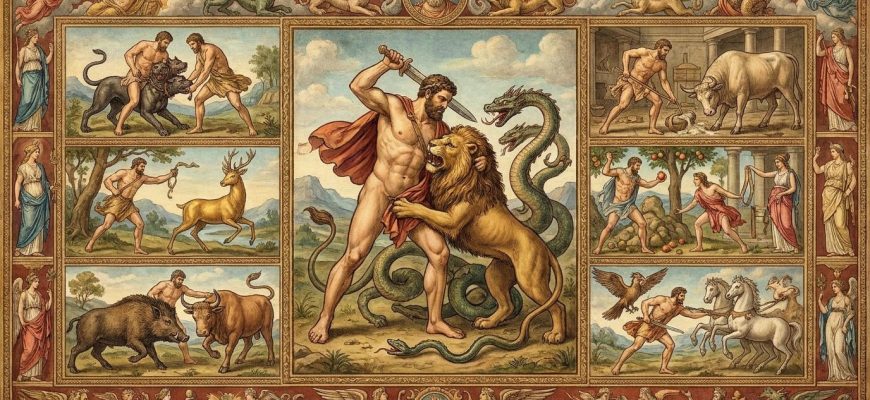
The Myths of Hercules are a collection of ancient Greek stories about the legendary hero, the son of Zeus and the mortal woman Alcmene, and his famous twelve labors performed for King Eurystheus. The exact authorship of these myths is not attributed to a single writer, as they belong to ancient Greek mythology and were preserved in different literary traditions.
- Myths of Hercules Main Characters analysis
- Myths of Hercules Summary
- The First Labor of Hercules — The Nemean Lion
- The Second Labor of Hercules — The Lernaean Hydra
- The Third Labor of Hercules — The Capture of the Erymanthian Boar
- The Fourth Labor of Hercules — The Capture of the Ceryneian Hind
- The Fifth Labor of Hercules — The Destruction of the Stymphalian Birds
- The Sixth Labor of Hercules — The Belt of Hippolyta
- The Seventh Labor of Hercules — The Augean Stables
- The Eighth Labor of Hercules — The Cretan Bull
- The Ninth Labor of Hercules — The Mares of Diomedes
- The Tenth Labor of Hercules — The Cattle of Geryon
- The Eleventh Labor of Hercules — Cerberus
- The Twelfth Labor of Hercules — The Golden Apples of the Hesperides
Myths of Hercules Main Characters analysis
- Hercules (Heracles) — the son of Zeus and Alcmene and the central hero of the myths. Originally named Alcides, he possesses extraordinary strength and becomes famous for completing twelve difficult labors.
- Zeus — the king of the Olympian gods and Hercules’s father. He expects Hercules to become an unmatched Greek hero and initially hopes to make him immortal.
- Hera — Zeus’s wife, who hates Hercules because he is the son of Zeus and another woman. She repeatedly creates obstacles for him, including attempts to kill him when he is still a child.
- Alcmene — Hercules’s mortal mother. Hera delays her labor so that Eurystheus can be born first and gain power over Hercules.
- Eurystheus — the weak and cowardly king of Mycenae who becomes Hercules’s master. He orders Hercules to complete the labors that make the hero famous.
- Chiron — the wise centaur who raises and educates Hercules, teaching him archery, music, fighting, and eloquence.
- Iolaus — Hercules’s companion who helps him during the battle with the Lernaean Hydra.
- Artemis — the goddess associated with the Ceryneian Hind. She becomes angry with Hercules after he wounds the sacred animal but eventually forgives him.
- Athena — the goddess who helps Hercules defeat the Stymphalian Birds by giving him bronze instruments.
- Hippolyta — the queen of the Amazons whose belt becomes the object of Hercules’s sixth labor.
- Atlas — the giant whom Hercules meets while searching for the golden apples of the Hesperides. Hercules eventually outwits him and takes the apples.
- Cerberus — the monstrous three-headed dog guarding the realm of the dead, whom Hercules must bring to Eurystheus as his eleventh labor.
Myths of Hercules Summary
Hercules was the son of Zeus and the mortal woman Alcmene. Countless literary works, sculptures, and paintings by famous artists from around the world have been devoted to him. Even today, animated films and computer games about the adventures of Hercules continue to be created.
His real name was Alcides, meaning “strong.” He received the name Hercules because of the hatred of Zeus’s wife, Hera. Literally, the name “Hercules” means “glory of Hera,” or “through Hera.” The ancient Greeks had already noticed this contradiction. Yet that was precisely how things turned out: Hera hated Hercules and placed all kinds of obstacles in his path, and by overcoming them, the hero became increasingly famous.
Zeus eagerly awaited the birth of Hercules, who was destined to help the Olympians defeat the Giants in war. He already knew that his son would become an unmatched Greek hero. Hera, however, had other plans. On the day Hercules was supposed to be born, Zeus boasted before the Olympian gods that the child from his descendants who was born that day would become ruler of Mycenae. Hera pretended not to believe her husband and, in the presence of the other gods, asked Zeus to swear an unbreakable divine oath that this would indeed happen. Zeus, failing to notice her trick, took the oath.
Hera then delayed Alcmene’s labor and hastened the birth of Eurystheus, the son of the queen of Mycenae. Eurystheus was indeed a descendant of Zeus, although he was his great-grandson rather than his son, as Hercules was. Only then did Zeus realize that he had been deceived, but it was already too late—the oath could not be broken.
Thus, the frail and cowardly Eurystheus became ruler of Mycenae, while Hercules was forced to serve him. But this was still not enough for Hera. She planned to kill the boy while he was still very young and sent two enormous poisonous snakes into his cradle. However, the infant possessed such extraordinary strength that he strangled the snakes instantly with his tiny hands. Thus, even as a child, Hercules became a serpent slayer.
An interesting Greek myth is also associated with Hercules and the origin of the constellation we call the Milky Way. Even before Hercules was born, Zeus dreamed of making his son immortal. To accomplish this, however, Hercules had to be not only the son of a god but also drink the milk of a goddess at least once. So one of the Olympians secretly placed the baby beside Hera while she was sleeping, hoping that he would drink her milk without waking her.
But the mischievous child began suckling with such force that Hera suddenly pushed him away in her sleep, and her milk splashed across the heavens. This, according to the myth, was how our Galaxy—the Milky Way—came into existence. The very word “galaxy” comes from the Greek word galaktikos, meaning “milky.”
Hercules was raised by the wise centaur Chiron, a mythical creature with the lower body of a horse and the upper body of a human. Chiron and his other teachers taught the boy how to use a bow and lyre, as well as the techniques of boxing and the art of eloquence. Hercules soon surpassed all his teachers, but he respected them greatly and remained grateful for what they had taught him.
According to a prophecy, Hercules was destined to serve the weak and timid Mycenaean king Eurystheus for twelve years and, during that service, complete ten labors. He did complete them. However, because Eurystheus refused to count two of the labors, their number eventually increased to twelve. Thus arose the famous myths of the Twelve Labors of Hercules.
The First Labor of Hercules — The Nemean Lion
Hercules was forced to serve King Eurystheus after killing his own sons during a fit of madness. Eurystheus immediately ordered Hercules to destroy the fierce Nemean Lion.
Hercules found the lion’s lair, blocked one of its exits, and waited for the monster near the other. When the lion appeared, Hercules shot arrows at it, but they simply bounced off its thick hide. Hercules then knocked the lion down with his club and strangled it with his bare hands. Afterward, he skinned the Nemean Lion and began wearing its hide as armor.
The Second Labor of Hercules — The Lernaean Hydra
King Eurystheus ordered Hercules to destroy the ten-headed Lernaean Hydra, a monster that killed people. Hercules set out with his friend Iolaus but demanded that Iolaus not interfere in the fight.
Hercules set the marsh on fire with his arrows, and when the Hydra emerged, he began cutting off its heads. But for every head that was severed, two new ones immediately grew back, leaving Hercules surrounded by a growing mass of heads.
Iolaus began cauterizing the severed necks, preventing new heads from growing. Hercules killed the Hydra and dipped the tips of his arrows into its poisonous blood.
The Third Labor of Hercules — The Capture of the Erymanthian Boar
King Eurystheus ordered Hercules to capture the enormous Erymanthian Boar.
The centaur Pholus gladly welcomed Hercules and held a feast in honor of the hero. The other centaurs became offended and attacked Hercules, who began striking them with his poisoned arrows. To escape, the centaurs hid in the cave of Chiron, the centaur who had raised Hercules during his childhood.
Hercules accidentally struck Chiron in the knee with one of his arrows and wept for a long time over the body of his friend, whom he had wounded by accident. He eventually captured the boar and brought it to Eurystheus, who was so frightened that he climbed into a bronze vessel.
The Fourth Labor of Hercules — The Capture of the Ceryneian Hind
King Eurystheus ordered Hercules to capture the swift Ceryneian Hind with its golden antlers.
The hind easily leaped across ravines, and Hercules chased it all the way to the land of the Hyperboreans and back. Finally, he shot the animal with his bow and wounded it in the leg.
The angry Artemis appeared before Hercules and began to confront him about what he had done. Hercules placed the blame on Eurystheus, whose orders he was forced to carry out.
Artemis forgave Hercules, but she kept her anger toward Eurystheus.
The Fifth Labor of Hercules — The Destruction of the Stymphalian Birds
King Eurystheus ordered Hercules to drive the Stymphalian Birds out of the land. They had sharp feathers and bronze beaks, attacked people, and devastated the flourishing countryside.
Athena appeared to Hercules and gave him bronze instruments, teaching him how to defeat the birds. Hercules put on the hide of the Nemean Lion and struck the bronze instruments. When the birds gathered together, he began shooting at them with his bow.
The birds started throwing their feathers at Hercules, but the feathers could not pierce the hide of the Nemean Lion. Frightened, the birds flew away from Greece toward the shores of the Pontus Euxinus.
The Sixth Labor of Hercules — The Belt of Hippolyta
At his daughter’s request, Eurystheus ordered Hercules to bring him the belt of Hippolyta, the queen of the Amazons.
Hercules sailed with his loyal companions and visited several islands and Troy, performing heroic deeds wherever he went. When Hippolyta learned why Hercules had come, she wanted to give him the belt. However, Hera confused the minds of the Amazons.
The Amazons attacked Hercules and his companions and killed several of them before Hercules entered the battle. Hercules killed many of the Amazons, and Hippolyta gave him the belt. Another Amazon later became the wife of Theseus.
Hercules brought the belt to Eurystheus. He gave it to his daughter, and she eventually returned the belt to the temple of Hera.
The Seventh Labor of Hercules — The Augean Stables
King Eurystheus sent Hercules to King Augeas and ordered the hero to clean his stables.
The stables of Augeas had not been cleaned for years, and Hercules demanded one tenth of the king’s herd in exchange for cleaning them. King Augeas only laughed, believing that such a task was impossible for anyone.
But Hercules changed the course of a river, and the water washed all the filth out of the stables.
Augeas then sent his nephews against Hercules, but the hero killed them and later killed Augeas as well.
The people asked Hercules to take the throne instead of Augeas, but Hercules refused. He gave the throne to Augeas’s son and ordered that the Olympic Games be held in the land of Elis in honor of Zeus.
The Eighth Labor of Hercules — The Cretan Bull
Eurystheus ordered Hercules to bring him the white Cretan Bull.
The bull had swum to the island of Crete on its own, and King Minos kept it instead of sacrificing it as he was supposed to. The gods drove the bull mad, and it began killing people.
A storm carried Hercules to Egypt, where King Busiris chained the hero in order to sacrifice him. Hercules broke free and killed King Busiris with the chains. Later, on Crete, he used the same chains to capture the bull.
Hercules brought the bull to Eurystheus, but the animal escaped. It was later killed by Theseus.
The Ninth Labor of Hercules — The Mares of Diomedes
Eurystheus ordered Hercules to obtain the mares of Diomedes, which fed on human flesh.
Hercules arrived in Thessaly and learned that King Admetus’s beloved wife, Alcestis, had died. Hercules waited for the god of death, Thanatos, and forced him to return Alcestis.
Hercules then traveled to Thrace and demanded that Diomedes surrender the horses. Diomedes sent his army against Hercules, but the hero defeated them all.
He brought the horses to Eurystheus, who released them into the mountains.
The Tenth Labor of Hercules — The Cattle of Geryon
To bring Geryon’s cattle to Mycenae, Hercules crossed Africa and erected his pillars on the shore of the ocean.
He encountered the god Helios, who carried Hercules in his chariot to the island of Geryon. There, Hercules had to fight a huge dog and a herdsman.
Then he fought Geryon himself, a six-armed giant, and killed him with his club. Helios gave Hercules his chariot so that he could transport the herd.
Hercules drove the cattle to Eurystheus, who sacrificed them.
The Eleventh Labor of Hercules — Cerberus
King Eurystheus ordered Hercules to bring him Cerberus, the dog from the realm of the dead.
At the entrance to the underworld, Hercules freed Theseus, who had been trapped and grown into the rock. Hercules witnessed many horrors in the realm of the dead and promised Meleager that he would marry his sister.
Hades agreed to let Hercules take Cerberus, but the hero had to subdue the dog first.
Hercules strangled Cerberus with his bare hands and led him to Eurystheus. Terrified, Eurystheus begged Hercules to return Cerberus to the realm of the dead.
The Twelfth Labor of Hercules — The Golden Apples of the Hesperides
To find the way to the gardens of Atlas, Hercules ambushed the sea god Nereus and defeated him in combat.
In Libya, Hercules encountered the giant Antaeus. Hercules lifted him into the air and strangled him.
In Egypt, Hercules was about to be sacrificed, but he killed King Busiris and continued on his way.
Hercules found Atlas and asked him to bring him the three golden apples of the Hesperides. Atlas wanted to trick Hercules into holding up the sky in his place.
But Hercules outwitted Atlas himself and took the apples from him.
After these labors, Hercules completed his service to Eurystheus.
Якщо ви не знайшли потрібну відповідь, можете запитати у нашого чат-бота у Телеграм.