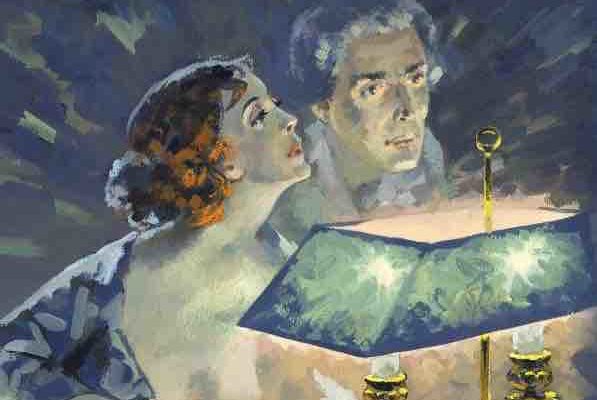
Written over more than a decade and revised repeatedly, Mikhail Bulgakov’s The Master and Margarita is a satirical novel that blends supernatural events, philosophical questions, and a love story. First published in 1966–1967, the novel follows the Devil’s extraordinary visit to Moscow, the fate of a persecuted writer and his beloved, and the story of Pontius Pilate and Yeshua Ha-Nozri.
- The Master and Margarita Main Characters analysis
- The Master and Margarita Summary
- The Stranger at Patriarch’s Ponds
- Pontius Pilate and Yeshua Ha-Nozri
- Woland Takes Over Apartment No. 50
- The Disappearance of Varenukha
- The Black Magic Performance
- Ivan Meets the Master
- Rimsky’s Escape
- Levi Matthew and the Execution of Yeshua
- Chaos at the Variety Theatre and the Griboyedov House
- Margarita’s Despair
- Margarita’s Transformation and Revenge on Latunsky
- Margarita Becomes the Queen of the Ball
- The Satanic Ball Begins
- Margarita’s Reward
- The Master and Margarita Return Home
- Pontius Pilate’s Final Orders
- Judas’s Death
- Pilate’s Dream
- The Burial of Yeshua
- The Master and Margarita Fall Asleep
- The Investigation into Woland’s Visit
- Behemoth and Koroviev’s Final Mischief
- Levi Matthew’s Request
- The Master and Margarita’s Death and Return
- The Departure from Moscow
- Pilate’s Release
- The Fate of Moscow’s Witnesses
- Ivan Ponyrev’s Dreams
The Master and Margarita Main Characters analysis
- Woland — A mysterious foreigner who arrives in Moscow with his supernatural entourage. He reveals the hypocrisy, greed, and weaknesses of the people he encounters.
- The Master — A writer who creates a novel about Pontius Pilate but faces rejection and persecution. His suffering leads him to a psychiatric hospital, where he eventually meets Ivan Bezdomny.
- Margarita — The Master’s beloved, a married woman who refuses to abandon him. She agrees to become the hostess of Woland’s ball in the hope of reuniting with the Master.
- Ivan Bezdomny (Ivan Ponyrev) — A young poet who encounters Woland and witnesses the strange events surrounding Berlioz’s death. Initially taken to a psychiatric hospital, he later becomes a scholar.
- Mikhail Alexandrovich Berlioz — The editor of a popular magazine and chairman of MASSOLIT. He dismisses religious belief and is killed in an accident that Woland predicts.
- Pontius Pilate — The Roman procurator of Judea who must decide the fate of Yeshua Ha-Nozri. His fear of political consequences leads him to approve Yeshua’s execution, a decision that torments him for centuries.
- Yeshua Ha-Nozri — A wandering philosopher accused of threatening the established religious order. He believes that there are no evil people and that truth and goodness can transform human beings.
- Koroviev (Fagot) — One of Woland’s principal companions, known for his checkered clothes, theatrical manner, and talent for deception.
- Behemoth — A gigantic black cat who accompanies Woland and Koroviev, causing chaos through his outrageous behavior and supernatural tricks.
- Azazello — A demonic member of Woland’s entourage who carries out dangerous assignments and helps Margarita transform and reunite with the Master.
- Hella — Woland’s supernatural maid, who is revealed to be a vampire and helps prepare for the Devil’s ball.
- Stepan Likhodeev — The director of the Variety Theatre, who is abruptly transported from Moscow to Yalta after Woland’s arrival.
- Nikanor Bosoy — The chairman of the building association where Berlioz lived. He accepts money from Koroviev and is arrested after being accused of currency speculation.
- Rimsky — The Variety Theatre’s financial director, who witnesses the supernatural terror surrounding the theatre and eventually flees Moscow.
- Varenukha — The theatre’s administrator, who becomes a victim of Woland’s entourage and is transformed into a vampire.
- Aloysius Mogarych — An acquaintance of the Master who betrays him and occupies his basement apartment after his arrest.
- Levi Matthew — Yeshua’s devoted follower, who witnesses the consequences of the execution and later carries a request from Yeshua to Woland.
- Frida — A woman condemned to an endless punishment for killing her child. Margarita’s compassion leads her to ask Woland to release Frida from her torment.
- Pontius Pilate’s dog, Banga — The procurator’s faithful companion, who remains beside him during his long spiritual suffering.
The Master and Margarita Summary
Bulgakov worked on the novel for more than ten years. He rewrote its chapters many times and changed their titles repeatedly. During the final years of his life, his wife recorded chapters of the novel from his dictation.
The Stranger at Patriarch’s Ponds
It is spring in Moscow. Mikhail Alexandrovich Berlioz, the editor of a popular magazine and chairman of MASSOLIT, sits on a bench near Patriarch’s Ponds with Ivan Bezdomny, a young poet. They discuss religion and atheism. Ivan has been commissioned to write a poem that clearly explains that God does not exist. Berlioz criticizes his work because, in his opinion, the poem does not deny God’s existence so much as ridicule Christ.
The weather is hot, and Berlioz feels unwell. He imagines a tall man wearing a bowler hat, with an insolent expression on his face.
A stranger emerges from a deserted alley. Witnesses later describe him differently: some claim that he limped, others remember him as exceptionally tall and wearing platinum crowns on his teeth, while still others insist that he was short and had gold crowns. The narrator describes him as a tall, dark-haired man who does not limp and has platinum crowns on one side of his mouth and gold ones on the other. His eyes are different colors, one black and the other green. His clothing and manner suggest that he is a foreigner of about forty. He carries a walking stick topped with the head of a poodle.
The stranger sits between the two writers and asks what they think of the five proofs of God’s existence. He then asks who controls a person’s life. Berlioz replies that people control their own lives. The stranger challenges this answer, pointing out that human beings are mortal and cannot even know what they will be doing that evening.
He predicts that a Komsomol girl will cut off Berlioz’s head. He then asks about the editor’s plans for the evening and declares that the scheduled meeting will not take place because Annushka has already spilled the cooking oil.
Ivan asks whether the stranger has ever been treated in a psychiatric hospital. In response, the man advises Ivan to ask Professor Stravinsky himself what schizophrenia is.
The writers suspect that the stranger is a spy. They become convinced that he can read minds and discover that he carries a passport identifying him as a consultant in black magic. He also insists that Jesus existed and that no proof is needed. Then he begins to tell them a story.
Pontius Pilate and Yeshua Ha-Nozri
The stranger tells the story of Pontius Pilate, the procurator of Judea. A prisoner named Yeshua Ha-Nozri is brought before him, accused of intending to destroy the temple in Jerusalem.
Yeshua calls the procurator a good man. For this, he is beaten with rods and ordered to address Pilate as hegemon. In defending himself against the accusations, Yeshua explains that Levi Matthew recorded his words incorrectly. He had merely said that the temple of the old faith would fall and that a temple of truth would be established in its place.
Pilate is suffering from a terrible migraine. He thinks about poison that could free him from his torment forever.
When Pilate asks what truth is, Yeshua replies that truth lies in the headache tormenting the procurator and in his desire for his beloved dog to come to him. Yeshua then says that the headache will pass, and the pain genuinely disappears.
Pilate asks why Yeshua calls everyone a good person. The prisoner answers that there are no evil people on earth.
Temporarily freed from his migraine, Pilate wants to save the unfortunate prisoner from death. However, in addition to the accusation of threatening the temple, Yeshua has also been accused of insulting Caesar. He has spoken of political power as violence against people.
Pilate has no choice, as he sees it, but to approve the charges and send Yeshua Ha-Nozri to his execution. Three other criminals are also sentenced to death.
In honor of the spring Passover festival, the high priest asks that Barabbas be pardoned. Pilate wants Yeshua to be released instead, but Caiaphas remains adamant. Pilate threatens him, yet the threat achieves nothing. The procurator announces to the people that Barabbas has been pardoned, and preparations for the executions begin.
Berlioz is deeply impressed by the story, but he argues that it bears little resemblance to the truth. The professor replies that he himself was on Pilate’s balcony at the time. The writers conclude that the stranger really must be insane.
When Berlioz asks where the professor is staying, he replies that he has not found accommodation yet but intends to live in their apartment. Outraged, the editor runs off to telephone the embassy.
Outside, he sees a tram approaching and steps backward. He slips on spilled sunflower oil and falls directly onto the rails. The tram runs over him, severing his head.
Ivan Bezdomny hears someone blaming Annushka for spilling the oil. He decides to seize the professor, but the stranger is joined by a regent in a checkered jacket—Koroviev, also known as Fagot—and a gigantic black cat.
The three disappear into a dark alley. Ivan runs after them, but he cannot close the distance.
Unable to catch the professor, Bezdomny ends up swimming in the Moskva River. When he climbs out, he discovers that his clothes have been stolen. Wearing only his underwear and carrying a candle and a small icon, he arrives at Griboyedov House, the literary headquarters of MASSOLIT.
He announces that a foreigner has murdered Berlioz and must be caught immediately. Ivan is taken to a psychiatric hospital, where he is diagnosed with schizophrenia.
Woland Takes Over Apartment No. 50
Stepan Likhodeev, the director of the Variety Theatre, shares apartment No. 50 with Berlioz. Suffering from a hangover, he sees a mysterious man who is signing a contract with him for a black magic performance. Likhodeev also notices a strange fellow wearing pince-nez and a checkered jacket, as well as an enormous cat.
The magician explains that he and his entourage will be living in the apartment and that there is no longer room for Stepan. When Likhodeev protests, Azazello emerges from a mirror and declares that Stepan must be thrown out of Moscow. The cat shouts for him to get lost, and Likhodeev suddenly finds himself on the shore in Yalta.
Nikanor Bosoy, chairman of the housing association in Berlioz’s building, has grown tired of people competing for the deceased man’s room. He decides to visit apartment No. 50 himself.
There he meets Koroviev, who assures him that Stepan has written a letter requesting that a foreigner be allowed to move into his apartment. Koroviev claims that the letter is in Bosoy’s briefcase. When Bosoy opens it, he finds the letter exactly where Koroviev said it would be.
Koroviev gives him five thousand rubles and a pair of complimentary tickets to the black magic performance.
Later, Koroviev makes a telephone call to report that Bosoy is speculating in foreign currency and that the money can be found in the ventilation shaft of his lavatory. Bosoy has indeed hidden the rubles there, but when the authorities search the place, they discover dollars instead. Bosoy is arrested.
The Disappearance of Varenukha
Rimsky, the Variety Theatre’s financial director, and Varenukha, its administrator, search for the missing Likhodeev. They are preparing for Woland’s performance, advertised as A Séance of Black Magic and Its Complete Exposure, even though neither of them has ever seen the magician.
A telegram arrives at the theatre from Yalta. The local authorities want confirmation of the identity of a half-naked man who has appeared at the Yalta police station claiming to be Likhodeev.
Rimsky and Varenukha initially send a reply denying his identity. However, several more telegrams arrive, and they realize that the man really is Stepan.
Despite receiving a strange telephone call warning him not to go anywhere, Varenukha sets out for the police station. On the way, near a public lavatory, he is attacked by a fat man who resembles a cat, while the attacker’s tall companion takes his briefcase.
Varenukha is then taken to Stepan’s apartment, where Hella, Woland’s naked maid, transforms him into a vampire.
The Black Magic Performance
The performance begins at the Variety Theatre. Woland settles into an armchair onstage and starts discussing with Koroviev how much Muscovites have changed over time.
The master of ceremonies, Georges Bengalsky, turns Woland’s criticism into enthusiastic praise. Koroviev accuses him of lying.
Next, Koroviev and the cat perform card tricks. Cards fly into the audience’s hands and turn into gold coins. Bengalsky interrupts again, announcing that the tricks are about to be exposed.
Koroviev decides to punish the insolent master of ceremonies, and members of the audience call for his head to be torn off. The cat carries out the punishment. When the spectators see Bengalsky standing before them without a head, however, they beg for his life to be spared.
His head is restored, and he is driven off the stage. He waves his arms and screams, and, having lost his mind, is taken to a psychiatric hospital.
Koroviev then opens a Parisian fashion shop right onstage, offering spectators the chance to exchange their clothes for fashionable foreign garments. Almost the entire audience visits the shop, grabbing whatever catches their eye.
Ivan Meets the Master
In the psychiatric hospital, Ivan Bezdomny makes repeated but unsuccessful attempts to write a statement for the police. Then he notices someone on the balcony. The man enters his room and explains that he borrowed the keys from a nurse named Praskovya Fyodorovna and sometimes takes walks on the balcony.
Ivan tells him about the mysterious stranger and the story of Pontius Pilate. His visitor reveals that he, too, wrote about Pilate. He explains that Ivan encountered Satan himself at Patriarch’s Ponds.
The man regrets never having met Woland personally, since the story of Pilate was the very reason he ended up in the hospital.
He calls himself the Master, a name given to him by the woman he loves.
One day, the Master won a lottery prize. With the money, he rented two small rooms near the Arbat and began writing a novel about Pontius Pilate.
Later, while out walking, he met the woman who would become his beloved. She predicted that his novel would achieve fame and sewed him a little cap embroidered with the letter M. She was married, so the two met in secret.
The novel was rejected for publication, and a passage that did appear in print was fiercely criticized by Latunsky. The Master fell into depression.
His new acquaintance, Aloysius Mogarych, whom Margarita disliked, began offering him advice about how to write the novel. As the Master continued working, his chapters became increasingly aggressive.
He began to experience an overwhelming sense of fear and told Margarita that he was ill. She promised that the following day she would stay with him forever.
But the next day, the Master was arrested, and Aloysius Mogarych moved into their little basement apartment. After his arrest, the Master was brought to the psychiatric hospital. He did not tell his beloved where he was.
Rimsky’s Escape
That evening, Rimsky sits in his office and hears a police siren outside. Women are standing in the street without clothes because the Parisian dresses and stockings they received during the performance have disappeared.
Rimsky picks up the telephone but hears a command not to call anyone. He remains in his office throughout the night, afraid to leave.
Varenukha enters and explains that Stepan has been sending telegrams from the Yalta Tavern and was taken to a sobering-up station. Rimsky notices that Varenukha is behaving strangely. He then realizes that the administrator, who is sitting beneath a lamp, casts no shadow.
Rimsky tries to escape, but Varenukha locks the door, while Hella begins climbing through the window. The crowing of a rooster finally saves Rimsky from the vampires. At dawn, he leaves Moscow.
Nikanor Bosoy, the chairman of the housing association in apartment building No. 50, is also taken to a psychiatric hospital because he is considered unfit for questioning. He runs around his room trying to catch the devil and repeatedly crosses himself.
Levi Matthew and the Execution of Yeshua
Levi Matthew runs after the caravan heading toward the execution site. He wants to kill Yeshua with a knife to spare him the suffering of dying on the cross, but he arrives too late.
Yeshua hangs alongside the other condemned men under the scorching sun. Their suffering eventually comes to an end when the hegemon orders that they be given water and that their hearts be pierced with spears.
Chaos at the Variety Theatre and the Griboyedov House
The Variety Theatre is left without an administration. Stepan’s apartment stands empty, and the money distributed during the black magic performance has turned into worthless scraps of paper.
The cat Behemoth and Fagot continue their mischief at the entertainment commission building. The chairman has disappeared, but his suit continues to perform his duties and even makes telephone calls.
All the commission’s employees begin singing The Glorious Sea, Sacred Baikal in a chorus conducted by Fagot. They cannot stop themselves from singing and are eventually taken to Professor Stravinsky’s hospital.
Meanwhile, Poplavsky, Berlioz’s uncle from Kyiv, receives a telegram supposedly sent by his deceased nephew. Written in the first person, it reports Berlioz’s own death.
The uncle travels to Moscow hoping to secure the valuable living space in apartment building No. 50. However, Woland’s entourage throws him out.
A buffet manager named Andrei Fokich then visits the apartment, furious that he has been paid in scraps of paper instead of money. Woland accuses him of selling sturgeon that is not even of the second freshness. Fagot predicts that within nine months Fokich will develop liver cancer and die.
Margarita’s Despair
Margarita is miserable. Every day, she waits for her beloved Master in Alexander Garden.
While sitting on a bench, she sees a funeral procession and hears people saying that the dead man’s head has been stolen. Suddenly, Azazello appears beside her.
He points out Latunsky in the crowd and invites Margarita to dinner with the foreigner. She refuses, calling Azazello a procurer, and walks away.
Azazello calls after her, telling her that she can stay where she is and continue waiting for her Master if she wishes. Margarita turns back. He offers her hope and gives her a cream that she must apply all over her body that evening. Then Azazello disappears.
Margarita’s Transformation and Revenge on Latunsky
After waiting a little longer for evening, Margarita rubs the cream over her body. She is astonished by the transformation. Her wrinkles disappear, her skin becomes smooth, and her hair curls into ringlets.
Overjoyed, she writes a farewell letter to her husband. Her housekeeper, Natasha, sees her, and Margarita gives her belongings away before saying goodbye.
Azazello calls and orders her to fly away, telling her to shout the word that will make her invisible. Margarita mounts a broom and takes off.
Flying over Moscow, she sees the House of Writers. She then heads for Latunsky’s apartment and wreaks havoc inside, smashing windows and turning on every tap.
After flying around the city for some time, Margarita heads toward a river. Natasha catches up with her after deciding to use the remaining cream herself. She is riding a pig in which Margarita recognizes their neighbor, Nikolai Ivanovich, who has been transformed.
Margarita Becomes the Queen of the Ball
A marching band plays to celebrate Margarita’s arrival at the river, while witches dance at their sabbath. Natasha flies back to Moscow to announce the arrival of the queen of the evening.
Margarita returns to the city in a car driven by a black rook. Preparations for the ball are underway at apartment No. 50 on Sadovaya Street. The interior has expanded to incredible proportions, and the staircase leading from the entrance seems endless.
Azazello introduces Margarita to Koroviev, who explains that Woland holds a ball on the night of every full moon and needs a hostess for the occasion. The woman must be named Margarita and must have royal blood.
Koroviev offers her the position, and Margarita agrees.
He leads her to Woland. Hella is applying ointment to Woland’s aching knee while he plays chess against Behemoth using living pieces.
Margarita offers to help and begins rubbing ointment into Woland’s painful knee herself. On the table stands a globe that shows everything happening in the world.
Looking at it, Margarita sees a mother and child dying in a fire. Woland explains that he is merely an observer. He praises Abaddon, the demon of war, whose work he considers flawless, and decides to introduce him to his guest.
The Satanic Ball Begins
Margarita is prepared for the ball. She is bathed and dressed with only shoes and a medallion shaped like a black poodle’s head, suspended from a heavy chain around her neck.
Koroviev gives her several instructions on how a hostess of the ball should behave.
The festivities begin with an orchestral fanfare conducted by Strauss. Margarita takes her position at the top of the long staircase to welcome the guests.
She must offer her hand to the men from the realm of the dead so they can kiss it, while presenting her knee to the women for the same purpose.
The guests arrive through a fireplace chimney. Koroviev introduces them to Margarita: murderers, alchemists, and men who have been hanged.
She must show respect to each one without giving special attention to anyone.
Margarita grows increasingly exhausted. Then Frida appears, and Koroviev explains her story. Frida once strangled her child with a handkerchief because she had nothing to feed it. Every morning, she is presented with the same handkerchief, regardless of what she did with it the previous day.
Frida looks at Margarita pleadingly. The queen of the ball feels sorry for her and advises her to have a drink. Without realizing it, Margarita gives the condemned woman hope that she might be freed from her punishment.
Margarita’s knee swells from all the kisses, and she can barely remain standing. At last, the final guests arrive.
After greeting them, Margarita tours all the halls, supported by Koroviev and Behemoth, making sure to pay attention to every guest.
Woland appears, accompanied by Abaddon. Azazello presents him with Berlioz’s living head on a platter, and Woland begins speaking to it.
He declares that everything has come to pass and that Berlioz was wrong to insist that everything ultimately disappears into nothingness. Since everyone receives according to their faith, Woland sends Berlioz to the nothingness in which he believed.
The severed head transforms into a goblet.
Another guest at Satan’s ball is Baron Meigel, a man from the world of the living. He is an informant who requested an invitation so he could spy on the supernatural gathering and listen to its secrets.
He is killed with a sword, and his blood fills the goblet that was once Berlioz’s head.
Woland drinks the wine and invites Margarita to take a sip. He reassures the queen that the blood has gone into the earth and that grape clusters have grown where it was spilled.
Margarita’s Reward
The room returns to its familiar proportions: the ball is over.
Behemoth pours Margarita a glass of alcohol, and they sit down to dinner. By morning, Margarita begins to feel ashamed of her nakedness and wants to leave.
No one offers her anything, and she feels deceived. Yet she refuses to ask for a reward herself.
Woland reassures her that she was being tested. He tells her never to ask for anything, explaining that people will offer things themselves and give what is needed.
Now he asks her directly what she wants.
Margarita has wanted only one thing for so long that she hesitates when finally given the opportunity to ask for it. She feels uncomfortable because she has inadvertently given Frida hope of escaping her endless punishment.
Margarita asks Woland to help Frida. Frida is brought before her, and Margarita tells her that she will no longer be tormented with the handkerchief.
Woland then asks what Margarita wants for herself.
She asks him to return the Master to her.
The Master appears, still wearing his psychiatric hospital pajamas, and initially assumes that he is hallucinating. Then he recognizes the people standing before him.
Woland expresses a desire to read the Master’s novel about Pontius Pilate. The Master explains that he burned the manuscript.
Woland replies that manuscripts do not burn and produces the novel himself.
The Master and Margarita Return Home
Margarita asks Woland to return them to their basement apartment.
Azazello brings Aloysius Mogarych to the apartment. Mogarych has occupied the little basement home while the Master was away.
Margarita attacks him, scratching him, and he is thrown out of the window.
At the psychiatric hospital, Koroviev destroys the Master’s medical records. Mogarych’s name is removed from the housing records, and the Master’s documents are restored.
Natasha, Margarita’s housekeeper, asks to remain among the witches. Nikolai Ivanovich, the neighbor whom Natasha transformed into a pig, demands a certificate explaining his absence from home.
The cat writes a document for his wife stating that Nikolai attended Satan’s ball.
Varenukha insists that he is not bloodthirsty and asks to be released.
Woland gives Margarita a horseshoe made of pure gold and set with diamonds. He promises the Master that his novel will still bring him surprises.
As Margarita leaves the apartment, she loses the horseshoe. The same Annushka who spilled the oil finds it.
Azazello returns to retrieve the lost treasure and frightens Annushka nearly to death.
The Master and Margarita return to their basement apartment.
Pontius Pilate’s Final Orders
Pontius Pilate becomes angry with a servant, smashes a jug, and spills wine. A storm begins.
The procurator waits for a visitor. When the man arrives, he reports that everything is peaceful in Jerusalem. He explains that Yeshua refused to drink the offered beverage before his execution but said that he blamed no one for his death.
Pilate wants Yeshua’s body to be buried secretly. He asks how much Judas received for betraying him.
Pilate has heard reports that Judas will be killed that night and orders his visitor to arrange protection for him. The visitor is Afranius, commander of the procurator’s guards.
Pilate gives Afranius a bag of money and tells him that he may wake the procurator at any hour if necessary.
Left alone, Pilate tries to understand the cause of his spiritual torment. He calls for Banga, his faithful dog.
Judas’s Death
In the city, Afranius visits the house of Niza, speaks to her briefly, and leaves.
Niza quickly dresses and goes outside. She meets Judas, who tells her that he wants to visit her.
She replies that she is going to the Garden of Gethsemane to listen to the nightingales. Judas wants to accompany her, but she tells him to come later to a grotto.
When he arrives, he calls for Niza but encounters two men instead. One asks how much Judas earned from his betrayal.
Judas assumes that the men intend to rob him and offers them money. They kill him anyway, place him in a sack, and leave a note inside it.
A third man leaves the garden by river. It is Afranius.
Pilate’s Dream
Pilate cannot sleep. Eventually, he falls asleep and dreams that he is climbing a moonlit path toward heaven, with Yeshua riding beside him.
Pilate tells Yeshua that he could not sacrifice his career for his sake. Yeshua replies that cowardice is the greatest of all vices.
Pilate laughs and weeps in his sleep. He wakes and remembers the execution.
Afranius arrives and reports that he failed to protect Judas. He hands Pilate a small purse containing the thirty pieces of silver Judas received for his betrayal.
Afranius says that he lost track of Judas in the marketplace. The conspirators had planted the money in Caiaphas’s palace, but Caiaphas claimed that he had given no one any money.
Pilate says he sees no reason to bring Afranius before a tribunal because the commander did everything possible. He also predicts that rumors will soon spread through the city claiming that Judas took his own life.
The Burial of Yeshua
Afranius also reports on the burial of the executed men.
Levi Matthew took Yeshua’s body and hid it in a cave. When the authorities discovered it, they explained that the body would be buried.
Levi asked to participate in the burial, and permission was granted.
Pilate thanks Afranius and remarks how reassuring it is to deal with someone who makes no mistakes.
He asks for Matthew to be brought before him.
Pilate offers Matthew a ring and invites him to eat. Matthew asks for the return of his knife, which was taken from him during the execution, so that he can return it.
Pilate promises that the knife will be returned and asks to see Yeshua’s notes. Reading them, he comes across the words about cowardice.
Pilate offers Matthew a position in his library, but Matthew refuses, saying that after Pilate caused Yeshua’s death, he could never look the procurator in the eyes.
Pilate tells him what happened to Judas and offers him something else instead. Matthew asks for a piece of parchment and leaves.
The Master and Margarita Fall Asleep
The Master sleeps while Margarita finishes reading his novel. She, too, eventually falls asleep.
The Investigation into Woland’s Visit
An investigation is launched into Woland’s activities, and everyone connected with the strange events is questioned.
No one is found in the notorious apartment No. 50. The chairman of the entertainment commission has returned to his suit, but he knows nothing about Woland.
Rimsky is discovered hiding in a wardrobe in a Leningrad hotel. Likhodeev has returned from Yalta, but Varenukha is nowhere to be found.
When questioned by an investigator, Ivan Bezdomny answers indifferently. However, the investigator realizes from their conversation that everything began at Patriarch’s Ponds.
Even attempts to search the apartment with nets fail to capture Woland and his entourage.
As soon as Likhodeev returns, he asks to be placed in an armored cell. Varenukha eventually reappears and claims that he got drunk and slept somewhere. Then he begins to cry and also begs to be locked in an armored cell.
Later, Rimsky expresses the same wish.
Annushka and Margarita’s neighbor Nikolai Ivanovich are questioned as well. From their statements, the investigators conclude that Margarita herself and her housekeeper have disappeared.
Signs of life begin to reappear in apartment No. 50. A cat is seen in the window, the window vents are opened, and someone is heard singing. When the police arrive, however, they find only the cat.
Behemoth fires a Browning pistol. The police try to catch him with a net and exchange gunfire with him.
The cat is wounded, but after taking a sip of alcohol from a kerosene stove, he comes back to life. None of the people is injured.
Then Woland’s voice is heard, angrily complaining that he is being disturbed.
The cat pours gasoline over the apartment and smashes the windows. In the burning apartment, the police see Baron Meigel’s corpse, but the fire prevents them from retrieving it.
Woland and his entourage take flight into the sky.
Behemoth and Koroviev’s Final Mischief
Koroviev and Behemoth decide to take one last stroll through Moscow.
They enter a Torgsin store, where the cat eats several tangerines and a couple of herrings. Someone whistles for the police.
Koroviev protests indignantly that even a member of the working class is not allowed to eat a tangerine costing three kopecks.
The pair then visit Griboyedov House, where the manager recognizes them and personally begins serving them.
He then runs to the telephone to inform the police. But when officers arrive to arrest the visitors, the pair vanish into thin air.
The incident ends with another fire.
Levi Matthew’s Request
Woland and Azazello sit on the terrace of Moscow’s oldest building, watching Griboyedov House burn.
A visitor approaches. It is Levi Matthew.
He does not greet Woland because he does not wish him well. Woland responds ironically, observing that good could not exist without evil.
Matthew explains that Yeshua has asked him to request that Woland grant peace to the Master and Margarita.
Woland asks why they do not take the couple into their own realm.
Matthew replies that they have not earned the light, but they have earned peace.
Woland sends Azazello to arrange everything. A thunderstorm begins.
The Master and Margarita’s Death and Return
Azazello gives the Master and Margarita wine that makes them fall asleep forever. The Master manages to utter one final word: poisoner.
Azazello flies away to witness the death of Margarita Nikolayevna in her own home from a heart attack.
He then returns and gives the couple the wine once more. They come back to life.
The Master guesses that they have been killed, but he agrees that the arrangement is very clever.
Azazello philosophizes that a person does not need to sit in a basement wearing psychiatric hospital underwear to feel alive.
Margarita wants to take the novel with them, but the Master explains that he remembers it by heart.
They set fire to their basement apartment and leave.
Before departing, the Master visits Ivan and suggests that he write a continuation of the novel. He introduces Ivan to Margarita, who kisses the young man on the forehead.
The couple leave, and Ivan hears a commotion in the Master’s hospital room. He calls for Praskovya Fyodorovna and asks what has happened.
The nurse does not want to tell him, but he insists until she finally reveals that the Master has died.
Ivan suspects that a woman has died in the city as well.
The Departure from Moscow
Woland and his entourage wait for the couple on Sparrow Hills.
Everyone bids farewell to Moscow. Behemoth and Fagot whistle at each other in a competition so powerful that trees are torn out by their roots.
They all climb into a carriage and rise into the sky.
As they travel, their appearances change.
Koroviev becomes a dark purple knight with a rather gloomy face. Woland explains to Margarita that the knight once made an unfortunate joke about light and darkness and must now spend a much longer time making jokes as punishment.
Behemoth transforms into a thin demon-page. Azazello is revealed to be a demon of murder. His eyes are no longer crossed, and his fang disappears.
Even the Master changes, his hair curling into a braid.
Pilate’s Release
Woland stops his horse on a rocky summit. There they see Pontius Pilate sitting with his dog, Banga, lying beside him.
Pilate has been sleeping on this rocky platform for two thousand months. Yet every full moon, he suffers from insomnia and migraines.
Even when asleep, he has the same dream: a moonlit path with Yeshua beside him. He speaks to Yeshua about how gladly he would share the fate of Levi Matthew.
Woland invites the Master to finish his novel and release the suffering procurator.
The Master cries out that Pilate is free and that Yeshua is waiting for him.
Pilate sees the moonlit path and runs along it.
The Master asks about his own fate. Woland answers that Yeshua requested peace for them.
He promises the Master and Margarita that they will listen to Schubert’s music while walking beneath the cherry trees near their eternal home.
The Fate of Moscow’s Witnesses
Moscow continues to circulate stories about Woland and his extraordinary entourage for a long time. Most people eventually settle on the explanation that a group of hypnotists was responsible for the events.
Only two people are considered genuine victims: Berlioz and Meigel.
The authorities conclude that Woland has escaped abroad. Black cats are hunted down everywhere, while people whose surnames resemble Woland’s or Koroviev’s are arrested.
In time, the entire affair is forgotten.
Bengalsky recovers and returns to work as a master of ceremonies. However, audiences constantly make jokes at his expense, and he eventually leaves the theatre.
Varenukha becomes unfailingly polite on the telephone.
Likhodeev grows very quiet and never returns to the Variety Theatre. Instead, he moves to Rostov, where he becomes the manager of a grocery store.
Rimsky resigns; his wife delivers his resignation letter. He subsequently takes a position at a puppet theatre.
Aloysius Mogarych is appointed director of the Variety Theatre. He wakes up somewhere near Vyatka after his encounter with Woland.
Andrei Fokich, the buffet manager, really does die of liver cancer.
Ivan Ponyrev’s Dreams
Ivan Ponyrev, formerly known as the poet Bezdomny, now works at an institute of philosophy and history.
Every spring, when the moon is full, he sits beneath the linden trees at Patriarch’s Ponds and talks to himself.
He then goes home, falls asleep, and dreams of the execution of Gestas.
His wife watches over his restless sleep.
In his dream, Pilate walks along the moonlit path, and Yeshua comforts him by insisting that the execution never took place.
The path then turns into a river. The Master and Margarita approach it, and Margarita kisses Ivan on the forehead.
Ivan falls asleep peacefully.
His nightmares do not return until the next spring full moon.
Якщо ви не знайшли потрібну відповідь, можете запитати у нашого чат-бота у Телеграм.