First published in 1835, Nikolai Gogol’s Taras Bulba is a historical novella about a Cossack father and his sons, whose lives are shaped by war, loyalty, faith, betrayal, and the struggle between the Cossacks and the Poles.
Taras Bulba Main Characters analysis
- Taras Bulba — A fierce and uncompromising Cossack who considers courage, military service, and loyalty to the Cossack brotherhood the highest virtues. He is the father of Ostap and Andriy.
- Ostap — Taras’s elder son. Strong, steadfast, courageous, and loyal to his comrades, he gradually proves himself as a capable Cossack warrior and leader.
- Andriy — Taras’s younger son. Clever, daring, and passionate, he falls deeply in love with a Polish noblewoman and ultimately betrays his father, brother, comrades, and homeland for her.
- Taras’s wife — A loving and suffering mother whose entire life revolves around her sons. She is devastated when Taras takes them away to the Zaporizhian Sich.
- The Polish noblewoman — Andriy’s former acquaintance from Kyiv, whom he loves so deeply that he abandons his loyalty to the Cossacks for her.
- Yankel — A Jewish acquaintance of Taras who helps him travel to Warsaw in an attempt to see Ostap.
- Kyrdyaga — An experienced Cossack and old friend of Taras who becomes the new kosh otaman after the Cossacks depose their previous leader.
- Tovkach — Taras’s loyal companion who rescues him after he is badly wounded in battle and takes him back to the Sich.
- Hetman Potocki — The Polish commander entrusted with capturing Taras Bulba.
Taras Bulba Summary
Chapter 1 Summary
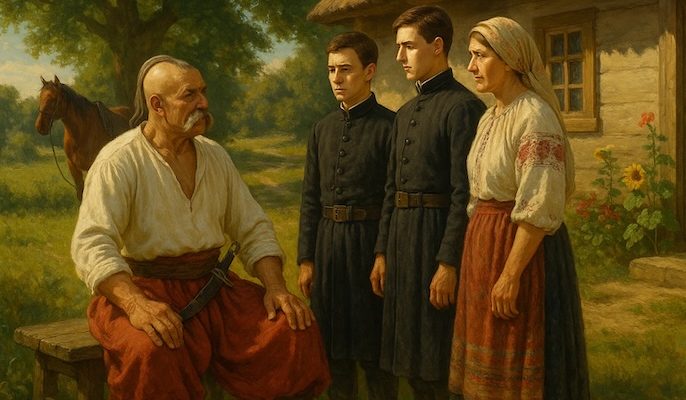
Taras Bulba’s sons, Ostap and Andriy, return home after many years of studying at the Kyiv seminary. When they meet, Taras immediately begins making fun of his sons’ clothing. His elder son, Ostap, dislikes his father’s mockery and asks him to stop laughing at him. Taras and Ostap begin fighting, but their mother intervenes and embraces her sons. Taras is not pleased by the tenderness his sons show toward their mother. In his view, a true Cossack needs only the open steppe and a good horse. He decides that in a week Ostap and Andriy will have to leave for the Zaporizhian Sich to learn the ways of the Cossacks.
Their mother is heartbroken because her sons will spend so little time at home with her. To celebrate their return, Taras invites his closest fellow soldiers to a friendly feast and introduces them to Ostap and Andriy. He asks his sons about their studies in Kyiv. After drinking vodka, Taras decides to “remember his youth” and travel with his sons to the Zaporizhian Sich the very next day. Taras’s wife has grown accustomed to her husband’s recklessness, but the unexpected departure of her sons brings her to tears. All night, without closing her eyes, she sits beside their beds, saying goodbye to them before their separation. Her life as a woman has been a difficult one. She has endured insults and sometimes even beatings, and she has grown old without love or tenderness. All the love she has never been able to give elsewhere has been devoted to her sons. Yet tomorrow her husband will take them to the Sich, and it may happen that she will never see them again. Taras was terribly stubborn.
Only in the fifteenth century, in a southern land devastated by raids from the Tatars and Turks, could such a character have emerged. Living beside fierce and dangerous neighbors gave rise to the Cossack spirit. The Cossacks could be considered an extraordinary expression of the strength of the people. In place of scattered little towns and small estates arose formidable Cossack settlements and fortified communities, united by hatred of non-Christians. The Polish authorities quickly understood the importance of having such neighbors and did everything they could to encourage and flatter the Cossacks.
Many representatives of the Russian nobility came under Polish influence. They adopted Polish customs and a love of luxury. Taras Bulba disliked this. He preferred the simple life of the Cossacks. He even quarreled with comrades who had taken the Polish side. He called them servants of the nobles. Bulba sincerely considered himself a rightful defender of the Orthodox faith. Whenever people in some settlement complained about oppression by Jewish leaseholders, whenever the Orthodox faith was mocked or the elders were not respected, Taras and his Cossacks would restore order there.
He believed that weapons should also be raised against the Turks and Tatars. Now he comforted himself with the thought of arriving at the Sich and boasting about his sons, whom he had raised into such fine and capable Cossacks.
Early in the morning, Bulba awoke and began preparing for the journey. The former seminarians changed into wide Cossack trousers and traditional Cossack clothing. Before setting out, Taras asked his wife to bless their sons. When they finally rode away, their mother, as if driven mad with grief, rushed to embrace first Ostap and then Andriy. The servants led her back into the house, while the sons could barely hold back their tears. Taras was shaken as well, but he did not show it to his sons.
Chapter 2 Summary
Taras, Ostap, and Andriy rode in silence, each thinking about his own concerns. The old father remembered the past while thinking about the meeting that awaited them at the Sich. The sons remembered the seminary. Ostap had run away from it during his very first year of study. After he was brought back, he was flogged and forced to study. He even buried his primer four times; each time he was beaten and given a new one. Only after Taras threatened to keep him working as a monastery servant for twenty years did Ostap begin to study seriously. He was rarely the leader of the students’ most outrageous pranks, but he was a loyal friend and never betrayed his companions.
His younger brother, Andriy, studied willingly and was not afraid to take the lead in the students’ mischief. Unlike Ostap, however, he was more cunning, and others usually took the blame for his tricks while he generally managed to escape punishment. By the age of eighteen, Andriy was already dreaming of women, but he never confessed his desires to his friends because he feared their mockery. Now, swaying in his saddle, Andriy remembered an encounter with a beautiful Polish girl.
One day, while walking through Kyiv, Andriy was nearly run over by a Polish nobleman’s carriage. The coachman struck the inattentive student with his whip, and Andriy became so furious that he grabbed the carriage wheel with one hand and stopped it. But the horses suddenly bolted, and he fell face-first into a muddy puddle. That was when he made the beautiful stranger laugh. It was this encounter, and the face of the beautiful Polish girl, that Andriy could not forget. He had even dared to sneak secretly through the chimney into her bedroom. But when he saw her, he was so stunned that once again he only made her laugh. It was this girl Andriy was thinking about on the road to the Zaporizhian Sich.
They rode across the steppe for a long time, stopping only for lunch and the night. At midday they ate bread and salo, and before going to sleep they cooked kulish over a campfire. Along the road they saw neither travelers nor horsemen. Only once did Taras point to a black speck on the horizon and tell his sons that it was a Tatar. After crossing the Dnipro, they entered the Sich. It received them peacefully: someone was sewing a shirt, someone else was dancing the hopak with great enthusiasm, and another person was simply sleeping. Soon Taras found some of his old acquaintances.
Chapter 3 Summary
Taras and his sons lived in the Sich for almost a week. Ostap and Andriy did little military training because the Sich taught its Cossacks through the experience of real battles. The Zaporizhian Sich was a continuous feast, noisy and seemingly endless. Yet those who celebrated there were not drunkards but cheerful, carefree Cossacks. They formed a close brotherhood of comrades who would go into battle against their enemies at the first call. The Sich was also a refuge for outcasts. Schoolboys who had run away from the seminary came there, as did peasants hiding from landlords, officers who did not care where they fought, and men seeking money. The only people who could not be found there were men courting women, because women were not allowed to appear in the Sich.
The admission ceremony was simple: only Orthodox Christians were accepted. Everything was shared there—money, food, and clothing. Theft was considered a dishonorable act, while murder was punished terribly: the murderer was buried alive in the same grave as the person he had killed.
Ostap and Andriy easily became part of the Cossacks’ wild way of life. They enjoyed both the cheerful customs of the Sich and its strict laws. The brothers quickly found friends. Before long, they stood out among the young Cossacks for their determination and skill. Taras did not particularly like this idle life. He dreamed of a daring campaign in which his sons could gain military experience. But the Sich had concluded peace treaties with the Turks and Tatars and could not violate them. The kosh otaman, the chief of the Cossack Sich, opposed starting a war.
Taras then persuaded some of the Cossacks to rebel. The Cossacks elected a new kosh otaman. Taras’s old friend, the Cossack Kyrdyaga, became the new leader.
Chapter 4 Summary
Kyrdyaga was a shrewd and experienced Cossack. He did not personally order the Cossacks to break their peace oaths. At his urging, some of the Cossacks called a general assembly and decided to launch a military campaign against the Turks.
While preparations were under way, a ferry approached the shore. The Cossacks who arrived on it began reproaching the revelers of the Zaporizhian Sich. While they were here drinking and celebrating, Poles were oppressing Orthodox Christians in their native Ukraine. At these words, the entire Sich rose as one. Riots and killings of Jews began. Taras saved an acquaintance, a Jewish man named Yankel, from death. The Zaporozhian Cossacks began preparing for a campaign against the Poles.
Chapter 5 Summary
The Zaporozhian army went to war against the Poles, and fear went before it. Fires engulfed villages, while cattle and horses were driven away. The Cossacks burned Catholic monasteries and killed Jewish leaseholders. The young Cossacks were reluctant to participate in looting or in killing the helpless. They honed their military skills in battles with Polish forces. Ostap and Andriy quickly grew into seasoned warriors through their clashes with the enemy. Bulba was proud of his sons’ achievements. In Taras’s eyes, Ostap seemed destined to become a commander—fearless and thoughtful. Andriy, meanwhile, impressed his father with his reckless determination in battle.
Soon the Zaporozhians decided to storm the wealthy city of Dubno, but they encountered fierce resistance from its inhabitants and garrison. The Cossacks withdrew, surrounded the city, and began plundering the surrounding villages. Before long, the siege became tiresome, especially for the younger Cossacks. Discipline began to deteriorate, and drunken sentries could increasingly be seen on guard duty.
One evening, a maidservant of the Polish noblewoman Andriy had known in Kyiv secretly made her way into the Cossack camp. She saw Andriy among the Cossacks and sent the maidservant to him for food because the city’s supplies had run out and famine had begun. The beautiful Polish woman’s mother was dying. Andriy gathered provisions and, accompanied by the Tatar maidservant, went into the besieged city.
Chapter 6 Summary
After passing through an underground passage, Andriy and the maidservant entered the city. Famine prevailed there. People were dying of exhaustion, and they had even eaten cats and dogs. The townspeople were not accustomed to keeping large supplies of food. The city was already ready to surrender, but its inhabitants were warned that reinforcements were coming to them.
Andriy met the Polish woman he had known in Kyiv. She was so beautiful that Andriy fell in love with her—and he loved her so deeply that he was ready to commit an act of madness. For her love, he betrayed his homeland, his father, his brother, and his friends.
That night, not only did Andriy Bulba commit his terrible betrayal. Reinforcements also broke through the Cossack siege and entered the city. They brought not only food but also captured Cossacks.
Chapter 7 Summary
The Cossacks, bored with inactivity, got drunk while on guard duty and allowed the Polish reinforcements to reach the city. The kosh otaman assembled the army and rebuked the Zaporozhians for their drunkenness. One of the kurin commanders promised to defeat the Poles. The Cossacks began preparing for battle.
Taras could not find Andriy anywhere and worried that his younger son might have been taken prisoner. Yankel, his Jewish acquaintance, approached him. He told Bulba that he had gone into the city and seen his younger son there. Yankel told Taras that Andriy was not a prisoner. He had asked him to tell his father that he had renounced his homeland, his comrades, and his father. Andriy would now fight against the Cossacks.
Soon the besieged Poles launched a sortie. The Cossacks bravely repelled the attack. Ostap distinguished himself in the battle. Afterward, the Cossacks of the Uman kurin chose Ostap as their otaman in place of their commander, who had been killed in the fighting. Taras was proud of his elder son, but his heart ached because of his younger one.
Chapter 8 Summary
Sad news arrived from the Sich. After learning that the Cossacks had gone away, the Tatars attacked the Zaporizhian lands. They killed some of the Cossacks who had remained in the kurins and captured others. The Tatars stole cattle and horses and also seized the military treasury. The Cossacks urgently gathered a council to decide what to do. If they did not hurry to help, the Tatars would sell their captured comrades into slavery.
The kosh otaman decided to lift the siege of Dubno and go to rescue the prisoners and recover the treasury. But Taras opposed this. He argued that there were also captured Cossacks in the besieged city, and they faced torture and death.
It was therefore decided that part of the Cossack army, led by the kosh otaman, would go to rescue their comrades from Tatar captivity and recover the treasury, while the rest would choose Taras Bulba as their temporary commander and continue the siege of Dubno.
That night, part of the Cossack force set out in search of the Tatars. After they parted, the Cossacks became sorrowful, but Taras ordered the wine to be unpacked. The Cossacks drank to the faith and to the Sich.
Chapter 9 Summary
The city once again ran out of provisions. The Poles attempted to make a sortie to obtain food, but the Cossacks killed half of them, while the rest returned to the city empty-handed. Taking advantage of the sortie, the Jews slipped into the Cossack camp and learned that part of the Cossack force had gone after the Tatars. They immediately spread the news throughout the city.
The Poles were encouraged and began preparing for battle. They decided to break the siege by destroying the Cossacks. Seeing the activity in the city, Taras urgently prepared the Zaporozhians for battle. He delivered a speech that inspired the Cossacks.
The battle was terrible and brutal. Many good Cossacks fell fighting for their faith and homeland. During the battle, Taras Bulba killed his son Andriy.
“I gave you life, and I will take it from you,” Taras said.
But even as he lay dying, Andriy whispered the name of his Polish beloved.
The brave and honorable Ostap, meanwhile, was taken prisoner.
Chapter 10 Summary
Taras himself was badly wounded in that final battle. He spent two whole weeks in a feverish delirium. By a miracle, he managed to avoid capture. His loyal companion Tovkach brought the barely living Taras back to the Sich and even found a doctor for him. Only after a month did Taras begin to feel better.
Yet his heart remained heavy because of Ostap. There was no order in the Sich either. Everyone he had known was either dead or in captivity.
Taras grieved for his son and could no longer endure the uncertainty. He decided to learn what had happened to Ostap. He found the Jewish man Yankel and, for five thousand gold pieces, persuaded him to take him to Warsaw.
Chapter 11 Summary
When they arrived in Warsaw, Yankel and Taras stayed with acquaintances. Bulba hoped that Yankel’s connections would help arrange a meeting with his son, so he asked them for this favor. Taras even hoped to arrange Ostap’s escape.
Dressed in the rich clothes of a count, Taras went to see his son. Through bribery and flattery, he and Yankel managed to get to the prison. But even after taking their money, the guard deceitfully tricked them and refused to let them see Ostap.
Taras then decided to go to the square so that he could at least see his son from a distance. A huge crowd had gathered there for the execution. Everyone was waiting for it to begin.
Before the execution, the prisoners were subjected to cruel torture. Ostap endured every inhuman torment with courage. Taras was proud of his son’s strength and endurance.
When Ostap called out to his father before his death, Taras loudly answered his son’s call. People tried to find Taras in the crowd, but he managed to escape.
Chapter 12 Summary
All the Cossacks rose up to fight the Polish invaders. An army of one hundred and twenty thousand marched against the Poles. Among them was one regiment, the finest of all. It was commanded by Taras Bulba.
A fierce hatred of the enemy drove Bulba forward. As the Cossacks liberated towns, they hanged traitors. The Poles attempted to make peace with the Cossacks, promising to restore their former rights and privileges. The Polish Crown Hetman was saved from death by the Russian clergy. Only before the Christian Church did the Cossacks bow their heads. They agreed to release the Poles after receiving their oaths that they would forget their former grievances against the Cossack army and leave the Christian churches in peace.
Only Taras Bulba did not trust the Poles’ oaths and urged the other Cossacks not to trust them either.
But the Cossacks did not listen to Taras and signed the peace terms. Bulba then left the army and took his regiment with him. The Poles indeed deceived the Cossacks and killed their otaman and many of their commanders.
Taras burned churches and settlements throughout Poland and plundered wealthy castles and the richest lands. No one could escape the fury of the Cossacks—not women, nor children. Throughout Poland, Taras held bloody memorials for Ostap.
With his Cossacks, he reached Kraków, leaving eighteen burned cities behind him.
Hetman Potocki was ordered to capture Taras Bulba. This led to a bloody battle that lasted four days. Victory seemed close, but Taras Bulba was captured while searching through the grass for his lost pipe.
He was burned at the stake.
The Cossacks managed to escape by boat. As they sailed away, they spoke of and praised their fearless otaman, Taras Bulba.
Якщо ви не знайшли потрібну відповідь, можете запитати у нашого чат-бота у Телеграм.