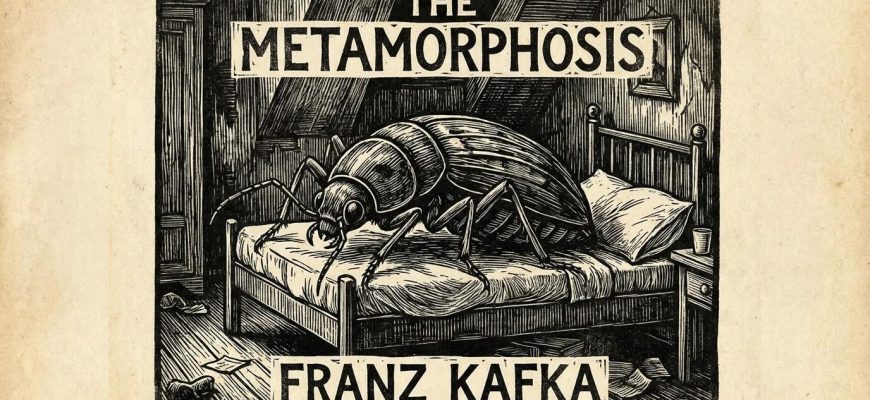
Franz Kafka’s The Metamorphosis, first published in 1915, is a famous novella about Gregor Samsa, a traveling salesman who mysteriously transforms into a giant insect and struggles with isolation, family responsibility, and rejection.
The Metamorphosis Main Characters analysis
- Gregor Samsa — A traveling salesman who supports his parents and sister until he mysteriously transforms into a monstrous insect. Despite his transformation, he remains deeply concerned about his family and their well-being.
- Grete Samsa — Gregor’s younger sister. At first, she takes responsibility for caring for him, bringing him food and looking after his room, but her attitude gradually changes as the family’s situation deteriorates.
- Gregor’s Father — Initially dependent on Gregor’s income, he becomes increasingly hostile toward his transformed son and eventually attacks him with apples.
- Gregor’s Mother — She remains emotionally attached to Gregor as her son but is terrified by his transformed appearance and increasingly unable to face him.
- The Manager — Gregor’s superior at work, who comes to the Samsa home after Gregor fails to report for duty and reacts with horror when he sees what has happened.
- The Maid — An older widow who is not frightened by Gregor and eventually takes over much of his care, treating him with bluntness and calling him a “dung beetle.”
- The Three Lodgers — Three men who rent rooms in the Samsa family’s apartment and demand strict cleanliness and order. Their discovery of Gregor ultimately contributes to the family’s decision to reject him.
The Metamorphosis Summary
One morning, after a restless night, Gregor Samsa woke up and discovered that he had been transformed into a monstrous insect. Lying in bed on his hard, armor-like back, he could see—he only had to lift his head slightly—his brown, bulging abdomen, divided into sections by curved ridges, with a blanket barely clinging to the top and almost ready to slide off completely. His numerous legs, thin and pitiful compared with the rest of his body, moved helplessly before his eyes.
“What has happened to me?” he thought.
It was not a dream. His room—a real room, although a little too small, but otherwise an ordinary room—rested peacefully within its four familiar walls. Above the table covered with samples of cloth stood a picture that Gregor had recently cut out of an illustrated magazine and placed in a handsome gilded frame that he had made himself with a jigsaw. Gregor worked as a traveling salesman.
The picture showed a woman wearing a fur hat and a fur boa. She sat very upright and held out toward the viewer a heavy fur muff in which her entire hand disappeared. Then Gregor’s eyes turned toward the window, and the gloomy weather—the sound of raindrops drumming against the windowsill—made him feel even more melancholy.
“It would be good to sleep a little longer and forget all this nonsense,” he thought.
But that was impossible. He was used to sleeping on his right side, and in his present condition he could not get into that position. No matter how hard he tried to turn onto his right side, he always rolled back onto his back. He closed his eyes so that he would not have to look at his helpless legs and felt a dull, faint pain in his side, unlike anything he had experienced before.
“Good Lord,” Gregor thought, “what a demanding profession I chose! Traveling day after day. There are far more business worries than when you work at the office, and on top of that you have to put up with all the hardships of traveling, worry about train schedules, tolerate bad and irregular meals, and constantly form new relationships with people that never last and are never particularly warm. To hell with all of it!”
Gregor lay on his back and thought that getting up so early could drive a person mad, while the other traveling salesmen lived like pampered courtesans. When he returned to a hotel during the day, for example, they would only just be having breakfast. If he behaved that way, he would be dismissed immediately. If he had not been supporting his parents and sister, he would have gone to his employer and told him exactly what he thought.
Still, there was hope. He would pay off his parents’ debts—it would take another five or six years—and then he would go to his employer and tell him everything. After that, they would part ways once and for all.
But now, Gregor thought, he had to get up. His train left at five o’clock. He looked at the clock and realized with horror that it was already nearly seven. Even if he hurried terribly, he would not catch the next train, and his employer had probably already been informed that he was late.
He thought about pretending to be ill, but that seemed likely to arouse suspicion. In five years of working for the firm, he had never once been sick. His employer would bring a doctor who believed that everyone was healthy and that some people simply did not want to work. Then they would blame his parents for having raised a lazy son.
Someone knocked on the door, and his mother’s voice reminded him that he had intended to leave for work.
Gregor wanted to tell her what had happened, but with horror he heard his own voice, which no longer sounded anything like the voice he knew. So he merely thanked his mother and said that he was getting up.
The conversation attracted the attention of the other people in the apartment. First his father, and then his sister Grete, began knocking on the door and asking what was wrong.
“Coming,” Gregor answered briefly.
His father calmed down and returned to his breakfast, but his sister begged him to open the door.
Gregor, however, wanted first to get up calmly and without interference, get dressed, eat breakfast, and then think about what to do next. There was no point trying to think while lying in bed. He remembered that more than once, while lying in bed, he had felt some kind of pain and, after getting up, realized that it had all been in his imagination. He was curious to see how today’s strange illusion would disappear.
Throwing off the blanket was easy, but everything became more difficult after that. To get out of bed, he needed his arms, while his many little legs were of no help. At first, he decided to get out of bed with the lower part of his body, but it turned out to be almost impossible to move.
So Gregor tried to escape with the upper part of his body. He carefully turned his head toward the edge of the bed, and eventually his body followed. Once he was hanging over the edge, however, he became frightened to move any farther. He could fall on his head and lose consciousness, and he absolutely could not afford that now.
For this reason, he decided to return to his original position, then rock himself back and forth and fall onto the carpet with his whole body, keeping his head raised during the fall.
He was afraid only that his fall would attract attention and cause everyone outside the door to panic. But he decided to do it anyway. He thought how easy everything would be if someone helped him climb down from the bed and stand on his feet. Yet even if the door had not been locked, would he really have called someone for help?
The thought made Gregor smile.
At that very moment, he heard someone ringing the apartment bell. He realized that someone from his company had come to find out why he was not at work.
With horror, he understood that it was the manager himself.
Gregor threw his whole body forward and fell onto the carpet. The sound of his fall could be heard in the living room. His father, standing by the door, said that the manager had arrived and that Gregor must open the door immediately.
Gregor, realizing that he could no longer control his voice, answered only with a short “No.”
Silence fell in the living room, while his sister began to cry in her room.
Gregor wondered why she was not with everyone else and why she was crying. Was it because he had not gotten up and had not let the manager in? Because he was risking losing his job, after which his employer would begin harassing his parents and demanding repayment of their debts?
But those fears were premature. Gregor was still here, with his family, and he had no intention of abandoning them. True, he was now lying helplessly on the carpet, and once people discovered his condition, no one could reasonably expect him to open the door to the manager.
The manager began losing patience. He reproached Gregor for the incomprehensible stubbornness with which he refused to let anyone into his room, then criticized him for not going to work, and finally even blamed him for the poor season in the sales business.
Gregor became so agitated that he forgot everything that had happened to him. All he wanted was to assure the manager that he would make everything right, that he would catch the next train, that he should not be fired for missing work, and that his parents should be spared.
As he spoke, he managed to stand upright, although doing so increased his physical suffering.
He really wanted to open the door. He wanted to come out and speak with the manager. He was curious to see how the people gathered outside would react to him. If they were frightened, then all responsibility would be removed from him, and he could calm down. If they accepted him calmly, then he would have no reason to worry, and by hurrying he might really still catch the next train.
Gregor waited for an answer. Instead, he heard the manager ask his parents whether they had understood even a single word their son had said. His mother was crying and shouting to Grete to run for a doctor. His father called for the maid and ordered her to fetch a locksmith to open the door. Amid all the commotion, Gregor heard the manager say very quietly that it had been the voice of an animal.
And yet Gregor felt calmer. The confidence with which everyone was giving orders gave him hope. His family had realized that something was wrong with him and were prepared to help.
He reached the door and tried to open it by gripping the key with his jaws. It hurt, and some disgusting liquid ran from his mouth, but he did not stop.
At last, the door opened. His appearance made a powerful impression. The manager could no longer speak. He merely backed away toward the hallway and the stairs. His mother clasped her hands, looked at his father, took two steps toward Gregor, and collapsed into a chair. His father first raised his fist, as though trying to force Gregor back into the room, then covered his face with his hands and began to cry.
After a while, his mother let out a terrible scream. She rose and backed away until she sat down on the table prepared for breakfast, without even noticing that the hot coffee had spilled across it and was running onto the carpet. Gregor felt that he was now the only one who remained calm. He looked around the room and then at the picture on the wall, in which he had been photographed during his military service wearing a lieutenant’s uniform with a sword at his side. He looked toward the open door, through which he could see the stairs leading downward.
Addressing the manager, he assured him that he would get dressed and go to work immediately if that was really what the manager wanted. He would go, because he had always fulfilled his duties, even though life as a traveling salesman was not exactly easy.
The manager was now moving away more quickly, and Gregor decided that he had to stop him at any cost and prove that he could continue performing his duties. But his father blocked his way. Using a cane, he tried to push his son back into his room, making horrible hissing noises as he did so. Realizing that he would never catch the manager, who was already on the stairs, Gregor decided to obey his father. But to do so, he had to turn around, and moving backward was extremely slow.
He still did not have very good control over his body, and his father’s hissing irritated him and made it difficult to concentrate. At last, his father understood his son’s good intentions and waited while Gregor performed the difficult maneuver of turning around, guiding him with the cane.
But Gregor faced another challenge. He had left his room standing upright, like a human being, although this caused him terrible pain. During the conversation, however, he had fallen onto all his legs, and it was much easier for him to move that way.
Now he could no longer squeeze through the narrow doorway. If someone had thought to help him stand up, or if his father had opened the other half of the door, he could have entered his own room. But no one came to help him, and he became stuck in the doorway. His father finally decided to help and kicked him so hard that Gregor flew into his room, scraping one side of his body as he went.
Only at dusk did Gregor wake from his heavy sleep. He was awakened by cautious footsteps near the door and went over to see what was happening. His left side hurt, and one of his legs was injured and dragged along the floor.
When he reached the door, he understood what had drawn him there. A bowl of sweet milk stood nearby, with pieces of bread crumbled into it. Gregor felt desperately hungry and plunged into the milk. But only a moment later, he realized that the food he had once loved had lost both its taste and its appeal. He could not eat it.
The family gathered in the living room, but they were quiet. Then the lights were turned off, and everyone quietly went to bed.
No one would disturb Gregor until morning, so he had time to think about his situation. He crawled under the sofa, where he felt safe, because the high-ceilinged room now frightened him. He remained there throughout the night, dozing and waking from hunger.
Thinking about his behavior, he concluded that he had to do everything he could to lessen the troubles his present condition was causing his family.
In the morning, Grete came in. At first she was frightened by his appearance, although he had almost completely hidden himself beneath the sofa. But she soon regained her composure. She noticed that Gregor had not touched the milk and brought him a selection of different “dishes”: rotten vegetables, bones covered with hardened sauce, cheese that Gregor had said two days earlier was already inedible, bread with butter, and water.
As soon as his sister left, Gregor rushed toward the food. He was surprised that he could move quite easily and that his wounds had almost healed. He even thought that perhaps he had become less sensitive to pain.
But he was even more surprised when he began eating, because he now preferred the rotten and foul-smelling “dishes” to the fresh food.
From then on, Grete brought him food twice a day: the first time while everyone was still asleep, and the second after lunch, when his parents were resting and the maid had been sent somewhere else.
His sister had apparently taken responsibility for caring for him in order to spare their parents at least the unpleasantness of seeing him every day.
Gregor still tried to remain part of the family. When they all gathered in the living room in the evenings, he pressed himself against the closed door and listened to their conversations. On the very first day, his father explained the family’s financial situation to his mother and sister.
Gregor was surprised and relieved to learn that his father had not lost all of his capital. He had kept a small portion aside in case of hardship. Gregor had also saved a little from the money he had earned, so the family now had a small reserve.
It was not enough to live on, so they decided to keep it for emergencies and earn their living through work.
His father’s explanation comforted Gregor. After his father’s bankruptcy, Gregor had made it his responsibility to do everything possible to keep his family out of poverty. He had worked hard and had soon advanced from a clerk to a traveling salesman.
Those had been good times, when he had first placed a substantial amount of money before his astonished and happy family.
It never happened again in quite the same way, although Gregor later earned even more. Everyone, including Gregor himself, had simply grown accustomed to the fact that he supported the family. They accepted his money gratefully, and he was happy to give it to them.
Only his sister remained especially close to him. Grete played the violin fairly well, and Gregor dreamed of sending her to the conservatory.
He had even decided to save some money and, at Christmas, announce his decision about her education and insist on it, even if his parents did not support him. So whenever the family now discussed the need to earn money, Gregor would collapse onto the cool leather sofa. He felt hot with shame and grief.
In his solitude, Gregor grew fond of looking out the window, although his eyesight had deteriorated and he could no longer even see the other side of the street clearly.
There was a hospital there. Gregor could not see it, but he knew it was there.
With incredible effort, he pushed a chair toward the window and, leaning against it, stood upright. With his head touching the glass, he looked out at the street and at the raindrops settling on the windowpane.
Grete was attentive to him. After noticing the chair by the window only twice, she began placing it there herself after she finished cleaning his room.
Her visits might have given Gregor pleasure if, every time she opened the door, she had not rushed straight to the window, thrown it wide open, and stood there for several minutes regardless of the temperature outside. Her hurried movements and the cold air coming in from outdoors irritated Gregor.
One day he was standing by the window and failed to hear his sister enter in time. As a result, he did not hide beneath the sofa as he always did during her visits.
When Grete saw Gregor in all his ugliness, she rushed out of the room. Afterward, he placed a sheet over the sofa so that its edge hung down and completely covered him whenever he sat beneath it. Grete must have understood what her brother intended, because she never touched the sheet while cleaning. His father could not bring himself to enter Gregor’s room. His mother was not allowed to go near him, although several times she had tried, crying and lamenting that he was still her son.
Gregor gradually became accustomed to his monotonous life as a prisoner. He adapted to his terrible, unwieldy body. A few meters of floor space were no longer enough for him to move around, and he discovered a new activity: climbing the walls and hanging from the ceiling. Eventually, he even began to enjoy hanging there for long periods.
Grete understood what he was doing when she noticed traces of sticky liquid from his legs on the wallpaper. She decided to clear the room of unnecessary furniture so that he would have more space for this activity. His mother entered her son’s room timidly for the first time.
Gregor sat beneath the sofa, covered by the sheet, and watched his mother and sister from there. Grete was determined, while his mother tried to persuade her not to go through with it.
She feared that removing the furniture would finally convince Gregor that the family had lost all hope of his recovery. She wanted everything in his room to remain as it had been before, so that if Gregor ever returned to them, nothing would remind him of his terrible transformation.
But Grete had taken upon herself not only the duty of caring for Gregor but also the authority to decide what was good or bad for him.
So she convinced her mother that the furniture had to be removed. Gregor watched sadly as they deprived him of a normal human living space, carrying out the chest in which he had kept his jigsaw and the table at which he had done his homework as a boy.
Gregor decided to save the last thing that connected him with his former life—the picture of the woman in the fur hat.
When his mother and Grete left the room, carrying the table, he crawled out of his hiding place, climbed up the wall, and pressed himself tightly against the picture, determined not to surrender it under any circumstances.
Grete noticed him first and tried to stop her mother, hoping to distract her. But his mother looked at the ugly reddish-brown stain on the wallpaper and realized that it was her Gregor. She let out a piercing cry and collapsed unconscious onto the sofa. Grete rushed to get medicine, while Gregor, feeling responsible for what had happened, tried to help her.
He helplessly moved behind his sister, pushed against something, and knocked over a small glass bottle containing a corrosive liquid. The liquid splashed into his eyes, while the broken glass painfully scratched his head.
Grete was attending to their mother, and the door to Gregor’s room was closed, so he did not know what to do. He began climbing the walls of the living room but lost his grip and fell directly onto the table.
At that moment, his father came home. He was now working as a bank messenger and wore a uniform with gold buttons. He asked Grete what had happened, and she said that “it” had escaped, as though Gregor had some predatory intention. His father shouted angrily, grabbed a bowl of apples, and began throwing them at Gregor.
The unfortunate creature ran away, but his father followed quickly and had good aim.
One apple lodged itself in Gregor’s body. He could barely move when his mother screamed at his father to spare his life.
Gregor suffered from the severe wound. His health deteriorated, and no one thought to remove the apple from his body. It began to rot inside him, and inflammation developed around it.
He almost completely stopped eating.
Nevertheless, after this incident, the family somehow decided that Gregor could not be entirely excluded from their family circle. In the evenings, they even left the door slightly open so that he could listen to what his relatives were discussing.
In this way, he learned that the family had decided to endure the situation for as long as they had the strength.
By then Gregor was no longer very interested in the family’s affairs. If they could have seen him, they would have discovered that during their conversations he withdrew into the darkest and most remote corner of his room.
Over time, Grete stopped cleaning his room, and it became covered with cobwebs and the sticky substance that dripped from his little legs.
On the very first day of his transformation, the elderly maid had left the household. After that, the servants never stayed long once they learned that some kind of monster lived in one of the rooms.
For some time, however, an older widow came to work there. She had seen a great deal in her life and was no longer afraid of anything.
One day she noticed that Gregor’s door was only partly closed and entered.
He had not expected this, and in any case he had no intention of hiding. He even crawled threateningly toward her. But the widow was not frightened. She grabbed a chair and raised it as though she intended to strike Gregor. He was forced to stop.
From then on, the widow came to see him every day. She even talked to him, calling him a “dung beetle.” Grete was now working in a shop and no longer had enough time to care for Gregor, so the maid took over her duties.
To make ends meet, the family decided to take in lodgers—three men who were extremely concerned with cleanliness and order throughout the apartment. They insisted that unnecessary belongings be removed from the room they rented and eventually from the kitchen as well.
Everything that had no place elsewhere in the apartment was now stored in Gregor’s room, which had completely ceased to resemble a living space.
One day, the lodgers were having dinner in the living room while the family ate in the kitchen. The door to Gregor’s room was slightly open, so he could clearly hear his sister playing the violin for the first time since his transformation.
The lodgers seemed interested in her playing and invited her to play for them.
Gregor listened to the music as if enchanted. He thought that he could not possibly be an animal when he understood so well what the violin was singing. He wanted to be beside his sister at that moment, so that she would play only for him. He looked into the living room and saw that the lodgers were not paying much attention to the music. They were more interested in what was happening outside the window, where they kept looking.
Gregor dared to move a little farther into the living room. His entire body was covered with the dust that lay everywhere in his room. On his back he dragged hair, threads, and scraps of food. He had become so indifferent to his appearance that he had long since stopped lying on the carpet as he once did and cleaning his back.
This untidy monster crawled onto the gleaming floor of the living room.
One of the lodgers noticed him, and a disgusting scandal broke out. The lodgers declared that they would not only refuse to pay anything for their accommodation but would also demand compensation for having to live alongside such a repulsive creature.
When they left, slamming the door behind them, Grete was the first to say that they could not go on living like this and that they had to get rid of the monster.
Her father asked helplessly: “But how?”
Her mother suffered an attack of breathlessness. Grete said that it was simple. They only had to stop thinking that the disgusting creature was Gregor, because he had ceased to be Gregor long ago.
The Gregor they had known had been considerate and tactful. He would never have allowed his family to suffer because of him.
“Why doesn’t he just go away?” his sister asked. Then they would lose Gregor, but they would preserve the best possible memory of him forever.
Gregor himself believed that he had to disappear.
The following morning, when the maid entered his room, she saw that he was lying completely motionless. She even nudged him with a broom, but only managed to move his body slightly. Then the widow cheerfully announced to the family that “it” had died. His mother came in to look and saw that the body had become dry and flat.
When the maid was about to move it with the broom, his mother wanted to stop her hand, but did not. Everyone felt relieved that day, so they decided to devote the following day to rest and take a trip into the countryside. They sat down to write letters to their employers, asking for a single day off. The maid entered and, with a mysterious expression, as though she had brought wonderful news, waited for them to pay attention to her.
His father asked what else had happened, and she began telling them what she had done with the body of the unfortunate monster.
But the family became absorbed in their letters again.
The widow spat and left.
His mother and Grete silently agreed when his father said that it was time to replace the maid. On the tram taking them out of the city, they eagerly discussed their prospects for the future, which no longer seemed so bleak.
The parents looked at Grete and thought that, despite her pale skin, their daughter had blossomed into a young woman, and that it was time to think about finding a good husband for her.
Якщо ви не знайшли потрібну відповідь, можете запитати у нашого чат-бота у Телеграм.