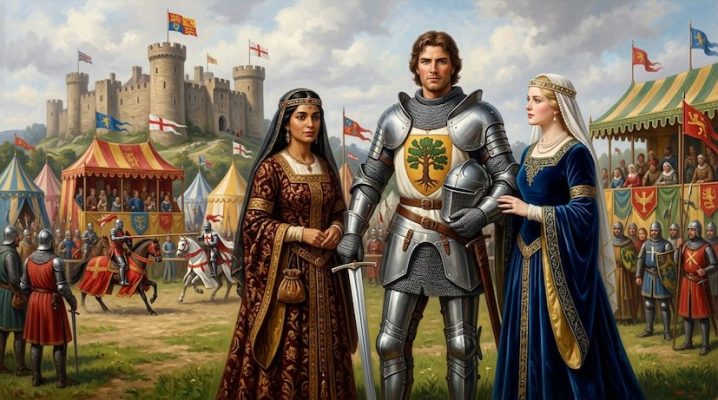
Walter Scott’s Ivanhoe, first published in 1819, is a historical novel about honor, loyalty, love, and political conflict in medieval England, where Saxons and Normans struggle for power.
Ivanhoe Main Characters analysis
- Wilfred Ivanhoe — A brave Saxon knight and the son of Cedric the Saxon. He is devoted to King Richard and in love with Lady Rowena, but his loyalty to the king and his love have brought him into conflict with his father.
- Lady Rowena — Cedric’s ward and the last descendant of the line of King Alfred. She loves Ivanhoe, although Cedric wants her to marry Athelstane.
- Cedric the Saxon — A proud Saxon thane who hopes to restore Saxon power in England. He disowns his son Ivanhoe because of his loyalty to King Richard and his love for Rowena.
- Brian de Bois-Guilbert — A powerful Knight Templar and one of Ivanhoe’s principal opponents. He becomes passionately obsessed with Rebecca.
- Rebecca — Isaac of York’s intelligent, courageous, and beautiful daughter. She is deeply concerned for Ivanhoe and faces danger because of Bois-Guilbert’s obsession with her.
- Isaac of York — A Jewish merchant and Rebecca’s father. He encounters Ivanhoe while traveling with Cedric’s party and later helps the disguised knight obtain armor and a warhorse.
- King Richard the Lion-Hearted — The rightful king of England, absent after the Crusade and secretly returning to his kingdom. He appears in disguise as the mysterious Black Knight.
- Prince John — Richard’s brother, who gathers supporters and seeks to seize the throne if Richard dies.
- Athelstane of Coningsburgh — A descendant of the old Saxon royal line whom Cedric hopes to place at the head of a Saxon movement and marry to Rowena.
- Maurice de Bracy — A Norman knight who agrees to help Prince John and attempts to abduct Lady Rowena.
- Front-de-Boeuf — A powerful Norman lord who holds Cedric and the other captives in his fortified castle.
- Grand Master Lucas de Beaumanoir — The head of the Knights Templar who orders Rebecca to be tried for witchcraft.
- Robin Hood — The legendary outlaw of Sherwood Forest who joins the resistance against Prince John’s supporters.
Ivanhoe Summary
About one hundred and thirty years had passed since the Battle of Hastings in 1066, when the Norman Duke William the Conqueror defeated the Anglo-Saxons and took control of England. Difficult times had fallen upon the English people. King Richard the Lion-Hearted had not returned from the latest Crusade. He had been taken prisoner by the Duke of Austria. Meanwhile, the king’s brother, Prince John, was gathering supporters, planning to seize the throne should Richard die. A cunning intriguer, Prince John spread uncertainty throughout the country, inflaming the old hostility between the Saxons and the Normans.
The proud lord Cedric of Rotherwood still hoped to throw off the Norman yoke and restore the former power of the Saxons by placing Athelstane of Coningsburgh, a descendant of the royal line, at the head of the liberation movement. However, the dull and sluggish Sir Athelstane inspired little confidence in many people. To give the cause greater importance, Cedric dreamed of marrying Athelstane to his ward, Lady Rowena, the last representative of the line of King Alfred. When these plans were threatened by Lady Rowena’s love for his son, Wilfred of Ivanhoe, the stubborn thane, who had been nicknamed the Saxon for his devotion to the cause, drove his son from his ancestral home and deprived him of his inheritance.
Now Ivanhoe secretly returns home from the Crusade dressed as a pilgrim. Not far from his father’s castle, he is overtaken by a party led by Brian de Bois-Guilbert, a commander of the Knights Templar who is traveling to the tournament at Ashby-de-la-Zouch. Caught in bad weather on the road, Bois-Guilbert decides to ask Cedric for shelter for the night. The noble thane’s hospitable house is open to everyone, even to Isaac of York, a Jew who joins the guests during the meal. Bois-Guilbert, who has also fought in Palestine, boasts at the table about his exploits in the name of the Holy Sepulchre. The pilgrim defends the honor of Richard and his brave warriors and, in Ivanhoe’s name—for Ivanhoe had already defeated the Templar in single combat—accepts the challenge to fight him. When the guests retire to their rooms, the pilgrim advises Isaac to leave Cedric’s house secretly. He has overheard Bois-Guilbert ordering his servants to seize the Jew as soon as they are some distance from the castle. Perceptive Isaac notices the spurs beneath the pilgrim’s clothing and, in gratitude, gives him a note addressed to a merchant relative, asking him to provide the pilgrim with armor and a warhorse. The tournament at Ashby brings together all the English knights, and Prince John himself serves as judge.
The knights organizing the tournament, including Brian de Bois-Guilbert, confidently win one victory after another. But when it seems that no one else dares to challenge them and the outcome of the tournament appears settled, a new contestant enters the arena with the motto “Disinherited” on his shield and fearlessly challenges the Templar himself to a fight to the death. The opponents charge one another several times, and their lances shatter into fragments. All the spectators’ sympathies are with the courageous stranger—and fortune favors him as well: Bois-Guilbert falls from his horse, and the contest is declared over. The Disinherited Knight then fights each of the tournament’s leading champions in turn and decisively defeats them. As the victor, he must choose the Queen of Love and Beauty. Gracefully lowering his lance, the stranger lays the crown at the feet of the beautiful Rowena.
On the second day, a general tournament is held. The party of the Disinherited Knight fights against the party of Brian de Bois-Guilbert. Almost all the tournament’s leading champions support the Templar. They press the young stranger hard, and without the help of the mysterious Black Knight, he would hardly have managed to become the hero of the day for a second time. The Queen of Love and Beauty must place the honored crown on the victor’s head. But when the vassals remove the stranger’s helmet, she sees before her Ivanhoe, pale as death, who collapses at her feet, bleeding from his wounds.
Meanwhile, Prince John receives a message from a messenger: “Beware—the devil is unchained.” This means that his brother Richard has been released. The prince panics, and so do his supporters.
To secure their loyalty, John promises them rewards and honors. To the Norman knight Maurice de Bracy, for example, he offers Lady Rowena as a bride—the heiress is wealthy, beautiful, and noble. De Bracy is delighted and decides to attack Cedric’s party on its way home from Ashby and abduct the beautiful Rowena.
Proud of his son’s victory but still unwilling to forgive him, Cedric the Saxon sets out on the journey home with a heavy heart. The news that some wealthy lady has carried the wounded Ivanhoe away on a litter only deepens his indignation. On the road, Isaac of York and his daughter Rebecca join the cavalcade of Cedric and Athelstane of Coningsburgh. They, too, had been at the tournament and now ask to be taken under Cedric’s protection—not so much for their own sake as for the sake of a sick friend whom they are accompanying. But as soon as the travelers enter the forest, a large band of outlaws attacks them, and all of them are taken prisoner.
Cedric and his companions are taken to the fortified castle of Front-de-Boeuf. The leaders of the supposed “outlaws” turn out to be Bois-Guilbert and de Bracy, as Cedric realizes when he sees the castle’s battlements. “If Cedric the Saxon cannot save England, he is ready to die for her,” he declares defiantly to his captors.
Meanwhile, after confessing everything to Rowena, de Bracy tries to win her love.
But the proud beauty remains unmoved. Only when she learns that Wilfred of Ivanhoe is also in the castle—and that it is he who was lying on Isaac’s litter—does she beg the knight to save him from death.
Yet however difficult Rowena’s situation is, Rebecca faces a far greater danger. Captivated by the beauty and intelligence of the daughter of Zion, Brian de Bois-Guilbert has become passionately obsessed with her, and now he tries to persuade the girl to escape with him. Rebecca would rather choose death than dishonor, but her indignant and fearless response only convinces the Templar that he has met the woman of his destiny, a kindred spirit. Unable to understand the nature of his feelings for Rebecca, Brian de Bois-Guilbert even compares her to the Witch of Endor.
Meanwhile, bands of free yeomen gather around the castle, brought together by Cedric’s servants who managed to escape captivity.
The siege is led by the Black Knight, who once came to Ivanhoe’s aid.
Under the blows of his enormous battle-axe, the castle gates crack and collapse, while the stones and beams hurled down at him from the walls trouble him no more than drops of rain. Amid the confusion of the battle, Rebecca makes her way into Ivanhoe’s room and tells the wounded young man, who is chained to his bed, what is happening outside. Tormented by her tender feelings for a man of another faith, she cannot bring herself to leave him at such a dangerous moment.
Meanwhile, the rescuers gradually take the castle from the besieged, yard by yard. The Black Knight mortally wounds Front-de-Boeuf and captures de Bracy.
After leaving the half-destroyed castle and thanking the free archers for their help, Cedric, accompanied by a litter carrying the body of the fallen Athelstane of Coningsburgh, sets out for Athelstane’s estate, where the dead man will be given his final honors. The Black Knight also parts from his loyal companions, for his journey is not yet over.
Bois-Guilbert takes Rebecca to the Temple stronghold at Templestowe. The Grand Master, Lucas de Beaumanoir, arrives at the preceptory to inspect it and finds numerous faults, being particularly outraged by the corruption of the Templars. When he learns that a captive Jewish woman is being sheltered within the walls and is quite possibly involved in a love affair with one of the order’s brothers, he decides to put the girl on trial and accuse her of witchcraft. In a brilliant speech that wins the sympathy even of some of her opponents, Rebecca rejects all of Beaumanoir’s accusations and demands a trial by combat: let whoever volunteers to defend her prove her innocence by the sword.
Meanwhile, the Black Knight travels through the forests toward a destination known only to him. He encounters an ambush and finally reveals his identity: he is Richard Plantagenet, the rightful King of England. Robin Hood of Sherwood Forest is not to be outdone and joins the company. The group is soon overtaken by Wilfred of Ivanhoe, who is traveling from St. Botolph’s Abbey, where he has been recovering from his wounds, to Coningsburgh Castle.
At Templestowe, everything is ready for the trial by combat. The only thing missing is a knight willing to fight Bois-Guilbert for Rebecca’s honor. If no champion appears by sunset, Rebecca will be burned at the stake. At last, a rider appears on the field. His horse is nearly collapsing from exhaustion, and the rider himself can barely remain in the saddle. It is Wilfred of Ivanhoe. Rebecca trembles with anxiety for him. The opponents charge—and Wilfred falls, unable to withstand the Templar’s powerful blow. Yet at the very same instant, Bois-Guilbert also falls from his horse, struck by Ivanhoe’s lance, and never rises again. The judgment of God has been rendered! The Grand Master declares Rebecca free. She is innocent.
Having taken his rightful place on the throne, Richard forgives his brother. Cedric finally gives his consent to the marriage of Lady Rowena and his son, while Rebecca and her father leave England forever. Ivanhoe lives happily with Rowena for many years. They love each other all the more because they have endured so many obstacles before finally being united.
Якщо ви не знайшли потрібну відповідь, можете запитати у нашого чат-бота у Телеграм.