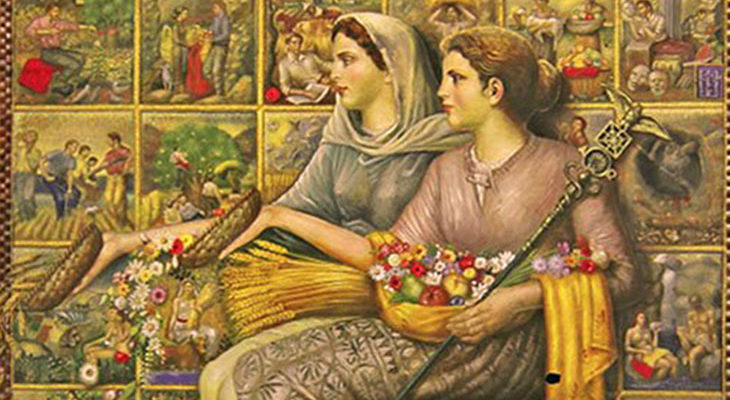
This Demeter and Persephone Summary retells the ancient Greek myth of Persephone’s abduction by Hades, Demeter’s desperate search for her daughter, and the events that explain the cycle of the seasons and the spread of agriculture.
Myth Demeter and Persephone Main Characters analysis
- Demeter — The goddess of agriculture and the mother of Persephone. After her daughter is abducted, she searches for her throughout the world and, consumed by grief, causes the crops to fail.
- Persephone — The daughter of Demeter and Zeus. Hades abducts her and takes her to the underworld, where she eventually becomes bound to the realm of the dead after eating pomegranate seeds.
- Hades — The ruler of the underworld and Persephone’s abductor. He agrees to return Persephone to her mother but secretly gives her pomegranate seeds, ensuring that she must periodically return to the underworld.
- Zeus — The king of the gods and Persephone’s father. He attempts to resolve the conflict between Demeter and Hades and orders Hades to return Persephone.
- Helios — The sun god who tells Demeter that Hades was responsible for Persephone’s abduction and reveals what happened to her daughter.
- Metanira — The queen of Eleusis who welcomes Demeter into her home without initially knowing that the stranger is a goddess.
- Demophon (Triptolemus) — Metanira’s young son, whom Demeter cares for and attempts to make immortal. In some versions, including Hyginus’s account, the child is identified as Triptolemus.
- Iambe — A servant whose sharp joke briefly makes the grieving Demeter smile.
- Celeus — The king of Eleusis and Metanira’s husband, whose daughters bring the disguised Demeter into their home.
Demeter and Persephone Summary
The goddess Demeter had a daughter named Persephone, whose father was Zeus, the thunder-wielding king of the gods.
Hades abducted Persephone, and Demeter wandered throughout the earth searching for her. After nine days, realizing that her search was in vain, Demeter turned to Helios for help. He revealed the name of the abductor, and Demeter understood that Zeus himself had given his daughter to his brother. She was powerless to change what had happened. Disguising herself, the goddess set out to wander through the world.
In Eleusis, Demeter sat down on a stone beside the spring, or well, of Amphion. There, the daughters of Celeus, the king of Eleusis, saw her weeping. The goddess did not reveal her secret to the girls. She told them that she came from Crete, that she had been robbed, and that she was looking for work and a place to stay. The princesses led her to their father’s house.
As Demeter entered the megaron, her head touched the doorframe, and a radiant light spread throughout the house. Queen Metanira noticed this and realized that the stranger before her was no ordinary mortal. She bowed to the goddess and offered her a seat. Demeter refused and instead settled on a simple wooden stool beside the table, giving herself over to grief. She refused wine and food and paid no attention to anyone around her. Only a sharp joke from the servant Iambe managed to make her smile.
The queen entrusted the stranger with the care of her son, Demophon, identified as Triptolemus in Hyginus’s account. Over the course of several nights, the infant seemed to grow a year older. Demeter wished to make the child immortal, so she wrapped him in swaddling clothes and placed him in a blazing fire. One night, Metanira saw what was happening, cried out, and ordered the child to be returned to her. Demeter then revealed her divine form to the people of the household and commanded them to build her a temple at Eleusis. She also ordered an altar to be built beside the spring, or well, of Amphion outside the city walls. In return, she promised to teach them the secrets of agriculture.
During Demeter’s wanderings on earth, the crops stopped growing. People began to die of hunger and could no longer offer sacrifices to the gods. Zeus began sending gods and goddesses to Demeter to persuade her to return to Olympus. But she, sitting in mourning clothes in the temple at Eleusis, paid no attention to them. Finally, Zeus ordered Hades to return Persephone.
But Hades gave Persephone pomegranate seeds. After eating them, she could no longer completely forget the underworld. From that time onward, Persephone spent nine months of each year with her mother, while for three months she was required to remain with Hades.
When Demeter saw Persephone again, she emerged from her state of grief, cast off her mourning clothes, and adorned her head with a wreath of cornflowers.
In gratitude for the hospitality she had received, Demeter taught the people of Eleusis the art of agriculture and returned to Olympus. She gave Triptolemus wheat seeds, and he was the first to plow and sow a field. Then, at Demeter’s command, Triptolemus flew across all the lands of the world in a chariot drawn by winged serpents, teaching people everywhere how to cultivate the earth.
Якщо ви не знайшли потрібну відповідь, можете запитати у нашого чат-бота у Телеграм.