Pygmalion and Galatea Main Characters analysis
- Pygmalion — King of Cyprus and a gifted sculptor who becomes deeply enamored with the beautiful statue he creates from ivory. He avoids mortal women because he longs for an ideal of beauty and perfection.
- Galatea — The ivory statue created by Pygmalion. Through Aphrodite’s intervention, she comes to life and becomes Pygmalion’s wife and, in the version retold here, the queen of Cyprus.
- Aphrodite — The goddess of love and beauty. Moved by Pygmalion’s sincere devotion, she grants his wish and brings Galatea to life.
- Paphos — A child associated with Pygmalion and Galatea in one version of the myth. Other ancient traditions give different accounts of Paphos’s relationship to Pygmalion.
- Cinyras — Another figure associated with Pygmalion’s family in one version of the story; according to Ovid, Cinyras was the son of Paphos.
- Metharme — A daughter attributed to Pygmalion and Galatea in one version of the tradition.
Pygmalion and Galatea Summary
Pygmalion was the king of Cyprus, the son of Belus and Anchinoe*. He was a gifted sculptor. During the exhausting hours he spent working, Pygmalion found happiness in his art. He carved a statue from ivory and fell in love with it. He gave it gifts—precious stones, necklaces, and ribbons—and dressed it in expensive clothes, but the statue remained a statue, and his love remained unrequited.
During a festival dedicated to Aphrodite, Pygmalion turned to the goddess with a plea to give him a woman as beautiful as the sculpture he had created. He did not dare ask directly for the cold statue to be brought to life. Moved by such profound love, Aphrodite gave the statue life, and she became Pygmalion’s wife.
In one version of the story, Pygmalion’s wife bore him the sons Paphos and Cinyras and a daughter named Metharme. According to Ovid, Cinyras was the son of Paphos. There is also a tradition in which Paphos is not Pygmalion’s son but his daughter.
The name of Pygmalion’s wife does not appear in ancient sources. Jean-Jacques Rousseau gave her the name Galatea in his 1762 work Pygmalion.
The Full Myth of Pygmalion and Galatea
On the island of Cyprus lived a great artist named Pygmalion. He carved magnificent statues that adorned the temples of the gods. Pygmalion lived alone and avoided women. No mortal woman pleased the artist. He searched for perfect beauty in a woman, yet perfection, he believed, could belong only to the gods.
The sculptor’s fame spread farther and farther, and his skill grew with it. His statues, carved from marble and other hard materials, were remarkably lifelike. Only their unnaturally pale skin revealed that they were statues rather than living people.
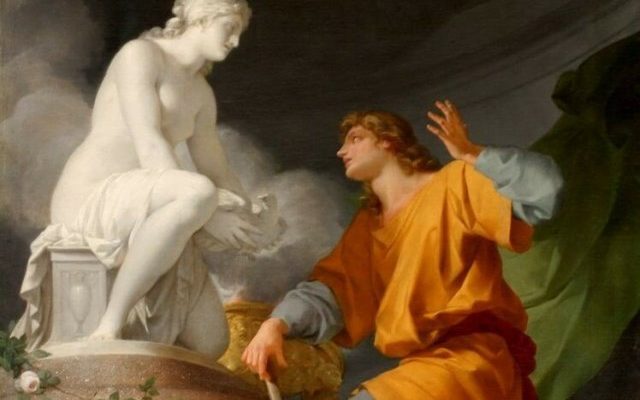
One day, Pygmalion succeeded in carving a statue of a young woman from precious ivory. She was extraordinarily beautiful. The more often Pygmalion admired his creation, the more virtues he discovered in her. He began to believe that no mortal woman could surpass his statue in beauty or nobility. Jealous of anyone who might see her, Pygmalion allowed no one into his workshop. Alone—by day beneath the rays of Helios, and at night by the light of lamps—the young king admired the statue, whispered tender words to her, and showered her with flowers and jewels, as lovers do. He named her Galatea, dressed her in purple, and seated her beside him on his throne.
Then came the days of celebration in honor of Aphrodite. Pygmalion offered the goddess of love a white heifer with gilded horns as a sacrifice. He stretched out his hands toward the goddess and whispered a prayer:
“Oh, if only I had a wife who looked like my creation.”
The goddess heard many fervent prayers on her feast day, but she took pity on Pygmalion alone, for she knew that nowhere on Cyprus was there a person who loved so passionately and sincerely as he did. Three times the sacrificial fire blazed upon the altar, a sign that Aphrodite had heard Pygmalion and granted his prayer.
Hardly feeling the ground beneath his feet, the king rushed back to his palace. Soon he was in his workshop, standing beside the woman he had created with his own hands.
“Why are you still sleeping?” he asked her tenderly. “Open your eyes, and you will see that Helios’s sun chariot has already risen. It will bring you good news.”
The rays of sunlight fell across the ivory face, and Pygmalion thought that it had begun to take on a faint rosy color. Taking his beloved by the wrist, he felt the ivory yield beneath the pressure of his fingers. He saw the skin of her face grow warmer in color and a blush appear upon her cheeks. Her chest rose and expanded as it filled with air. Then Pygmalion heard the calm, steady breathing of the sleeping woman. Her eyelids slowly lifted, and her eyes shone with the dazzling blue of the sea that surrounded the island of Aphrodite.
News that the power of love had brought the ivory to life—and that a beautiful maiden, rather than the elephant from which the ivory had come, had been born—soon spread throughout the entire island. Many people gathered in the square before the palace. Now that he was happy, Pygmalion no longer feared jealous looks or gossip. He brought the newly awakened woman before the crowd, and when the people saw her beauty, they fell to their knees and loudly praised Aphrodite, the goddess who grants love to all living things and possesses the power to bring even stone to life.
There, before everyone’s eyes, Pygmalion proclaimed the maiden Queen of Cyprus and placed a royal crown upon her hair.
In one version of the story, Pygmalion’s wife bore him the sons Paphos and Cinyras and a daughter named Metharme. According to Ovid, Cinyras was the son of Paphos. There is also a tradition in which Paphos is not Pygmalion’s son but Pygmalion’s daughter.
Якщо ви не знайшли потрібну відповідь, можете запитати у нашого чат-бота у Телеграм.