This Narcissus Summary presents the Greek myth of Narcissus, the beautiful young man whose pride and self-love lead to a tragic fate after he falls in love with his own reflection.
Narcissus Main Characters analysis
- Narcissus — A remarkably handsome young man, admired by nymphs but consumed by pride and self-love. His inability to return the love of others ultimately leads to his tragic fate.
- Liriope — Narcissus’s mother, a water nymph who seeks a prophecy about her son’s future from the blind seer Tiresias.
- Cephissus — The river god and Narcissus’s father. He is identified with the river of the same name in ancient Greece.
- Tiresias — The legendary blind prophet who foretells that Narcissus will live a long life only if he never sees his own face.
- Echo — A beautiful nymph punished by Hera so that she can no longer speak first and can only repeat the last words spoken by others. She falls deeply in love with Narcissus but is rejected by him.
- Hera — Wife of Zeus and queen of the gods. She punishes Echo by taking away her ability to speak freely.
- Aphrodite — Goddess of love and beauty. After Narcissus repeatedly rejects those who love him, she punishes him by making him fall in love with his own reflection.
- The rejected nymph — One of the nymphs whom Narcissus has spurned. In despair, she wishes that Narcissus himself will experience unrequited love.
Narcissus Summary
In ancient Greek mythology, Liriope, a beautiful nymph, had a handsome young son named Narcissus. She adored her child and, concerned about his future, once went to the blind prophet Tiresias to ask what fate awaited him. Tiresias gave her a strange prophecy: “Narcissus will live as long as he does not see himself.” Liriope could not understand what the words meant and eventually forgot about the prophecy.
Narcissus grew up spoiled and adored by everyone around him. He became selfish and intensely vain, loving himself above all others. He was particularly fond of hunting and often wandered through the wilderness alone. One day, he entered a dense, untouched forest and became lost. He called out for help, asking whether anyone was there, and a voice answered him from the woods. Confused, he called again, only to hear his own words echoed back to him.
The voice belonged to the beautiful nymph Echo. In the past, Echo had been extremely talkative, constantly annoying the gods with her endless chatter. She had also repeated to others the conversations she overheard among the gods. Hera, queen of the gods, eventually punished her for this behavior. From that moment on, Echo could no longer speak first or express her own thoughts. She could only repeat the final syllable or words spoken by someone else.
When Narcissus saw the nymph, he asked who she was. Echo trembled at the sight of the handsome young man because she immediately fell in love with him. Unable to speak for herself, she could only repeat his words. Narcissus asked how he could find his way out of the forest, and Echo repeated the final part of his question. Irritated by her strange behavior, Narcissus pushed her away and continued on his way. Heartbroken, Echo wished that Narcissus would one day fall in love with someone who would never return his feelings. Consumed by unrequited love, she gradually wasted away until nothing remained of her except her voice, forever repeating the words of others.
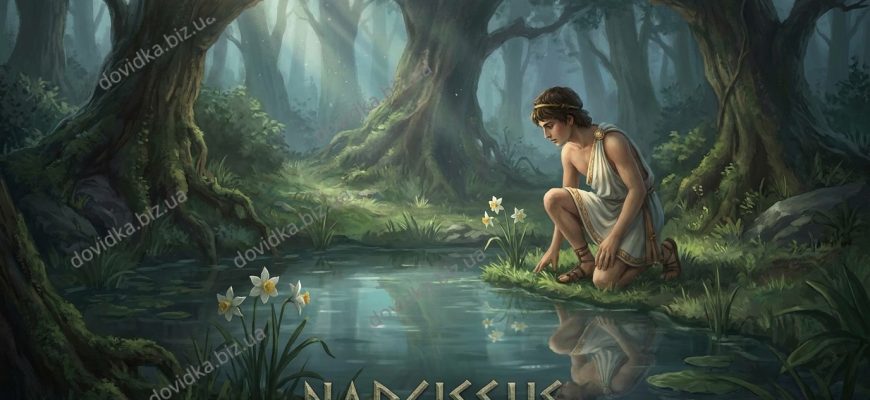
Narcissus eventually came to a quiet forest pool. Its clear surface reflected the sky, the trees, and the birds flying overhead. He sat beside the water to rest and bent down to drink. At that moment, he saw a beautiful face reflected in the pool. Narcissus had never seen his own reflection before, so he did not realize that the person in the water was himself. He believed that an extraordinarily handsome being lived beneath the surface, and the longer he gazed at the face, the more deeply he fell in love with it.
Narcissus abandoned his bow and quiver of arrows. He no longer cared about food or drink and wanted only to gaze at the beautiful face in the water. Whenever he reached toward it, however, his hands found only the surface of the pool. Day and night, he remained beside the water, begging the mysterious creature to come out, but the figure could neither hear nor see him. Narcissus gradually withered away from his hopeless love. At last, exhausted, he lay down beside the pool and quietly said goodbye. Echo, who remained nearby, repeated his final words in sorrow.
The forest nymphs later came to the pool to bury Narcissus, but they could not find his body. In the place where he had died, they found only a delicate white flower bending toward its own reflection in the water. From then on, the flower was called the narcissus.
The story of Narcissus was adapted by the Roman poet Ovid in his Metamorphoses. The myth later inspired operas by Francesco Cavalli, Alessandro Scarlatti, and Christoph Willibald Gluck, while Pedro Calderón de la Barca wrote a drama based on the story. In a figurative sense, a narcissist is a person who is excessively self-absorbed and in love with their own qualities.
Greek Myth Narcissus read online
No one can resist the will of the beautiful goddess Aphrodite, the patron of love and beauty. She can generously reward people with happiness, but she can also punish those who reject or disrespect her gifts. This is why people still remember the tragic story of Narcissus, the son of the river god Cephissus, the deity associated with the river of the same name in ancient Greece, and the nymph Liriope, a water nymph.
From early childhood, Narcissus astonished everyone with his extraordinary beauty. His parents understood that beauty does not always bring happiness, so they went to the famous seer Tiresias, the legendary blind prophet, and asked him to reveal their son’s fate.
The wise Tiresias studied the boy carefully and said that their son would live a long life, but only under one condition: he must never see his own face. His parents were astonished by the prophecy. It seemed so strange and absurd that they laughed at the old seer and soon forgot his warning.
Years passed, and Narcissus grew into an exceptionally handsome young man. Almost every nymph who saw him fell in love with him and tried to win his attention. Yet the young man’s heart remained cold. He loved no one but himself and believed that he alone deserved admiration.
One day, while hunting in a dense forest, Narcissus became lost. The nymph Echo saw him there and hid among the trees, watching the beautiful young man with fascination. She desperately wanted to speak to him, but she could not.
Long before this encounter, the goddess Hera, wife of Zeus, had punished Echo severely. According to the legend, the nymph had helped Zeus conceal his secret meetings with other nymphs by distracting Hera with long conversations. The furious goddess took away Echo’s own voice. From then on, she could only repeat the last words she heard from someone else.
Narcissus looked around, trying to find his way, and called loudly for help. Echo answered him from her hiding place. He called for her to come out, and she repeated his words. When he called again, she answered joyfully. Unable to restrain herself, Echo emerged from her hiding place and ran toward Narcissus.
But Narcissus merely pushed her away angrily. Without saying another word, he walked off and disappeared among the dark trees. Ashamed and heartbroken, Echo covered her face with her hands and fled deep into the mountains. She settled in a lonely cave. Sometimes she ventured back into the forest, but she could no longer have a real conversation with anyone; she could only repeat the words of others.
Narcissus continued living without caring about anyone else’s feelings. He coldly rejected everyone who dared to confess their love to him. Many nymphs suffered because of his pride and indifference.
One day, one of the nymphs he had rejected cried out in despair that Narcissus should fall in love as well, but that the person he loved should never return his feelings. Aphrodite heard her words. The goddess was angered by Narcissus’s contempt for the gifts of love and beauty and decided to punish him.
In spring, during another hunting trip, Narcissus became thirsty and went looking for water. He found a quiet forest stream whose surface was as clear as a mirror and leaned over it. But just as he was about to drink, he froze in astonishment.
From the depths of the stream, an unbelievably beautiful face was looking back at him.
Narcissus did not realize that he was seeing his own reflection. He could not tear his eyes away from the beautiful stranger. The longer he looked, the more fascinated he became. Before long, he had fallen completely in love with this mysterious creature.
He forgot about food, sleep, and even his thirst. Day after day, he sat beside the stream, gazing at the image in the water.
“Who are you, beautiful stranger?” he whispered. “Why do you hide from me beneath the water?”
The face in the stream moved its lips as well, but Narcissus could not hear a single word.
“Come out to me!” he pleaded. “Can’t you see how deeply I love you?”
The reflection seemed to reach toward him and smile in return. Narcissus leaned closer, hoping to kiss the one he had fallen so deeply in love with, but his lips touched only cold water. Ripples spread across the surface, and the beautiful image disappeared.
“Have I fallen in love with myself?” the young man whispered in horror. “Yes… now I understand. You are me. My own reflection. I am doomed to love someone I can never embrace. There is no escape from this torment.”
Day by day, his strength abandoned him. Yet Narcissus could not leave the stream. He wept, and his tears fell into the water, disturbing the precious image.
“Where are you? Come back! Don’t leave me!” he pleaded whenever the reflection disappeared beneath the ripples. “Let me see you just one more time!”
Whenever the water became still, the image appeared again, and the young man continued staring at it, condemned to his unhappy love.
Nearby, the nymph Echo was also grieving. She watched Narcissus suffer and felt compassion for him, even though he had once treated her with cruel disdain.
“Oh, what sorrow!” Narcissus cried one day, exhausted by his suffering.
“Sorrow…” Echo quietly repeated.
“Farewell…” the young man whispered faintly.
“Farewell…” the nymph answered sadly, and her voice continued to echo among the trees, gradually fading into the silence of the forest.
Thus the life of the beautiful Narcissus came to an end. According to ancient tradition, his soul descended into the gloomy realm of Hades, the ruler of the underworld. It was said that even there, beside the sacred River Styx, which separated the world of the living from the world of the dead, he continued to gaze into the dark water, searching for his reflection.
The forest nymphs wept bitterly, and Echo wept with them. They wanted to bury the young man, but when they reached the stream, his body was gone. In the very place where his head had rested, a delicate white flower with a subtle fragrance had blossomed.
From that time onward, people called the flower the narcissus, in memory of the young man who, more than anything else in the world, had fallen in love with himself.
Якщо ви не знайшли потрібну відповідь, можете запитати у нашого чат-бота у Телеграм.